Axios Crypto

January 07, 2025

GM! Dogecoin was created as a joke, and the jokes have just continued. As we enter a new era of meme coins making their own jokes, both DOGE and its progeny are only getting more valuable.
- Are you lurking in any AI agent coin Telegram groups? [email protected]
Today's newsletter is 1,086 words, a 4-minute read.
1 big thing: 🤖 Talking meme coins

Meme coins with a chatbot attached — AI agent coins — have been blowing up, at least among the most risk-hungry crypto traders.
Why it matters: On the surface, it's all very silly, but it's a real(ish)-world experiment with giving AI agents actual responsibilities.
How it works: With an AI large language model (LLM), a digital coin can be attached to a character or a mood, and it can seem to be alive, responding to its fans on social media or in Telegram chats — in character.
- This enables an idea to grow. Even if the idea is just: The 💨 emoji is funny.
In a way, all cryptocurrencies are memes (just like all currencies), but AI agents aren't for every coin.
- Asking bitcoin what flavor of ice cream it might like seems a bit ridiculous. But asking pepecoin? You could have that conversation because pepecoin has a vibe.
And meme coins that had vibes were the hotness last year. While outsiders caught vapors over the silliness masked as "investing," insiders saw it differently: Of course, it was silly — it was a game.
- It was a massive multiplayer game of Apples to Apples. (Only everyone is a player and everyone is also a judge, and there are no turns, but there is money on the line.)
- AI agents allow a token or coin to interact with fans. A bespoke large-language model created around a character or vibe could keep being inventive about its core idea, keep pumping out content and interacting with its community in real time.
Zoom in: AI agent coins represent a small subset of the market, with just a $16.6 billion collective market cap today, according to CoinGecko.
- A few driving the hype include goatseus maximus (GOAT), aixbt (AIXBT) and ai16z (AI16Z).
What they're saying: "They are the thing because there is nothing else to do," Matti of Zee Prime Capital, an investor who specializes in investing based on what people are talking about, tells Axios.
- "But it does open a new design space, and people tinker."
- (Matti described the larger meme game in detail back in ancient times: 2020.)
The intrigue: Folks have been making AI accounts like this for years, but they didn't previously have a financial instantiation observers could trade.
What's next: Some AI agents are going a step further than chatting already and making crypto trades.
2. 🤬 The broker rule

A triad of crypto's big lobbying groups is kicking up a fuss with the IRS over its updated rules for reporting by brokers.
Why it matters: The IRS has released new guidance that pushes into the realm of decentralized finance as it seeks information on taxpayers.
The latest: The Blockchain Association, the DeFi Education Fund and the Texas Blockchain Council have sued over the new rules under the Administrative Procedure Act.
What they're saying: "The rule fails to recognize the decentralized nature of this technology, where many actors simply do not have access to the information the IRS is now demanding," Texas Blockchain Council president Lee Bratcher said in a statement.
3. 🔬 A hard grilling over $1,300

The FDIC had some hard follow-up questions for an unidentified American bank... over $1,300 worth of digital asset holdings.
Why it matters: The interaction suggests there was no level of cryptocurrency product offered by a bank in recent years that wouldn't draw a lot of sharp questions from bank regulators.
What's happening: Coinbase got a raft of 25 FDIC letters to banks released with somewhat less redaction (there's still a lot), and it published them Friday as a court filing.
- In April 2022, the agency asked its bank supervisees to let it know about all crypto-related activities.
Zoom in: In one letter, labeled Document 22, it seems like all one bank did was make trades in various crypto assets, from tokens to NFTs.
- Because of the redactions, it's hard to tell exactly what happened. But it seems like the bank might have put as much as $98,900 to work in crypto markets at some point. (That doesn't sound like much for a bank).
- At the point the FDIC followed up with multiple detailed questions, it seems like the bank was holding just $1,300 in crypto assets with a custodian.
- In a worst-case scenario, this could mean that the bank lost over $90,000 through trades. It could also mean that that's all the bank kept in the end, after selling the rest.
💭 Our thought bubble: Either way, it seems like much ado about very little, but perhaps that was the point.
- What we can't see from these letters, though, is whether or not the bank in Document 22 had the OK (that is, a "supervisor non-objection") from its regulator, as detailed in this Office of the Comptroller of the Currency memo.
The big picture: The recurring theme throughout the FDIC's so-called "pause letters" appears to be banks that simply wanted to let customers buy and sell bitcoins (some of them seem like they might have wanted to offer more).
- Axios counted 12 letters that seemed to just be about offering roughly the same services that Cash App and PayPal offer now. One of them seemed to want to get a little more complex.
- Several appeared to want to offer settlement services to their users on a blockchain. One wanted to make a stablecoin.
Yes, but: It appears that one bank in this mix wanted to offer crypto-based lending, such as lending cash against crypto deposits.
- That is a business line that got a lot of other companies in serious trouble. (Though not all. For example: Ledn, Unchained Capital and the Defi lenders).
The other side: One job the FDIC has to be careful about is clarifying which activities of a bank are FDIC-insured and which ones aren't.
- Offering trading services to customers might have been seen as a risk, in that light.
- See the FDIC's instructions to its staff in the field in this June 2022 memo.
The bottom line: This explains why several banks announced they were offering bitcoin and such to customers in 2021 and 2022, and then we never heard anything about those offerings again.
5. Culture hash: Product suggestion
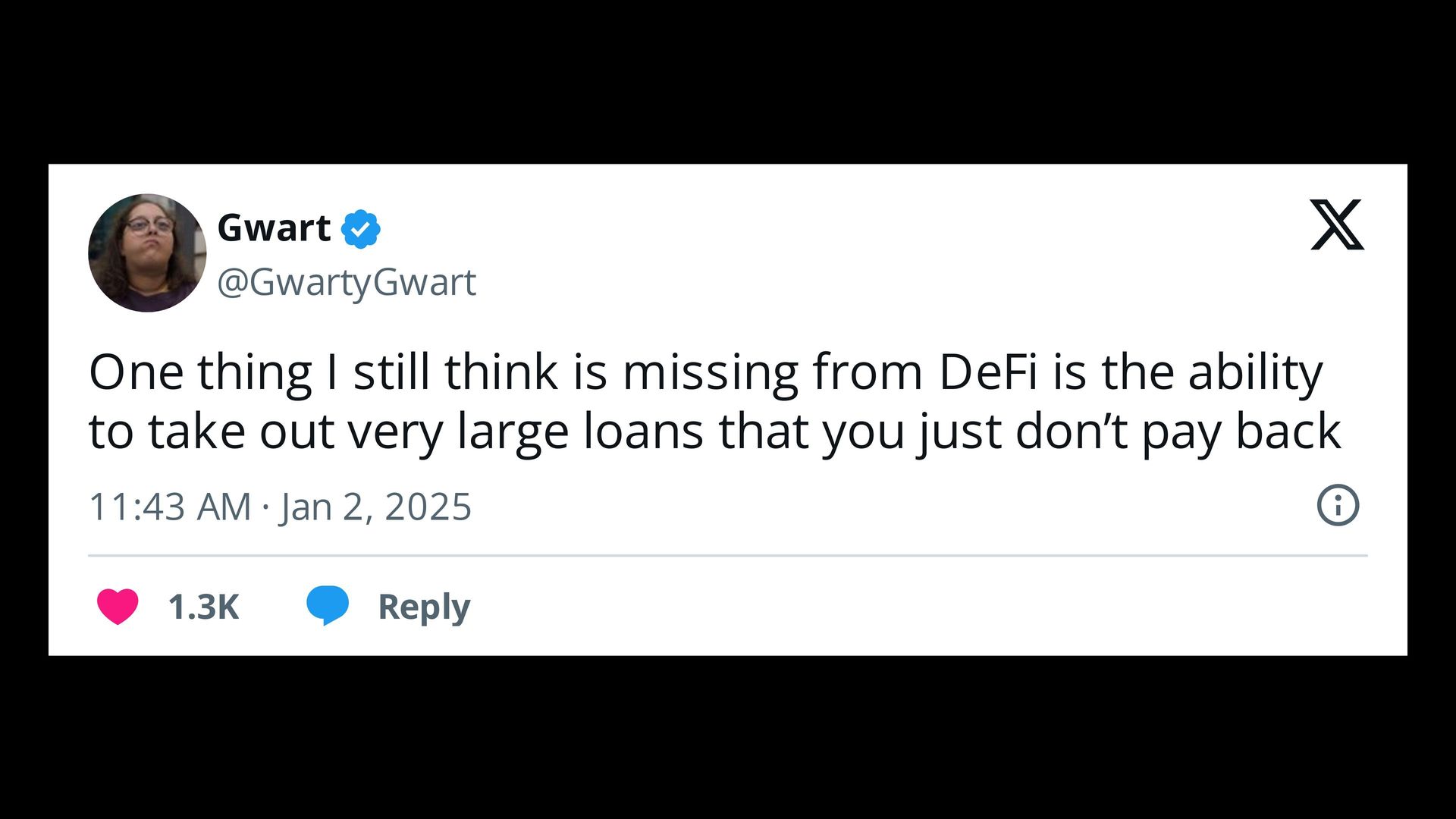
It's a good point.
- Devs, do something.
Zoom in: There was a character named Gwart on the HBO show "Silicon Valley," which ran from 2014 to 2019.
This newsletter was edited by Pete Gannon and copy edited by Carolyn DiPaolo.
Are folks out there Team Stockpile (keep what we got) or Team Strategic Reserve (buy more)? Or even: Team Just Sell Now? —Brady
Sign up for Axios Crypto