Axios Crypto

July 06, 2022
Weird that it's already Wednesday, right? Today a critique of DeFi from one of its pioneering young builders.
- ๐ง As ever, email us at [email protected].
This newsletter was edited by Pete Gannon and is 1,139 words โ a 4-minute read.
1 big thing: Mercenaries are hoovering up DeFi's value
Illustration: Aรฏda Amer/Axios
Jai Bhavnani is all-in on decentralized finance (DeFi), but he's also frustrated with DeFi as it operates today.
- "I think the big thing that became clear with time is the vast majority of capital inside DeFi isn't here to use DeFi," Bhavnani tells Axios in an interview.
Why it matters: DeFi has a chasm to cross. It has a lot of potential to make credit transparent, but it is still โ much like the rest of crypto โ a speculator's industry, Brady writes.
- To become useful beyond the blockchains, it needs to solve problems and create more new wealth in the world.
Driving the news: Bhavnani penned a goodbye announcement to members of the Fei community, the crypto project that absorbed the crypto lending protocol he founded: Rari.
- Rari joined the decentralized stablecoin protocol, Fei, last year (yes, it's been a bad year for such projects). Fei was one of Rari's biggest users.
- His experiences in DeFi have soured Bhavnani on the way projects stimulate a user base.
Flashback: Rari was a permissionless lending protocol where anyone could set up pools for depositing tokens and lending them out.
- Compound, which we have discussed before, is very similar, except it is super careful about which tokens it incorporates.
- Rari's openness allowed a way for any project with a token to give their holders a way to earn a little yield.
"There's going to be thousands of tokens in the future, each doing their own thing," Bhavnani said.
Zooming out: DeFi summer kicked off in 2020 because of something called liquidity mining or yield farming. Basically, protocols would reward users in a new token โ one the project made for just this purpose โ for providing liquidity for other users to make use of.
- Basically, it's as if a new bank started and gave away all its equity to its earliest depositors for the first few years.
- Liquidity mining was meant to attract early users who would stick around, but big funds would dump huge amounts of capital in only to get most of the early tokens, sell them and then move on to the next liquidity mine.
What they're saying: "The vast majority of DeFi TVL [total value locked] is from these mercenaries, and no one is catering to anyone but these mercenaries," Bhavnani says.
What we're watching: One compelling part of Bhavnani's story: He and his friends launched Rari in high school. Now 20, he can afford to self-fund his next venture, and he plans to totally upset the approach to DeFi by building new protocols as "public goods," things anyone can use but no one "owns."
- Without tokens, once the new protocols (he calls them "hyperstructures") are released, they can't change without someone forking the code and redeploying (which Bhavnani sees as inevitable).
The bottom line: "I just wanted to focus on what excited me about DeFi, which wasn't serving financial speculators but rather making something meaningful," Bhavnani says.
โฝ๏ธ 2. Charted: Gas fee relief

Gas is expensive these days, am I right?
- Oh sorry. I don't mean gas for cars! I haven't owned a car since 2010, Brady writes.
I mean gas to use smart contracts. One time I looked and it was $100 to make the purchase of a cool NFT project I was studying, nevermind the price of the art itself.
Be smart: Ethereum, and all its many knockoffs, are global computers that can process any kind of software. Because they are decentralized, every computer on the network has to run every computation.
- That's a lot of work, so it doesn't come free. Smart contract blockchains charge a fee to run computations. That fee is based on demand for the network. More users, more computations, higher fees.
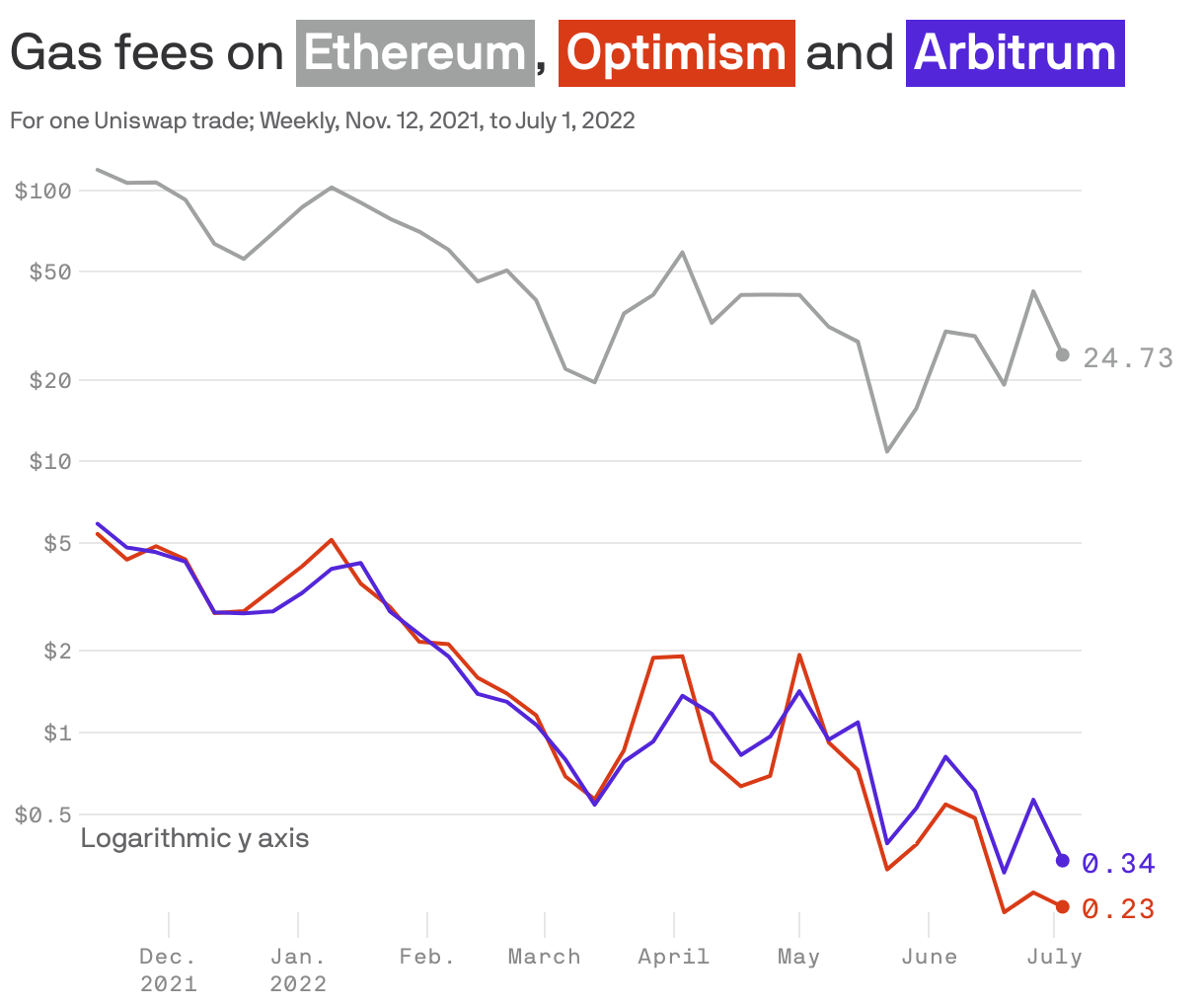
To combat fees: Entrepreneurs have spun up new blockchains connected to Ethereum. Two of them, Optimism and Arbitrum, are shown above, with fees that are about 1/100th of those on the original smart contract blockchain.
- If they get super popular, more blockchains will be needed.
๐โพ๏ธโฝ๏ธ 3. Crash threatens pro sports' wallets

Illustration: Lindsey Bailey/Axios
Some of the top professional sports leagues could see cryptocurrency sponsorship dollars dry up in the wake of sector-wide troubles, Tim Baysinger of Axios Pro writes.
Why it matters: Crypto companies flooded the zone with sponsorship and naming rights dollars, becoming among the fastest-growing sponsors in sports. That now threatens to change.
By the numbers: Crypto companies collectively spent around $208.5 million in sponsorship rights fees across the top five professional sports leagues โ NBA, NFL, MLB, NHL, MLS โ over the past year.
- The NBA in particular rode the crypto wave. Crypto sponsorship went from $1.75 million in 2020-21 to $130 million in 2021-22.
- Multiple NBA teams had crypto sponsors on their uniforms this season, while MLB's umpires have been rocking an FTX patch.
- Terra, the ill-fated stablecoin maker, closed a deal with the Nationals' D.C. stadium that remains in effect.
- Crypto.com's $700 million, 20-year agreement to take over the naming of the Staples Center is the biggest naming rights deal ever.
- FTX began its own naming rights deal with Miami-Dade County for the Miami Heat's home arena this past season.
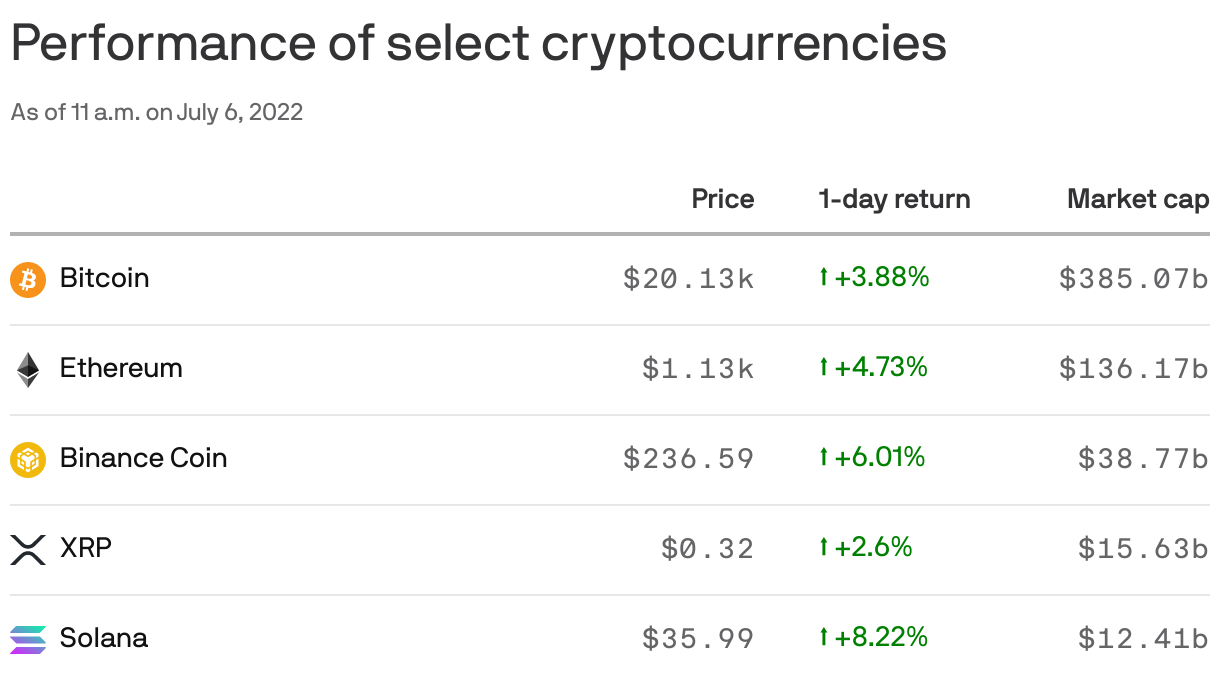
State of play: Bitcoin is trading around $20,000, less than a third of its all-time high in November. Nearly $2 trillion in crypto market value has been wiped out since last November.
- FTX founder Sam Bankman-Fried told Forbes he expects more crypto exchanges to go belly up. "There are some third-tier exchanges that are already secretly insolvent."
What they're saying: At least some of those with skin in this game aren't getting cold feet about the space amid crypto's struggles.
- "Crypto.com is a fantastic and engaged partner who is as active today as the day we announced. The economic downturn is hitting every industry and is not unique to cryptocurrency," said Todd Goldstein, chief revenue officer for Anschutz Entertainment Group, which owns the Crypto.com Arena, in an emailed statement.
๐ฉ Top coins

๐ 4. Catch up quick
โ Core Scientific, a publicly traded miner, has sold $165 million worth of bitcoin, most of its holdings. (Axios)
๐ก Troubled lender, Celsius, has been paying down debts. It paid off $183 million in debt against Wrapped Bitcoin on MakerDAO. (CoinDesk)
๐ต Crypto broker Voyager Digital filed for Chapter 11 bankruptcy in the Southern District of New York. (TechCrunch)
๐ฎThe $540 million hack on crypto gaming project Axie Infinity started with a phony recruiter pursuing one of the game's engineers. (The Block)
๐ช 5. Culture hash: NFT buyers don't want real stuff
Screenshot: @TechSpot (Twitter)
NFT buyers want NFTs, not physical objects, Brady writes.
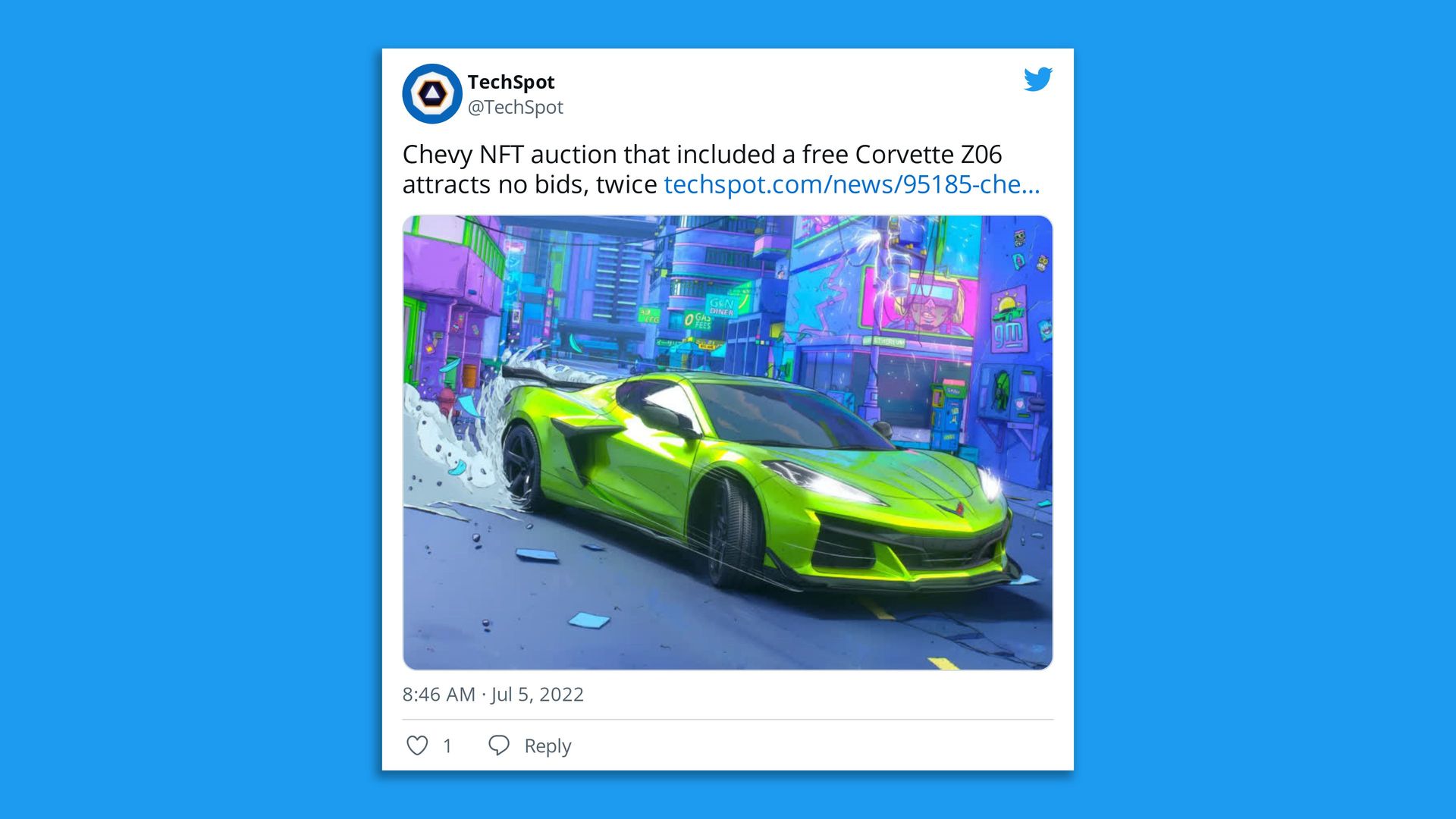
In the latest example of this disconnect, Chevrolet tried to sell a Corvette in an NFT. The buyer would get both the NFT and the car.
- Folks didn't want either, in TechSpot's telling. NFT marketplace SuperRare actually extended the auction window to give potential buyers more time โ to no avail.
Amber Vittoria told Axios a similar story when she tried to pair NFT art with an actual analog work.
Did any of our readers out there get interested in crypto during the last downturn? Some came in then. Not a lot! But some. โB & C
Sign up for Axios Crypto

Brady Dale covers crypto and blockchain impacts on markets and regulation.