Axios Crypto

April 14, 2023
Friday is for revisiting the rules and how they could change.
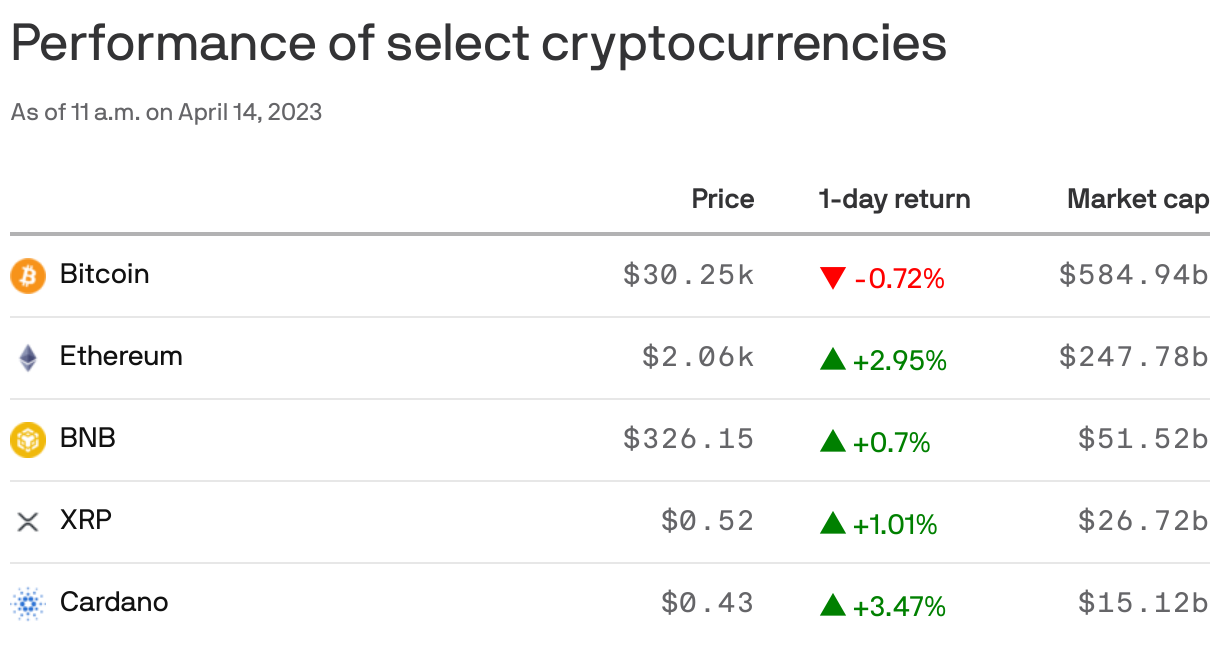
🚨 Situational awareness: The price of Ethereum's ether has broken $2,000 following the Shapella upgrade this week, the highest level since mid-May of last year.
đź“§ [email protected]
Today's newsletter is 1,165 words, a 4-minute read.
📬 1 big thing: The SEC revisits proposed "exchange" definition
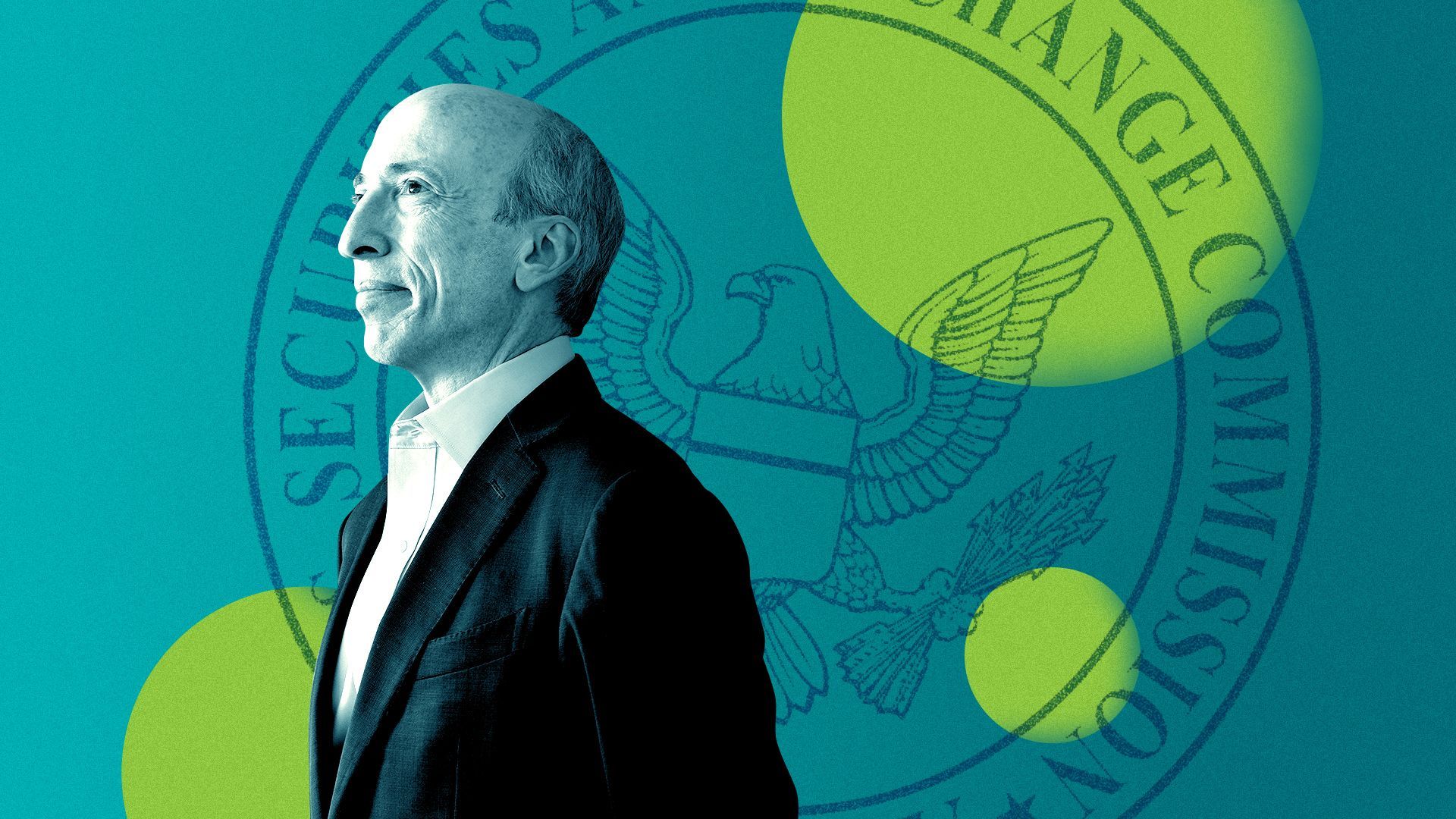
Gary Gensler. Photo illustration: AĂŻda Amer/Axios. Photo: Melissa Lyttle/Bloomberg via Getty Images
The SEC is considering reopening the comment period for its proposal last year to re-define the definition of "exchange," Crystal writes.
Why it matters: The small proposed change would have sweeping implications for traditional financial firms and crypto — and specifically DeFi.
Details: The SEC's proposed change to Rule 3b-16 of the Securities Exchange Act would apply the definition of exchange more broadly — with the commission arguing that the rule as originally envisioned would've otherwise covered systems like DeFi.
- It would touch so-called alternative trading systems, request-for-quote platforms and indication-of-interest platforms, as well as other sorts of messaging ones.
What they're saying: "Make no mistake: many crypto-trading platforms already come under the current definition of an exchange and thus have an existing duty to comply with the securities laws," chair Gary Gensler said in a statement.
- "These platforms match orders of multiple buyers and sellers of crypto securities using established, non-discretionary methods. That’s the definition of an exchange — and today, most crypto trading platforms meet it."
Between the lines: It's the activity that matters, not the technology.
The big picture: This could be a lasting legacy of Gensler's tenure at the helm of the SEC.
- Flashback: When the rule was proposed in January 2022, it caused something of a ruckus and many, many comment letters have rolled in.
Of note: SEC commissioner Hester Peirce, a known crypto proponent, dissented in the open commission meeting this morning, saying the commission's “cavalier approach” shows that it is “uninterested in facilitating innovation and competition” and “instead seeks to protect incumbents.”
- Among the few high-level issues with the proposed change, she argued, is that the commission does not seek to define “communication protocol systems.”
What others are saying: FINRA and some individuals, strongly support it, while stock exchanges Nasdaq, and NYSE parent Intercontinental Exchange agree with the effort and parts of the proposed change, but had questions about finer points.
The other side: Crypto firms like Coinbase and some industry groups, were less supportive — some taking issue with the premise.
- David Burton, senior fellow in economic policy at the Heritage Foundation remarked in a comment letter sent last April, "The proposing release is 591 pages long and seeks comments on over 250 issues."
Details: The reopening would include a supplemental release, providing additional information on how the change affects those to which the rules apply.
What's next: Three buckets of information to come:
- Information and economic analysis for systems that would be included in the new, proposed exchange definition.
- Responses to comments addressing questions about how the rule would apply.
- And the reopening of the comment period to allow further analysis and comment.
What we're watching: The next set of comments that roll in.
🥩 2. Charted: Liquid staking protocols


The last 24 hours have been good to governance tokens, particularly those of liquid staking protocols, Crystal writes.
What's happening: Lido's LDO and Rocket Pool's RPL shot the lights out after yesterday's Shapella upgrade to the Ethereum blockchain, which seemed to boost so-called alternative tokens — anything not BTC or ETH.
- The upgrade would allow folks to unstake ETH and withdraw.
Context: Lido and Rocket Pool allow users to stake their ETH and earn yield while remaining liquid, via derivative tokens.
Flashback: Some folks thought that the enabling of withdrawals would prompt a mass exodus out of ETH staking.
- Nope.
The intrigue: Folks have mainly been withdrawing rewards from staking, but not really touching their principle.
🎩 3. Two governors to consider mining legislation

Illustration: AĂŻda Amer/Axios
Two new pieces of crypto mining legislation have passed state legislatures, Brady writes.
- In Montana and Arkansas, legislation that protects cryptocurrency miners against targeted regulation is headed to the governors of each state for final approval.
Why it matters: Crypto mining, especially for bitcoin, occurs at a large scale and requires a vast and continuous stream of electricity. Opponents of the industry have suggested legislation or regulation that curtails the specific activity of mining.
Details: SB 175 passed the Montana Senate on April 12. It is being "enrolled" (printed up) before going before Gov. Greg Gianforte. HB 1799 reached Gov. Sarah Huckabee Sanders' office on April 7.
- The Montana bill passed both chambers with a large majority. The Arkansas bill passed both chambers nearly unanimously.
- Both bills are written to prevent local governments from passing laws that would put burdens on data centers dedicated to cryptocurrency that don't apply to other industries (such as punitive electricity rates or noise ordinances that only pertain to miners).
- Of note: The Arkansas legislation also specifies miners shall not be considered money transmitters.
What they're saying: The chief sponsor in Montana tells Axios he submitted the legislation in response to a measure taken in Missoula County requiring miners to use 100% renewable electricity.
- "I wanted the state of Montana to send a different message, which is that as long as you follow the same rules as everyone else, you are welcome in Montana," Sen. Daniel Zolnikov tells Axios.
What we're watching: Whether or not the two Republican governors sign their respective bills.
- Huckabee Sanders' office has not replied to a request for comment.
- Gianforte's spokesperson, Kaitlin Price, said, "The governor will carefully consider it."
Of note: The Satoshi Action Fund sent out a statement saying both pieces of legislation were based on its "Right To Mine" campaign.
The intrigue: It's not all going smoothly in state legislatures.
- A bill in Texas that would limit bitcoin miners' role in the state's demand response system and place other limitations on mining operations has passed its Senate and is now before the state House.
🦿 4. Catch up quick
🤳 Solana's $1,000 Saga smartphone will go on sale on May 8. (CoinDesk)
🥷 One of crypto exchange Bitrue's hot wallets was compromised, resulting in a hack of roughly $23 million in funds. (Decrypt)
✂️ DeFi protocol Balancer said it's cutting its operating budget and laying off staff. (CoinDesk)
Top coins

🎨 5. Culture hash: Pace Verso

Tyler Hobbs' "QQL: Analogs" exhibition at Pace Verso. Photo: Courtesy of Pace Gallery
Code produces art, but with a human touch, it can do a bit more than that, Crystal writes.
Driving the news: Tyler Hobbs' "QQL: Analogs" opened at Pace Gallery in New York City, its first exhibition dedicated to a web3 artist.
Context: Hobbs' focus is on "computational aesthetics," playing with the biases of computer hardware and software and how they relate to the real world.
- He's known for Fidenza, a flow-field algorithm that was designed to produce curves, but also ribbons of rectangular shapes; and checks to make sure they don't collide.
Zoom in: The 12 physical artworks at Pace are from a different project called "qql.art"—one co-created with regenerative artist Dandelion Wist.
- The project asks its collectors to be a part of the creative process.
- The physicals were made by both robotic hand and Hobbs, who adapted a mechanical plotter to produce part of the artwork and fed the code that would bring it to life.
Of note: There's an online exhibition of artist-created qqls on Pace Verso — the gallery's answer to web3.
Be smart: Pace is a contemporary gallery of world renown.
- The show at the gallery on West 25th Street ends April 22.
The intrigue: Pace accepts crypto and has for some time.
This newsletter was edited by Pete Gannon and copy edited by Carolyn DiPaolo.
💎 Net withdrawals on Ethereum have been fairly modest, which is likely the reason ETH price is doing so well.—C & B
Sign up for Axios Crypto

Brady Dale covers crypto and blockchain impacts on markets and regulation.