Axios Crypto

September 13, 2023
SEC Chair Gary Gensler was grilled yesterday. Plus, cash is hard to trace.
- Shout at us 📧 [email protected]
Today's newsletter is 1,021 words, a 4-minute read.
🔋 1 big thing: Gensler's testimony
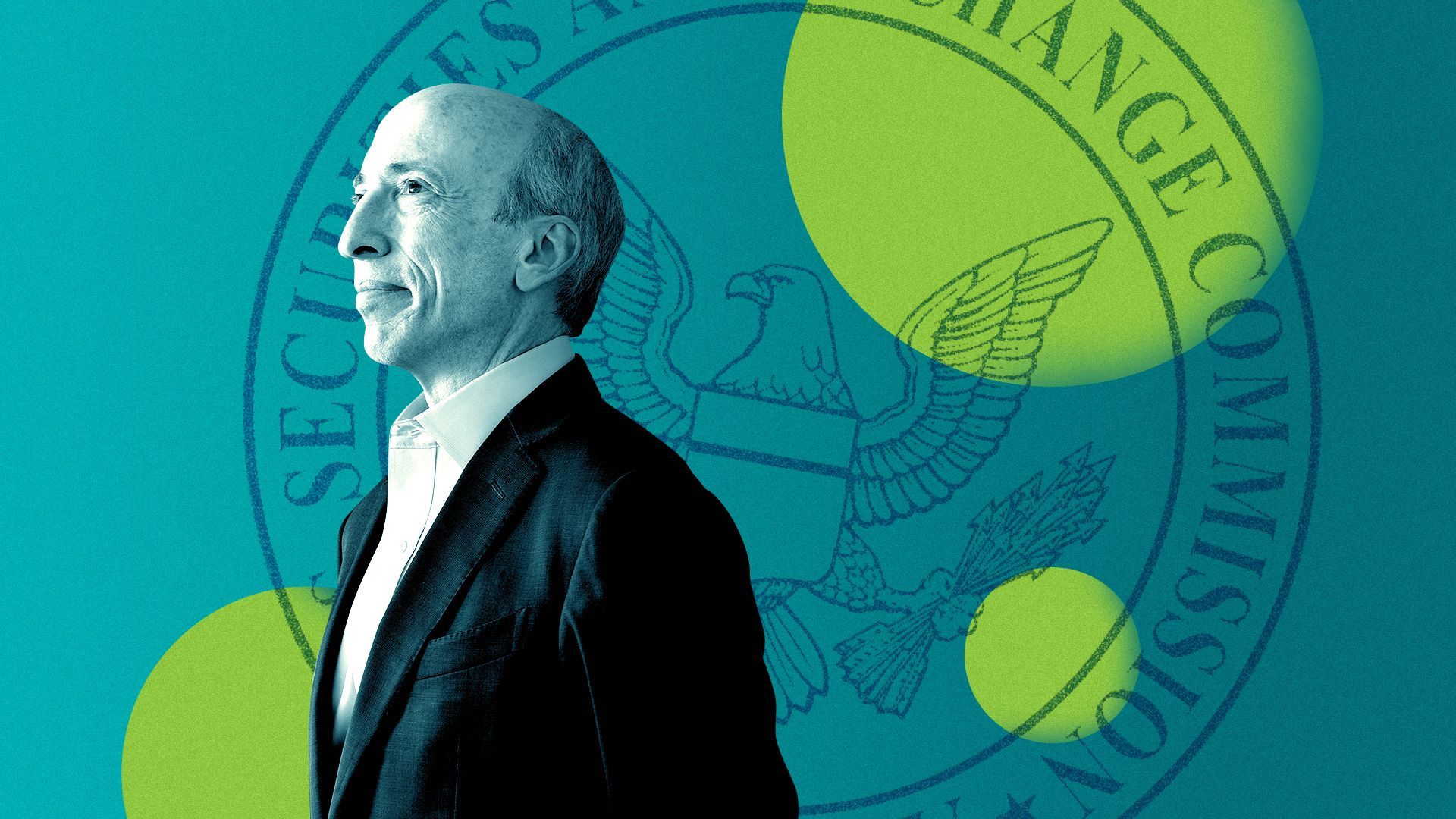
Photo illustration: Aïda Amer/Axios. Photo: Melissa Lyttle/Bloomberg via Getty Images
One senator from Wyoming doubts that a key facet of the SEC's plan to protect crypto investors actually protects investors, Crystal writes.
Driving the news: At a Senate banking committee hearing yesterday, pro-crypto Sen. Cynthia Lummis (R-Wyoming) pushed SEC Chair Gary Gensler on agency guidance for how public companies must account for custodied crypto — an issue she admits to "harping on" for some time.
- Gensler was the day's sole witness.
Catch up fast: In March 2022, the SEC published Staff Accounting Bulletin 121, which said crypto assets under custody should be accounted for as a liability on the custodians' balance sheets, asserting that they posed significant increased risk.
- The standard differs from how stocks and bonds are accounted for.
- It would also require publicly traded banks to adhere to onerous capital requirements to provide custodial services.
Quick take: Critics say that it discourages the involvement of some of the companies best suited to protect investors — a central mission of the SEC per Gensler's social media crusade.
What others are saying: Crypto custodians have complained about it, in context with a proposed custody rule directed at registered investment advisors, or RIAs.
- The American Bankers Association also had questions and asked the effective date be delayed.
The intrigue: The requirement doesn't necessarily help consumers in the event of a bankruptcy; some courts have ruled that customers' assets can be subject to creditors' claims.
What others are saying: Sen. Lummis said: "Like we saw in the Celsius bankruptcy last year when thousands of customers were made unsecured creditors — isn't it true that placing custody assets on a company's balance sheet could result in consumer assets being seized by creditors of a bankruptcy?"
The other side: Gensler pointed out that the Celsius example happened in spite of the guidance and explained:
- "The reason the staff came to the conclusion, which is different than for stocks and bonds in custody, is because the laws in the U.S. right now, you can't readily, easily segregate those crypto assets the way that Celsius was taking it on."
- As it relates to banks' capital requirements: "Bank regulators are free to address how they treat capital, however they wish to treat capital," he said.
The big picture: Gensler also fended off accusations of a heavy-handed SEC, citing a Bloomberg Law article that showed that the agency under his lead created fewer rules than three of his predecessors, including former chair Jay Clayton.
- He repeatedly said the SEC takes public comments into account when making adjustments to proposed rules, providing enough time to interested parties to respond.
Yes, but: SAB 121 didn't get that treatment, because it's not a proposed rule, but a guidance memo.
- Pro-crypto SEC Commissioner Hester Peirce questioned whether such a substantive change to digital assets accounting should be made outside of the regular rule-making process.
💬 2. Charted: Telegram's Toncoin


It shouldn't be all that surprising that Telegram today endorsed the TON blockchain network, Crystal writes.
Driving the news: The messaging app said it would be integrating TON's web3 wallet right into the app, sending the blockchain's native Toncoin (TON) higher on the news.
Yes, but: Telegram would endorse the TON network, because it started out as an in-house project in 2018 (funded by a billion dollar-plus initial coin offering) that got the kibosh after regulators took issue and sued.
- Flashback: The TON Foundation was created a year later and picked up the blockchain project where Telegram left off.
Quick take: The latest development looks like a boon for Toncoin.
👀 3. Tom Emmer's anti-CBDC bill

Illustration: Shoshana Gordon/Axios
Digital dollars issued by the state threaten financial privacy — that's the argument behind Republicans' anti-CBDC stance, Crystal writes.
Driving the news: With Congress back in session, House Majority Whip Tom Emmer reintroduced his CBDC anti-surveillance state act, with 50 Republicans co-sponsoring the bill.
Zoom in: The legislation, first introduced in February, seeks to bar the Federal Reserve from issuing a central bank-backed digital dollar for regular folks in the U.S. to use.
Details: There are two substantive tweaks from the original:
- A new section bans so-called intermediate CBDCs, digital dollars that would be issued by the central bank but managed by banks and other financial institutions like China's digital yuan.
- It loses the section requiring the Fed to report to Congress any potential CBDC pilot programs it's reviewing.
What he's saying: "If not open, permissionless, and private — like cash — a CBDC is nothing more than a CCP-style surveillance tool that can be weaponized to oppress the American way of life," Emmer tweeted Tuesday.
Quick take: The real political brouhaha won't be about CBDCs; it'll be about stablecoins.
🏃 4. Catch up quick
Illustration: Natalie Peeples/Axios
🪙 5. What's this? OneCoin

Illustration: Annelise Capossela/Axios
OneCoin and its so-called "Cryptoqueen" are back in the news, once again spotlighting the bad reputation of this industry as a den of fraudsters and criminals.
- But OneCoin was not a cryptocurrency scam, because there was never a cryptocurrency.
Zoom in: OneCoin was just a straight-up fraud. It was a get-rich-quick scheme wrapped in some rhetoric about serving low-income people, but there was never any there there, Brady writes.
Driving the news: A co-conspirator in the fraud, Sebastian Karl Greenwood, has been sentenced to 20 years in prison after pleading guilty in December.
- In the public imagination, however, OneCoin was entirely the project of his cofounder, the "Cryptoqueen" Ruja Ignatova, last seen in Greece in 2017.
Flashback: OneCoin shut down abruptly in 2016.
- OneCoin was a digital token that existed only in OneCoin's servers. Owners could trade it on the OneCoin exchange, which also put limitations on how much it could be traded. It was never listed on an actual cryptocurrency exchange because it wasn't a cryptocurrency.
- The only thing a person could actually trade for OneCoin was their euros. It was just a scheme to separate the desperate from their cash.
💭 Brady's thought bubble: OneCoin upset a lot of people, perhaps some very dangerous people. If I had to bet: Ignatova is dead.
This newsletter was edited by Pete Gannon and copy edited by Chris Speckhard.
One senator did ask Gensler about the spot bitcoin ETF, to which the SEC chair said that the agency is still reviewing the Grayscale ruling. —B & C.
Sign up for Axios Crypto

Brady Dale covers crypto and blockchain impacts on markets and regulation.