Axios Crypto

June 02, 2022

Happy Thursday! Today we're focusing in on FTX, the exchange that just became No. 2 in the world, according to The Block. Mainly we're digging into its proposal for digital assets futures trading in the U.S., which FTX has for years done abroad.
🤗 The bear market in crypto got real today, with significant layoffs at a major firm (see Catch up quick). Now is the time to tune in, not tune out. The next era of crypto will be defined in the downturn. Got opinions about what it will be? Email: [email protected].
This newsletter was edited by Pete Gannon and is 1,408 words, a 5-minute read.
🔄 1 big thing: What FTX wants from the CFTC
Illustration: Sarah Grillo/Axios
One crypto trading platform wants to allow its U.S. retail customers to make levered trades on future bitcoin and ether prices, proposing a different way of running an old market that is drawing ire from Wall Street firms with skin in the game, Crystal writes.
What's happening: FTX, a global crypto exchange, has been seeking permission from U.S. regulators to execute its model of risk management for the clearing of margined trades in the futures derivatives market.
- The crux of the debate over this model centers on the use of middlemen, or intermediaries, who play a central role in these transactions.
- FTX's model doesn't use intermediaries.
- In its model, FTX would take on the role of clearing house for its customers in addition to operating its exchange, which is something of a seismic shift from the way things work now.
- FTX's model is centralized, in that FTX is handling all of it.
How futures work: For a farmer, they are all about price risk management. The farmer today can plant corn and sell a contract to deliver it on a certain date, for a certain price, sometime in the future.
- That contract and many others like it for physical things like corn, oil and gold — or whatever else is deemed a commodity (read: bitcoin) — are called futures.
- Single stock, index and interest rate futures exist and are regulated by the Commodity Futures Trading Commission (CFTC) jointly with the Securities and Exchange Commission.
The intermediaries, futures commission merchants (FCMs), among other things, absorb counterparty risk in these contracts.
- They accept the orders, collect margin from the parties involved, and see to the delivery of the asset or cash at the agreed upon date.
- They also check to make sure their customers have sufficient capital or assets (margin requirements) to mitigate the credit-risk exposure in the trade.
- In effect, that system is decentralized.
Details: FTX's model automates — and bypasses — the role of those FCMs, but only for crypto futures traded on its exchange.
- The company already uses this risk management system and has been doing so for more than three years outside of the U.S. It contends that the system has held up in spite of the wild swings in crypto prices.
Between the lines: In the existing U.S. model, FCMs (the intermediaries) reach out to customers when they approach credit limits, which are precipitated by movement in the underlying contracts. These are called margin calls.
- FTX, acting as the sole risk manager for their customers, conducts margin checks automatically — which it does every few seconds.
- In the situation where an FTX US customer's margin on deposit falls below the maintenance margin level, FTX US will simply liquidate that customer's position on a 24 hours a day/seven days a week basis.
What they're saying: The existing traditional derivatives market is closed overnight, on weekends and during holidays, so FTX argues that its constant checks would reduce systemic risk because it's closing or re-collateralizing these trades in real-time.
FTX also proposes posting $250 million for its default fund in the event of some adverse market event, which is substantially more than it has ever had to draw over the last three years, combined, according to FTX.
- Over that period, FTX has experienced single-day bitcoin moves of 38%, and the fund has paid out a NET total of $9.5 million.
- They've also committed to raising the amount that the fund would hold at minimum as activity on the platform rises.
The other side: See Section 3.
📱 2. Crypto app growth is down (mostly)
Speaking of FTX...
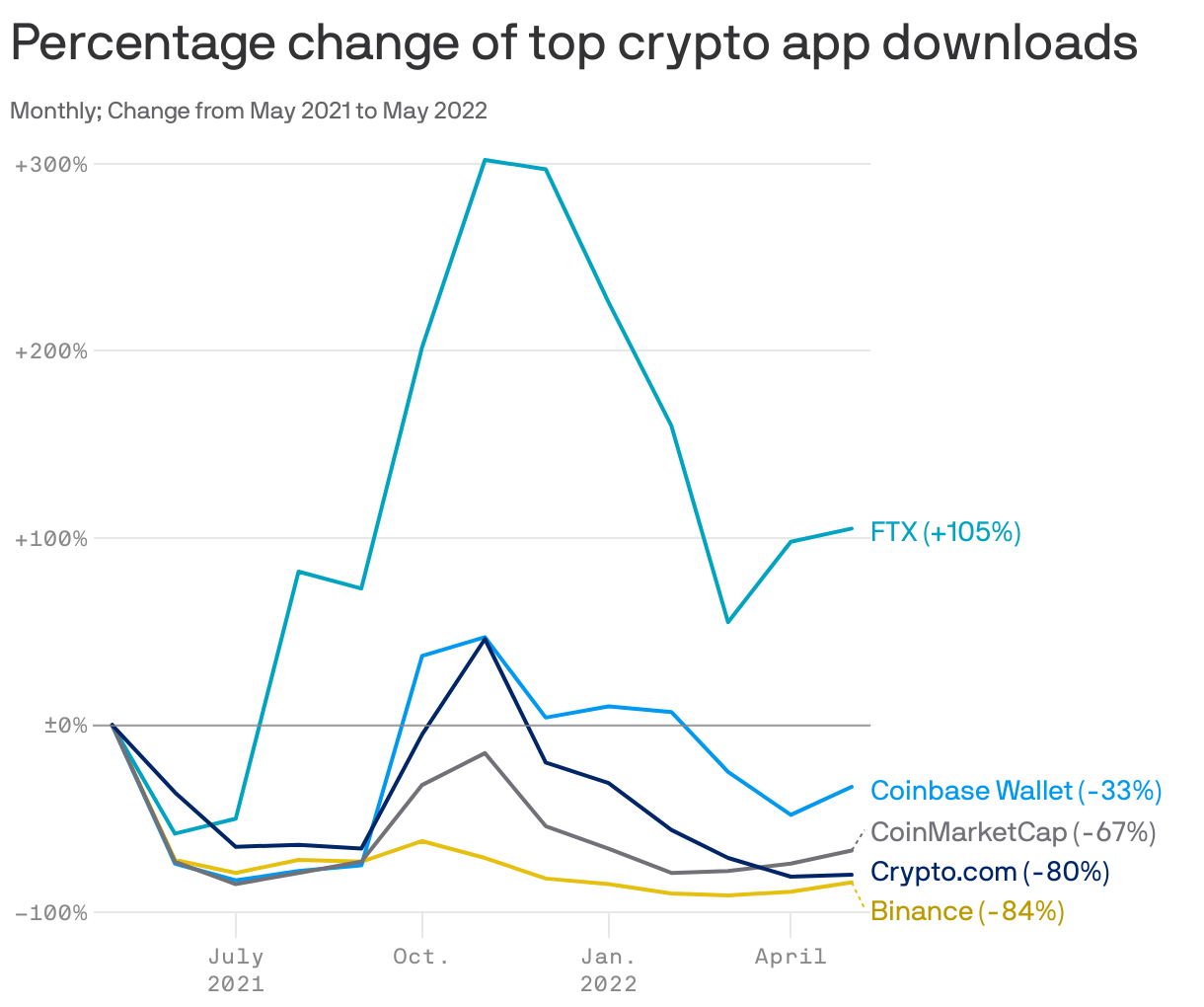
When we reached out to SensorTower to find out what was going on with the downloads of crypto apps, we expected they would all be down, Brady writes.
- Not quite.
Zooming out: To be clear, the chart above doesn't show that users are shrinking on different crypto apps, just that they are growing much more slowly than they were in May 2021, except for the FTX app.
- Of note, the app Phemex (not shown) is also up in the last month, but its downloads had been dropping previously like the others.
That said, a SensorTower spokesperson said that monthly active users for the top crypto apps are up 5% from May 2021, but downloads (that is, new users) are slowing dramatically.
The bottom line: "This data seems to indicate that adoption is slowing year-over-year but retention among existing users remains high," SensorTower's spokesperson said.
👹 3. Who's afraid of FTX's risk model?

Illustration: Sarah Grillo/Axios
There is a narrative swirling that pits FTX US against farmers.
- That seems kinda odd, because FTX's specific proposal does not touch agricultural products, Crystal writes.
What's happening: Incumbents (really not farmers) fear that if FTX's proposed application is approved, its risk management model could become the new standard not just for digital assets futures trading — but for the entire complex at large.
Driving the news: The CFTC is reviewing FTX's application submitted recently and in late May held a roundtable discussion.
- Included in the discussions were executives of the CME Group, the marketplace for derivatives, and New York Stock Exchange owner Intercontinental Exchange.
- BlackRock, Citadel, Goldman Sachs and JPMorgan were also in attendance.
- Some financial industry leaders rang the alarm on the potential dangers of FTX's model.
What they're saying: Commentary from Nelson Neale, president of CHS Hedging, a futures brokerage subsidiary of a farmers co-operative, struck a nerve.
- "[W]hile we are not direct participants in the cryptocurrency markets, we believe that, if the Proposal were to be approved, the model underlying the Proposal would quickly spread to other asset classes," he said in submitted commentary to the CFTC.
- Here's Neale's comment in full.
- CHS Hedging is an FCM.
Of note: Sam Bankman-Fried (aka SBF), who heads FTX, makes some concessions in a 50-tweet Twitter thread, acknowledging that the company's risk model has worked for digitally settled assets but "would require more work to be appropriate for goods whose settlement is primarily in physical warehouses."
- Obviously, delivering bitcoin by a certain date is very different than a truckload of corn.
- Again, FTX US's proposal does not intend to deal in ag futures at the moment. But incumbents fear the slippery slope.
What others are saying: "The stuff FTX is doing is the future. It is inevitable. But that doesn't mean it has no risks and doesn't mean that the old system has no value," Dave Nadig, financial futurist at VettaFi tells Axios.
- What can be simultaneously true, says Nadig, "The new kids are running hot and fast, and the old guard is defending a monopoly."
Juan Arciniegas, a derivatives and financial markets attorney at Vedder Price, tells Axios that FTX's proposal follows the trend in crypto and digital assets markets to allow broader participation of retail traders.
- "It raises interesting fundamental questions of how U.S. derivatives market structure should operate in the future," he said. "If approved, the disintermediated model of clearing could find its way into other asset categories such as agriculture, energy, forex, rates."
💭 Our thought bubble: Bringing the "farmer" into this debate over a newer system vs. the current system reeks of "robots are taking over" mentality. This is a false narrative that breeds fear rather than constructive inquiry.
🏃♂️ 4. Catch up quick
♊️ Layoffs are announced at the crypto exchange run by the Winklevoss brothers, Gemini, impacting 10% of staff. (Bloomberg)
🪀 Ex-OpenSea staffer is arrested by the FBI this week for insider trading. (Axios)
👛 Let's Go Brandon Coin fan, Rep. Madison Cawthorn's, crypto wallet is sleuthed out, and you won't believe how much money he didn't make. (CoinDesk)
🙄 When celebrities make financial recommendations, maybe change the channel? (Vox)
Top coins
🕵️♀️ 5. Culture hash: Blockchain investigators
Screenshot: @tayvano_ (Twitter). Redacted by Axios.
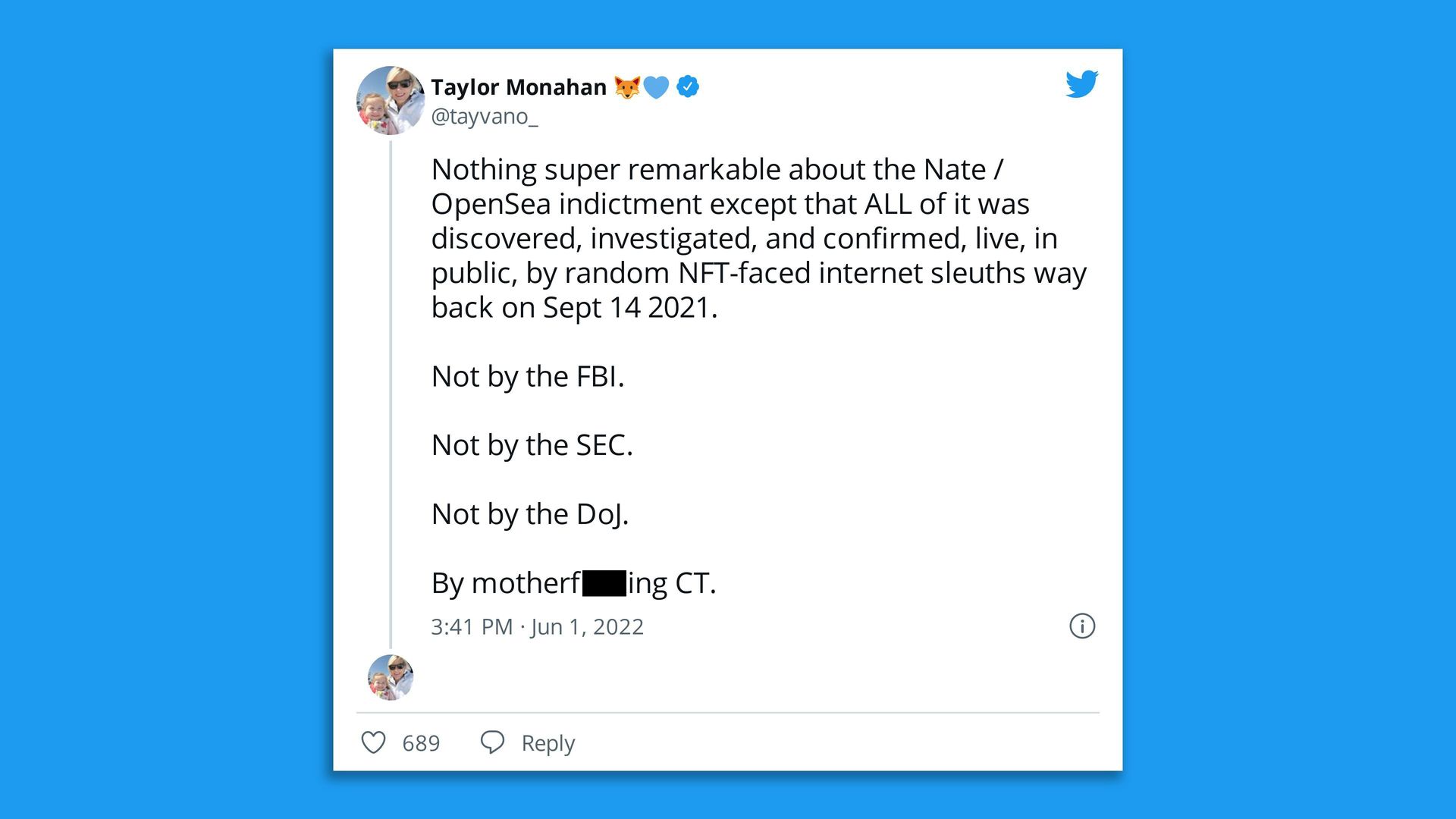
We talk a lot about how blockchains provide a unique level of transparency, but here's a very concrete example, Brady writes.
- Jargon check: "CT" means "Crypto Twitter."
Yesterday, we reported that a former OpenSea employee had been arrested for insider trading of NFTs that he knew would pop in value because they were about to be featured on the world's leading NFT marketplace.
- The FBI provided a detailed indictment with the arrest, but Taylor Monahan (a pioneering entrepreneur who co-founded the company that made the most widely used early Ethereum wallet) pointed out in a Twitter thread yesterday that basically everything in the indictment was discovered by blockchain denizens and posted on Twitter last year.
- She resurfaces these findings, point by point from the indictment, over 14 tweets.
State of play: There are tons of Twitter threads about shady behavior out there if FBI agents want more readymade blockchain cases.
Who is going to announce layoffs next? There will, for sure, be more. In fact, if your crypto firm is laying off staff, give us the scoop. You know how to reach us. —C & B
Sign up for Axios Crypto

Brady Dale covers crypto and blockchain impacts on markets and regulation.