Axios Crypto

February 16, 2023
Today we take a deep dive into NFTs, as a hot marketplace generates buzz through a token giveaway.
๐ง [email protected]
Today's newsletter is 1,319 words, a 5-minute read.
๐งโโ๏ธ 1 big thing: Buying NFTs wholesale with Blur
Illustration: Shoshana Gordon/Axios
Some people out there make their living day trading NFTs, Brady writes, and Blur, an NFT marketplace, is winning the market for vibes by catering to such traders.
Why it matters: Blur's entire design encourages more buying and selling of NFTs, with less discrimination.
- From the beginning of the NFT boom in early 2021, the issue that's held the marketplace back has been liquidity โ a person can't necessarily know for certain that an NFT will sell quickly when they want to sell, making its "value" somewhat specious.
How it works: Blur's design is based on the idea that some traders want to buy or sell a bunch of NFTs at once. It makes it easy to "sweep" an NFT collection.
- That is, say you want to buy 11 Moonbirds Oddities NFTs as fast as you can because you believe the whole collection will appreciate soon for some reason.
- Blur is designed to make that super easy. You can basically tell it "buy me the 11 cheapest on whatever market" and get it done in a few clicks (or sell basically the same way).
Be smart: That kind of buy is called "sweeping the floor."
The insight here is this: While every NFT is unique (non-fungible), the truth is the least rare NFTs of any given collection are basically fungible, at least from a wholesale perspective.
- Sure your special Moonbirds Oddity might mean something to you (and it will be recognizably different), but the market probably doesn't see it that way.
Flashback: Blur raised $11 million a year ago, led by Paradigm with lots of notable angels in the mix.
- It's rumored to be raising at a billion-dollar valuation now.
By the numbers: Blur is quickly seizing market share in the NFT world.
- This Dune Analytics dashboard tells the story the most starkly in its weekly volume chart.
- Through 2021, OpenSea, the market leader, pretty much had the retail NFT business to itself. Then in 2022 lots more markets started to come online, but they only chipped away at OpenSea's dominance.
- Then in October Blur kicked off, and its volume immediately started registering. By November, it was doing 25% of volume or more. These days, it's got about 40%.
Quick take: If more traders are sweeping the floor that does two important things for the NFT market.
- That increases the likelihood that cheap NFTs just sell, which makes their value more "real."
- It speeds the velocity of money moving through the whole market, which gives everyone more confidence in prices.
Zoom in: If you want to see Blur's features in action as demonstrated by a real day trader, this short video on the Collecting Jpegs YouTube channel breaks it down in a few minutes.
๐ฆ 2. Charted: Of course, there's a token


Blur airdropped a new token to its loyal users on Valentine's Day. The chart does a nice job of showing typical price action for a new offering, Brady writes.
- Blur's token will be used to govern the platform once it starts to decentralize and let holders weigh in on changes.
By the numbers: The maximum supply will be 3 billion blur, but only 360 million are on the market now.
- The market cap has broken $400 million as of today.
Be smart: See that giant drop at the start? This is typical. As folks start claiming early airdrops, the most eager traders will buy at any price. So when hardly any were for sale, some got picked up at a multiple of the market price a few hours later.
- Some folks always do this. It is very hard to say why.
๐ง 3. $500 million a month is still $500 million


This is our occasional reminder that the NFT market shrank. It hasn't died.
Quick take: There's this endemic thing in the tech press where, if something becomes less popular, it is "dead." It is not helpful, Brady writes.
- Fun fact: Blogging site Tumblr is not dead, despite a prevailing mood to the contrary. In fact, it's been delightfully weird in a collective way lately.
- NFTs are more important than Tumblr and โ unlike blogging โ will make a huge comeback as they find their next form.
Why it matters: While the frenzy has come out of the NFT market, it's not escaped the notice of many hungry young investors that there's still more than enough money sloshing around this market to make a buck.
- Yes, it used to do billions of dollars a month in volume and now it's mere millions. It's still a lot of money.
- It was never not a lot of money.
- For what it's worth, the number of sales is also sitting around 10K a day.
Be smart: Up top, we talked about how the NFT market has a problem with liquidity. That's not a problem depending on where you're sitting, though. It's in buggy, inefficient markets where savvy traders with good sense can get a leg up.
- Once everything has been sorted out and professionalized, good luck ever beating the big guys again.
Zoom in: Blur may be taking a sizable share of the market away from the NFT kingmaker, OpenSea, but don't feel too bad for the original eBay for digital collectibles: It's still doing about $3 million a day in revenue, according to Token Terminal.
- Like the whole market, that's way down, but it's still a very nice business.
Zoom out: Through 2021, OpenSea and the CryptoPunks website were basically the only games in town for trading NFTs (Foundation was a contender too, to a much lesser extent).
- These days, a half dozen websites command at least 1 percent of the marketplace on any given day.
Among NFT collections, the Bored Apes universe continues to dominate.
- Four of the top five projects (Otherdeeds, Bored Apes, Mutant Apes and CryptoPunks), as ranked by NFT Price Floor, are owned by Yuga Labs, the creators of the Bored Apes Yacht Club and various ancillary lines of NFTs.
The bottom line: When headlines declare death, it pays to check the data.
๐ค 4. Culture hash: What does it all mean?
Screenshot: @HIVE____MIND (Twitter)
In the early web, the internet created meeting places. In web3, it's creating organizations, Brady writes.
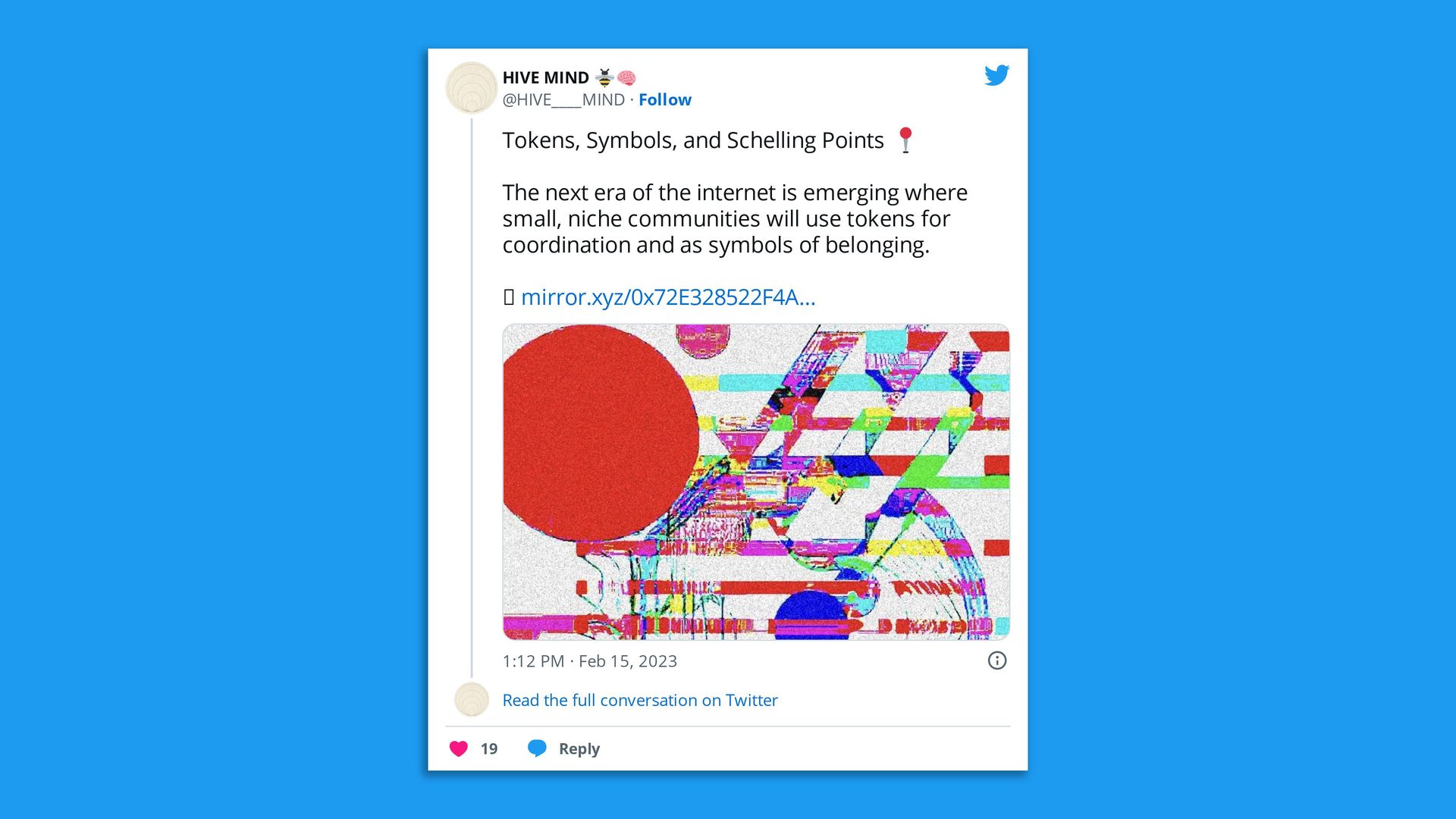
- Hive Mind has a new blog post out explaining how crypto technology enables new kinds of online tribes.
- We've touched on this before.
Why it matters: People need each other.
How it works: People have always made friends online, but those relationships haven't been readily portable.
- Maybe you were a big blogger on LiveJournal back in the 2000s. Were you able to find your "friends" from there again as folks migrated elsewhere?
- Probably, you kept track of your internet BFFs, but what about your casual acquaintances? Could you find them again if you wanted to?
- On the old web, platforms effectively owned those relationships, unless you were a very conscientious user.
The big picture: When relationships are tied to a token of some kind, they are portable. A website can go down, but that won't change a person's connection to others in the community, because members each own what identifies them as a memberโtheir token.
What they're saying: "It's not just about speculation; it's about coordination, and their ability to act as global symbols," the post explains.
Yes, but: It also says, "Hyperreality is our forthcoming state where weโll no longer be able to distinguish between what is real and what is a simulation of reality. It will be a condition where the simulation becomes more real than the real thing."
- OK... No more for you guys.
Smart brevity: If you decide to read the post, feel free to skip down to "THE INTERNET AND SCHELLING POINTS."
๐ 5. Catch up quick
โ๏ธ Signature Bank CEO Joe DePaolo plans to step down as his successor COO Eric Howell takes the reins. (CoinDesk)
๐ธ Binance expects to pay mandatory penalties to resolve U.S. probes. (Wall Street Journal)
๐ฐ FTX bankruptcy judge denied the appointment of an independent examiner, citing cost. (Axios)
๐ฆฌ Wyoming's House passed a bill that prohibits forced disclosure of private keys by U.S. state courts. (CoinDesk)
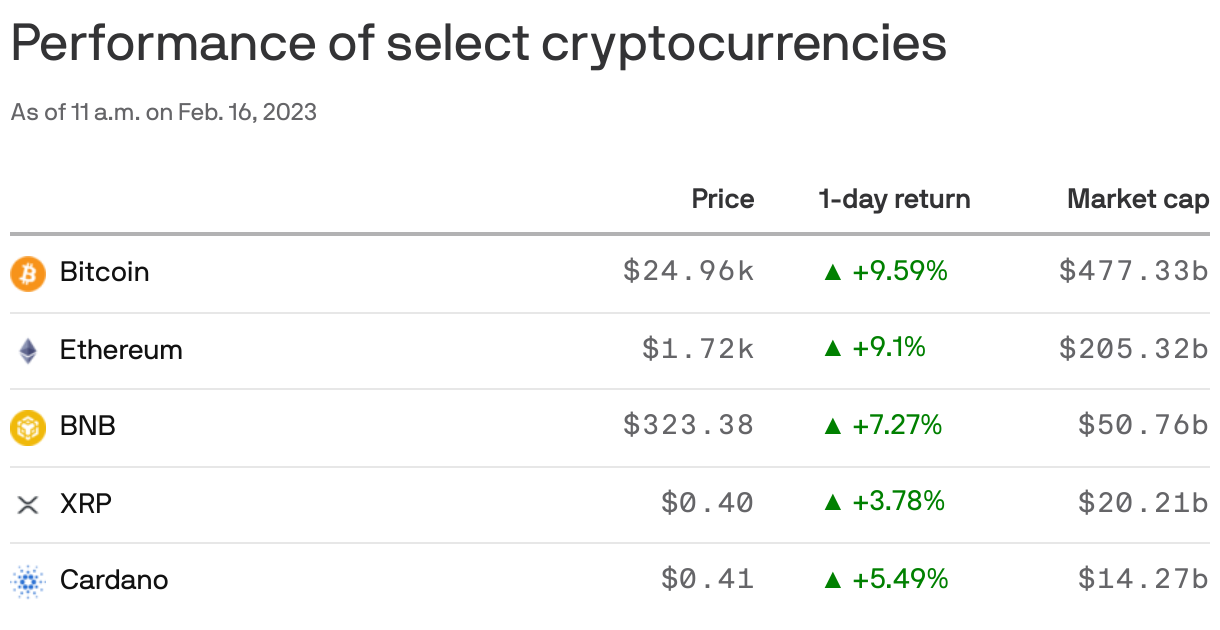
Top coins

This newsletter was edited by Pete Gannon and copy edited by Carolyn DiPaolo.
๐ข Tomorrow, back to our regularly scheduled doomed market programming. โC & B
Was this email forwarded to you? Sign up here to get Axios Crypto in your inbox.
Sign up for Axios Crypto

Brady Dale covers crypto and blockchain impacts on markets and regulation.