Axios Crypto

November 08, 2022
This might be the biggest news day of 2022. Time will tell. We're giving it 80% odds it is, though.
- 📧 Email us at [email protected] but honestly? Who knows.
Today's newsletter is 834 words, a 3-minute read.
💣 1 big thing: Binance to acquire FTX
Photo illustration: Gabriella Turrisi/Axios. Photo: Tom Williams/CQ-Roll Call, Inc via Getty Images
Binance has signed a letter-of-intent to acquire FTX.com, the exchange associated with Sam Bankman-Fried, according to tweets from CEOs of both companies, Brady writes.
Why it matters: Binance is the largest exchange by volume in the world. FTX is the fourth largest, but it's been growing fast. Many thought it might be a rival for the throne.
- No longer.
What they're saying: "This afternoon, FTX asked for our help. There is a significant liquidity crunch," Binance CEO Changpeng Zhao (better known as CZ) tweeted today.
- "To protect users, we signed a non-binding LOI, intending to fully acquire FTX.com and help cover the liquidity crunch. We will be conducting a full [due diligence] in the coming days."
- Terms of the deal weren’t disclosed.
Context: FTX had taken a significant leadership role in the U.S. blockchain industry as it aggressively sought regulations that would provide clarity in its largest market.
- Its young CEO, Bankman-Fried, has become one of the industry's most recognized faces as well.
Zoom out: Binance has been around the crypto industry a long time, but FTX's growth has been absolutely explosive, allowing it to quickly rival the market leader.
- Drama broke out this weekend between the CEO of Binance and FTX.
- It started after a CoinDesk report suggested that FTX's solvency is over reliant on its own token.
- The report zeroed in on the ties between the trading and investment fund, Alameda Research, and the exchange, FTX.
The intrigue: In August, Bloomberg reported that Alameda and FTX were merging their venture operations, but the two firms subsequently denied it.
Of note: Both companies have separate companies set up to serve U.S. customers. FTX-US will not be impacted by this deal, according to a separate tweet from Bankman-Fried.
- FTX has not responded to a request for comment. Binance has not yet provided additional details.
🔗 2. Bonus charted: FTT's fall


FTX's exchange token FTT tanked over the past 24 hours leading to today's announcement, Brady writes.
What is FTT: It grants its holders discounts on trading and a way to share in the revenue of the exchange.
- Its price was over $80 last September, but, lately, it has traded between $22 and $26, until just recently.
- The price collapse was kicked off by Binance announcing it would sell its FTT holdings.
- The price of FTT recovered modestly this afternoon on the news of a deal between the exchanges.
What's next: The fate of FTT holders remains to be seen.
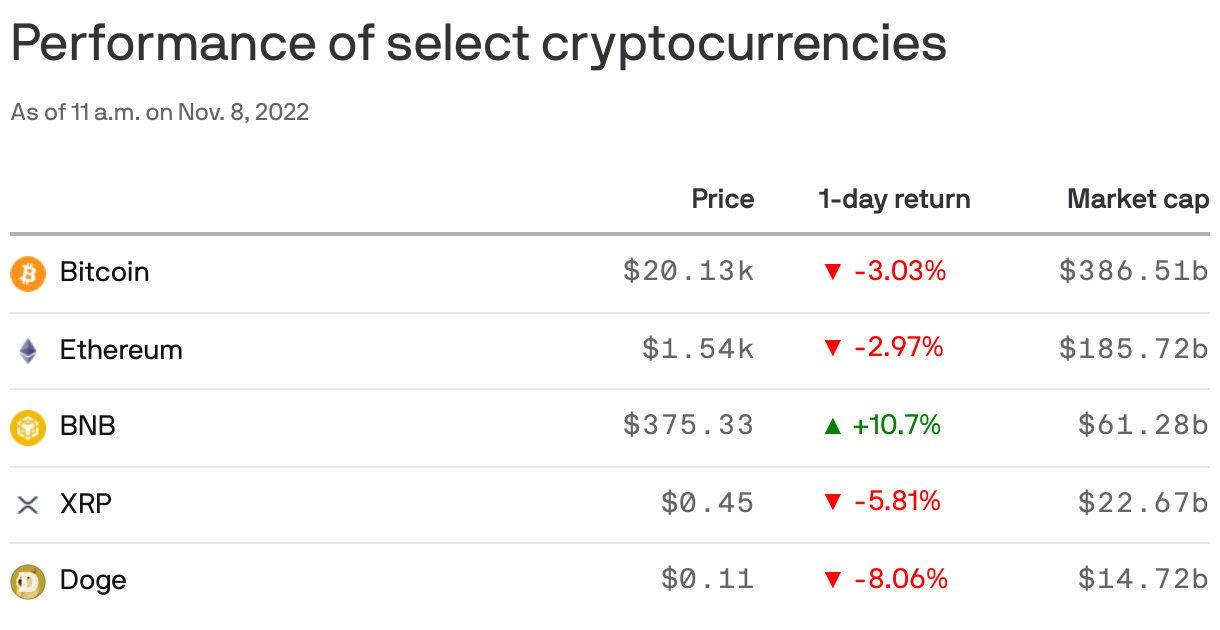
- Binance also has an exchange token, BNB, the fourth largest cryptocurrency in the world.
🚧 3. OpenSea's royalty code

Illustration: Aïda Amer/Axios
OpenSea is embracing creator royalty payments, rolling out code to embed fee requirements right into smart contracts, Crystal writes.
Why it matters: The leading NFT marketplace operator will enable recurring payments on-chain, even as the rest of the industry appears poised to break from them.
- NFT marketplaces at large have been nixing royalties on the premise that it is poor business in a market defined by sapped trading volumes and a substantial decline in prices.
- In effect, OpenSea is going off-trend.
- Following the acquisition news, FTT price ticked up again somewhat, without quite regaining lost ground.
Driving the news: Starting today, Nov. 8, OpenSea will give creators an option to enforce creator fees for new Ethereum NFT collections, the firm's CEO and founder Devin Finzer announced Sunday.
What they're saying: "We believe creators should have the power to build the collections and communities that they desire, and buyers and sellers should continue to have the freedom to choose which collections they do and don’t engage with," Finzer said in a blog post.
Yes, but: The premise of that freedom to choose begins to look dubious for a hypothetical buyer of these royalty-enforced NFTs.
- The very code that would empower creators would also limit owners from selling their wares on certain venues.
How it works: The code Ethereum NFT creators can insert into their newly created collections' smart contracts bars them from being traded on other NFT marketplaces that don't enforce royalties.
- Since so many other NFT marketplaces have decided to go to zero royalties or make them optional on their respective platforms, OpenSea's code seems to point to more closed doors than open ones.
🐇 4. Catch up quick
🇺🇸 Lobbying spending by the crypto industry finally leveled off in Q3 (The Block)
💰 Fordefi raises $18 million to build a DeFi wallet with security suitable for institutional investors. (Fortune)
🎁 Bonus: Yesterday Bloomberg's Matt Levine put the FTX vs. Binance thing in historical context in the second part of his daily column. (Bloomberg)
Top coins

🌒 5. Culture hash: FTX's blood moon
Source: Twitter @gegelsmr4
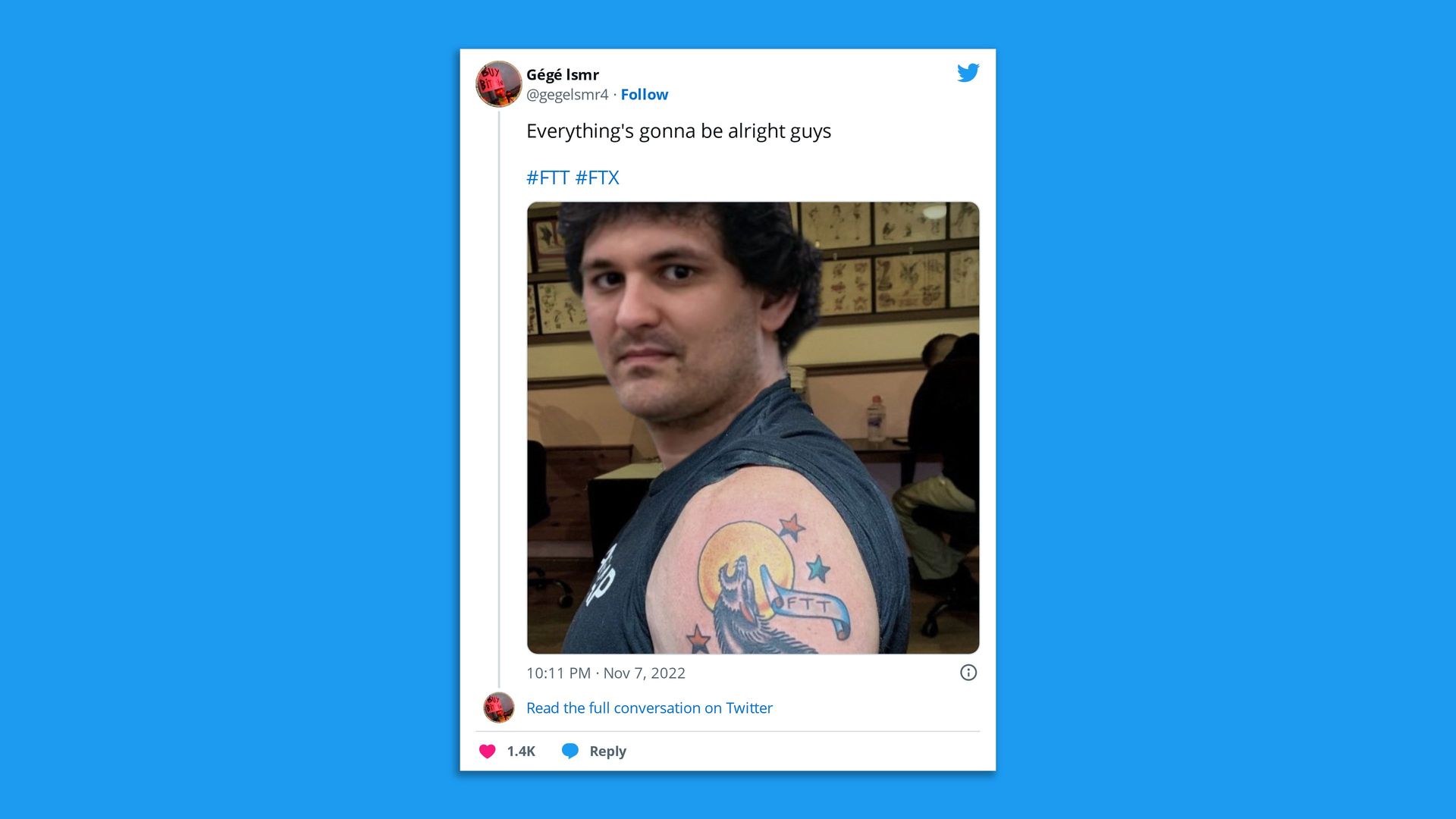
Bankman-Fried, chief of FTX, is having his own "Terra/Luna" moment, Crystal writes.
- So, some clever Twitter user superimposed SBF's face on crypto billionaire Mike Novogratz.
- The image above is modified based on an old one of Galaxy Digital CEO Novogratz, once a "Luna-tic," who showed his support earlier this year with a tattoo, paying homage to the since collapsed sister-token of the defunct algorithmic stablecoin.
Context: Just yesterday, Bankman-Fried attempted to dismiss the rumors as brinksmanship. Things look very different today.
The bottom line: Exchanges are black boxes.
This newsletter was edited by Pete Gannon and copy edited by Carolyn DiPaolo.
🧘 If you've got bags, buckle up. —C & B
Sign up for Axios Crypto

Brady Dale covers crypto and blockchain impacts on markets and regulation.