Axios Crypto

May 20, 2022
It's Friday! Today we're talking about crypto-powered telecoms and π.
π¨ Situational awareness: Prosecutors in Seoul announced an investigation into Terraform Labs, the company behind the shattered algorithmic stablecoin, terraUSD.
Remember: You can hit us up on Twitter any time: Brady and Crystal. Email is [email protected].
- If you're working at a crypto company and feeling the bear market pinch, hit us up. We are happy to speak confidentially: [email protected].
This newsletter was edited by Pete Gannon and is 1,087 words, a 4-minute read.
π‘ 1 big thing: Dish Network's crypto bet

Photo illustration: Sarah Grillo/Axios. Photo: Courtesy Dish Network
DISH, the wireless company, has already been through one major technological transition, and it's betting that cryptocurrency is part of its next one, Brady writes.
"As somebody born in 1987, I'm probably one of the last generation that was recording radio songs onto mixtapes, and then Napster came along," Chris Ergen, head of wireless innovation at DISH Network tells Axios in an interview.
- Driving the news: DISH invested in Pollen, a new crypto-enabled grassroots wireless network, and has previously announced a partnership with Helium, a very similar network that's already reached thousands of cities.
- Helium and Pollen use cryptocurrency to incentivize people to set up wireless nodes that provide last-mile access to the internet.
For DISH, these moves were about its long-term aim of becoming a competitor in 5G wireless services.
- "We don't have a venture capital arm," Ergen said. "If you see us investing, it's more strategically central to what we're doing."
How it works: Networks like Helium pay people in cryptocurrency for hosting nodes that can receive wireless messages and send them to the internet. The nodes also check in with each other to verify each other's locations (which can be a crucial piece of data for internet-of-things devices).
- Helium started primarily helping devices send low-data messages back to the internet (tracking things like lost pets or rented bicycles).
- Helium announced support for 5G services last year. Pollen launched with 5G support. Both make use of the Citizens Broadband Radio Service (CBRS).
For DISH, such partnerships are about extending their range. Ergen compared it to roaming from the early days of cellular.
What's next: Ergen believes these kinds of networks are going to give developers a whole new design space to build on.
- "The smart network is akin to the transition you had when you went from the flip phone to the smartphone, but at the network level," he said.
- Context: Dish is best known today for providing subscription TV services via satellite β which is still the bulk of its revenue.
The next transition is to provide data services wirelessly. "Dish has been investing in spectrum for about 13 years. We've invested a little north of $30 billion," Ergen explained.
- Leasing public spectrum is a key asset any company needs to compete in wireless.
- Ergen believes the company also has an advantage as their offering is all virtualized, running over the cloud.
State of play: DISH just lit up its first city, Las Vegas.
- "Providing internet and providing data connectivity to people and things is the next 50 years of this company," Ergen said.
πΆ 2. Charted: Memecoins!


One thing you can guarantee every time there's a boom in crypto: A major publication is going to trot out one of the creators of dogecoin to remind everyone the blockchain started as a joke, Brady writes.
- To which crypto denizens of the moment say: "LOL, π€·."
Dogecoin started all the way back in 2013. It's had various moments in the sun, usually somewhere in the middle of every crypto boom, but it always comes crashing back down.
- It's a coin with an unlimited supply, that has had β at times β no developers working on it and a fanbase that goes from diehard to hard to find, depending on little more than vibes.
Shiba Inu started as a joke about dogecoin in August 2020. It doesn't even have its own blockchain. It just runs on Ethereum.
- The joke of Shiba Inu caught on so ferociously that it's been, on some level, one of the best "investments" of all time, but you could describe a lottery ticket the same way.
- Now, the same publications that once gushed about its potential are forecasting doom for the dog token.
Zooming out: While at different times, each has been thought of as crypto's great champion by some, it helps somewhat to look at these two very similar projects' charts side-by-side and see that, at least in terms of price appreciation, they have behaved... very similarly.
The bottom line: Nevertheless, they are very good boys. π
π€€ 3. That first purchase with bitcoin
Illustration: Eniola Odetunde/Axios
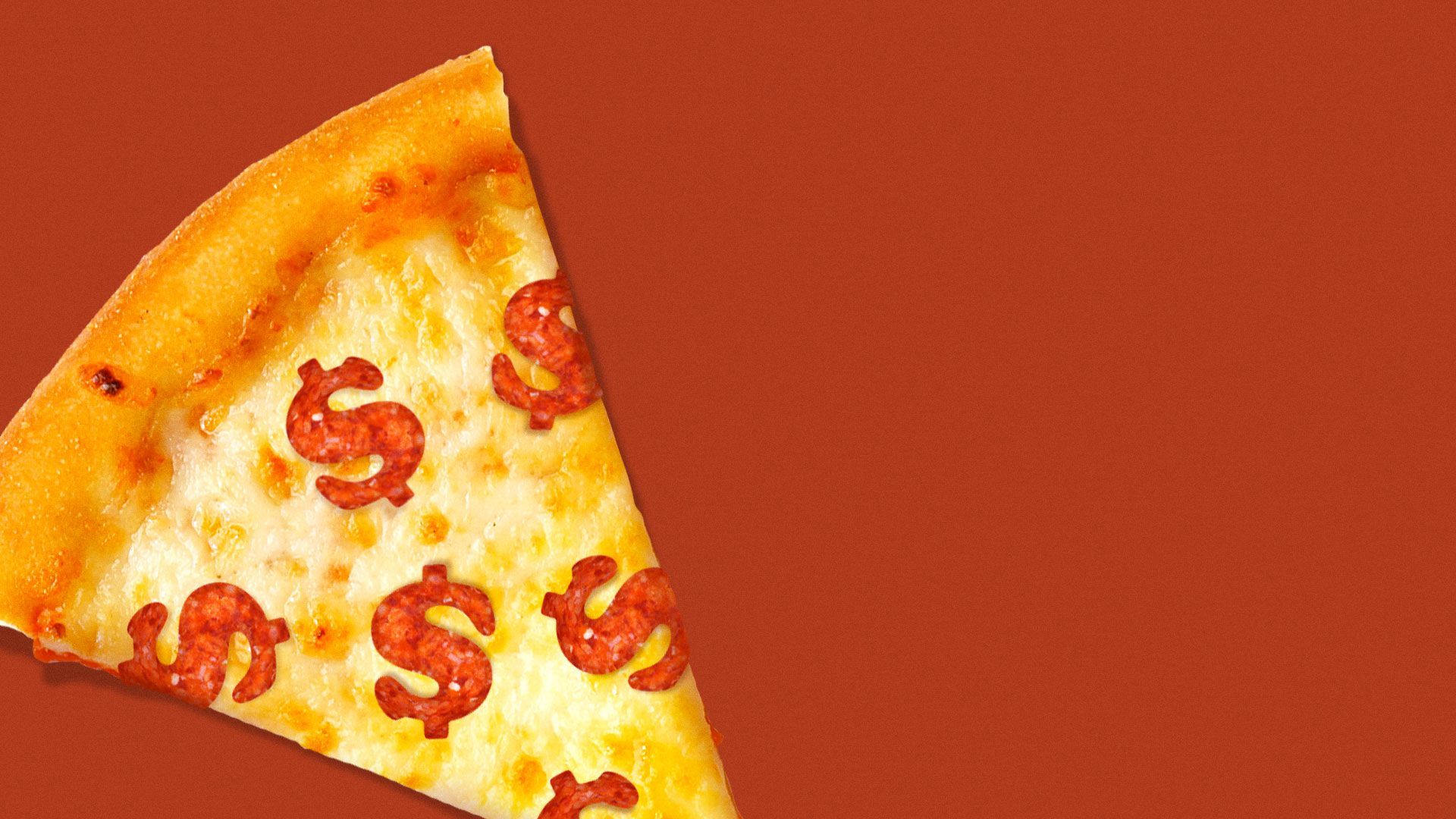
Sunday is Bitcoin Pizza Day π.
Context: On May 22, 2010, Florida programmer and hobbyist Bitcoin miner, Laszlo Hanyecz, bought two pizzas with 10,000 bitcoins. It is the first known purchase made using the original cryptocurrency.
- So it's now celebrated as Bitcoin Pizza Day, Brady writes.
Our thought bubble: Every year, some news organization will do a story about the however-many-million dollar pizzas sold X years ago (example here). These stories are nonsense.
- If no one had ever used bitcoin, it wouldn't be worth anything today. The fact that Hanyecz didn't sit on his bitcoins is one of the reasons the cryptocurrency has gotten somewhere.
By the numbers: Today, 10,000 bitcoins is worth roughly $300 million.
- In May 2010, they were worth two pizzas. The end.
πββοΈ 4. Catch up quick
βΎοΈ Here's what's up at the Nationals' ballpark after the Terra immolation. (CoinDesk)
π¦₯ Signs of a crypto slowdown are taking hold. (Axios Pro)
π΄ MiamiCoin is tanking. (Axios)
π§ββοΈ Former BitMex CEO Arthur Hayes faces sentencing today after pleading guilty to violating the Bank Secrecy Act. (The Block)
π Terra debacle highlights exchanges' role as tastemakers in the trading world, thanks to their discretion in listing token. (FT)
π§Έ Transactions on the Solana-based NFT marketplace, Magic Eden, pull ahead of OpenSea, the category leader. (CoinDesk)
π 5. Culture hash: Grayscale ads
Photo: Brady Dale/Axios
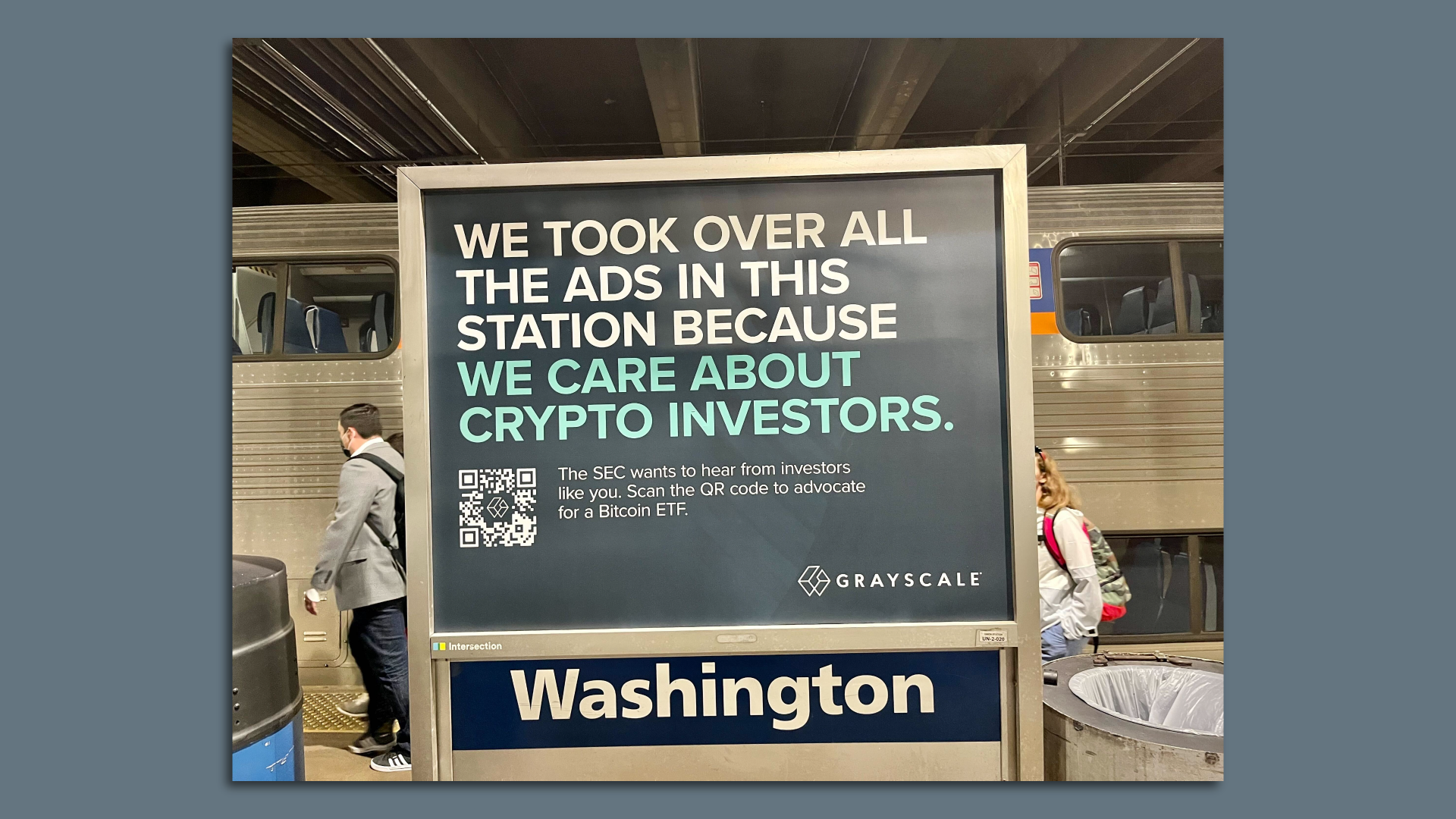
Grayscale Investments, the folks behind the world's largest publicly traded bitcoin fund, papered over Washington, D.C.'s, Union Station with one message: "We care about crypto investors."
- Context: Grayscale is pushing to convert its fund, The Bitcoin Trust, into an ETF as the July 6 deadline looms for the SEC to accept or reject its application, Crystal writes.
Between the lines: Often referred to by its ticker symbol, GBTC, the fund recently traded at a record discount to its net asset value. In layman's speak: It has declined more than the price of bitcoin.
- Grayscale says that converting the fund to an ETF will close that gap.
- Firm CEO Michael Sonnenshein has previously threatened to sue the regulator in the event of a rejection, asserting that the SEC was doing investors a disservice by not approving a fund that is a more direct bet on bitcoin.
What they're saying: "Our priority will always be advocating for investors, and this campaign embodies that commitment," Sonnenshein tells Axios.
- "We designed an out-of-home campaign to make it even easier for investors to share their thoughts on if there should be a spot bitcoin ETF in the United States," he said.
Yes, but: You can just own bitcoin outright.
If you celebrate pizza day Sunday, be sure to email us and let us know what kind you ordered. β C & B
Sign up for Axios Crypto

Brady Dale covers crypto and blockchain impacts on markets and regulation.