Axios Crypto

October 30, 2025

The crypto market was disappointed by the Fed yesterday, and bitcoin has fallen below $110,000. Are you scared? 🎃
- But one old coin has been going up like crazy. See 2️⃣ below.
Today's newsletter is 1,035 words, a 4-minute read.
1 big thing: Bitcoin governance
The people who operate Bitcoin and secure it for posterity are in a debate over how much data can be stored on its blockchain.
Why it matters: It's an ideological battle over what Bitcoin should be used for, with a growing number of network participants working to keep it just about money.
Zoom in: As Bitcoin node operators decide which software implementation to use to validate the cryptocurrency's transactions, they're staking a position on policy differences that dictate which rules to enforce on the blockchain.
- One choice, Bitcoin Core's latest version, opens the chain to storing a lot more data in a transaction.
- The other choice, known as Knots, keeps things basically as they are. These nodes won't accept more than a little bit of data in a given block.
Core has always been the most widely used implementation. It's written by the Bitcoin core developers, who are the closest thing the network has to a board, though its authority is much looser than that.
- Knots is growing quickly in popularity. About a quarter of the network is running it now, according to the team's reckoning.
Between the lines: In effect, there's a vote underway.
The tension began in April, with the filing of a pull request on Bitcoin Core's Github page.
- The proposer and supporters of the change want to remove what they see as arbitrary data caps in transactions.
- This, they say, will help the network remain policy neutral. For example, some Bitcoin privacy tools need more block space in transactions to function.
- Crucially, though, the Core team argues that the data limitation is pointless because users are finding workarounds anyway.
Friction point: The change could also open up more use cases running on Bitcoin, like other blockchain networks enjoy. Not just NFTs but also layer-2s and perhaps moderate smart contract-like functions.
- That's exactly what the Knots proponents are afraid of.
- Advocates for Knots seriously dislike other blockchain networks. The only use for blockchain technology, in their view, is to make unstoppable money.
The most eye-catching argument in the debate is the topic of Child Sexual Abuse Material: Knots proponents contend that by opening Bitcoin up to easily store more data, CSAM purveyors will use the network more for distribution, potentially exposing node operators to prosecution.
- In fact, research in 2018 found a tiny amount of content on chain that was likely illegal material.
- Indeed, some paranoid folks believe the update is a way to create a legal vulnerability for Bitcoin.
The bottom line: On a theoretical level, the whole idea of Bitcoin was to give people a way to exit from politically governed money.
- But it turns out you can't divorce governance from money, even if governance mechanisms look very different from typical political forms.
2. Charted: Zcash


Zcash (ZEC) has been on a tear the last few months, but no one knows why.
Why it matters: Crackdowns on privacy-focused infrastructure over the past couple of years have negatively impacted liquidity for privacy coins, with some exchanges delisting them in certain global markets.
How it works: With Zcash, like other privacy coins, users can make transfers that are nearly impossible to track.
- Under the hood, it uses fancy math to keep everything in check — making sure every coin is where it should be and no one is spending the same money twice.
What they're saying: "Bitcoin is insurance against fiat. Zcash is insurance against Bitcoin," Naval Ravikant, founder of AngelList, wrote on X.
- It's considered one of the oldest and strongest privacy coins, alongside Monero (XMR), which uses different obfuscation technology.
Yes, but: Monero has basically been trading sideways over the same period since the end of April 👆, in the $300 to $340 range.
The bottom line: Zcash is still 90% down from its all-time high in 2016, but someone out there thinks privacy is making a comeback.

3. Consensys hires bankers
Crypto company Consensys has picked JPMorgan and Goldman Sachs to lead its IPO, Axios Pro has learned.
Why it matters: A friendlier policy environment has crypto companies more eagerly eyeing public markets.
Zoom in: Founded by Ethereum co-founder Joseph Lubin, the company initially focused on blockchain applications and software like the MetaMask crypto wallet. It has since entered the digital asset treasury space.
- It was last valued at $7 billion in 2022 from investors like ParaFi Capital, Marshall Wace, Third Point, SoftBank, and Microsoft.
Catch up quick: Consensys was sued by the SEC for allegedly engaging in the unregistered offer and sale of securities through MetaMask Staking, but the case was dropped this year.
- It laid off 7% of its workforce this year in a profitability push.
Context: Public market investors have rewarded many crypto IPOs this year, but not all.
- Shares of blockchain HELOC company Figure are up 72% over their IPO price, and stablecoin player Circle is up 331%.
- Gemini, however, is down over 30%
Consensys, JPMorgan and Goldman Sachs declined to comment.
If you need smart, quick intel on fintech dealmaking for your job, get Axios Pro Deals.
4. Catch up quick
🍬 Several new spot crypto ETFs launched this week despite the government shutdown. (Bloomberg)
- This thread explains the legal loophole issuers and exchanges used.
🧮 The FASB voted yesterday to study the idea of treating the highest quality stablecoins as cash equivalents. (YouTube)
📰 Blockworks has shut down its news division, leaning into its data business instead. (The Street)
- (Shoutout to our BW friends that we hung out with outside the SBF trial. The Blockworks crew were true stalwarts. 🍀)
💳 Mastercard is in advanced talks to acquire stablecoin firm Zerohash. (Axios Pro)
📱 Messaging giant Telegram has launched a crypto-powered decentralized network for compute to an AI system. (Decrypt)
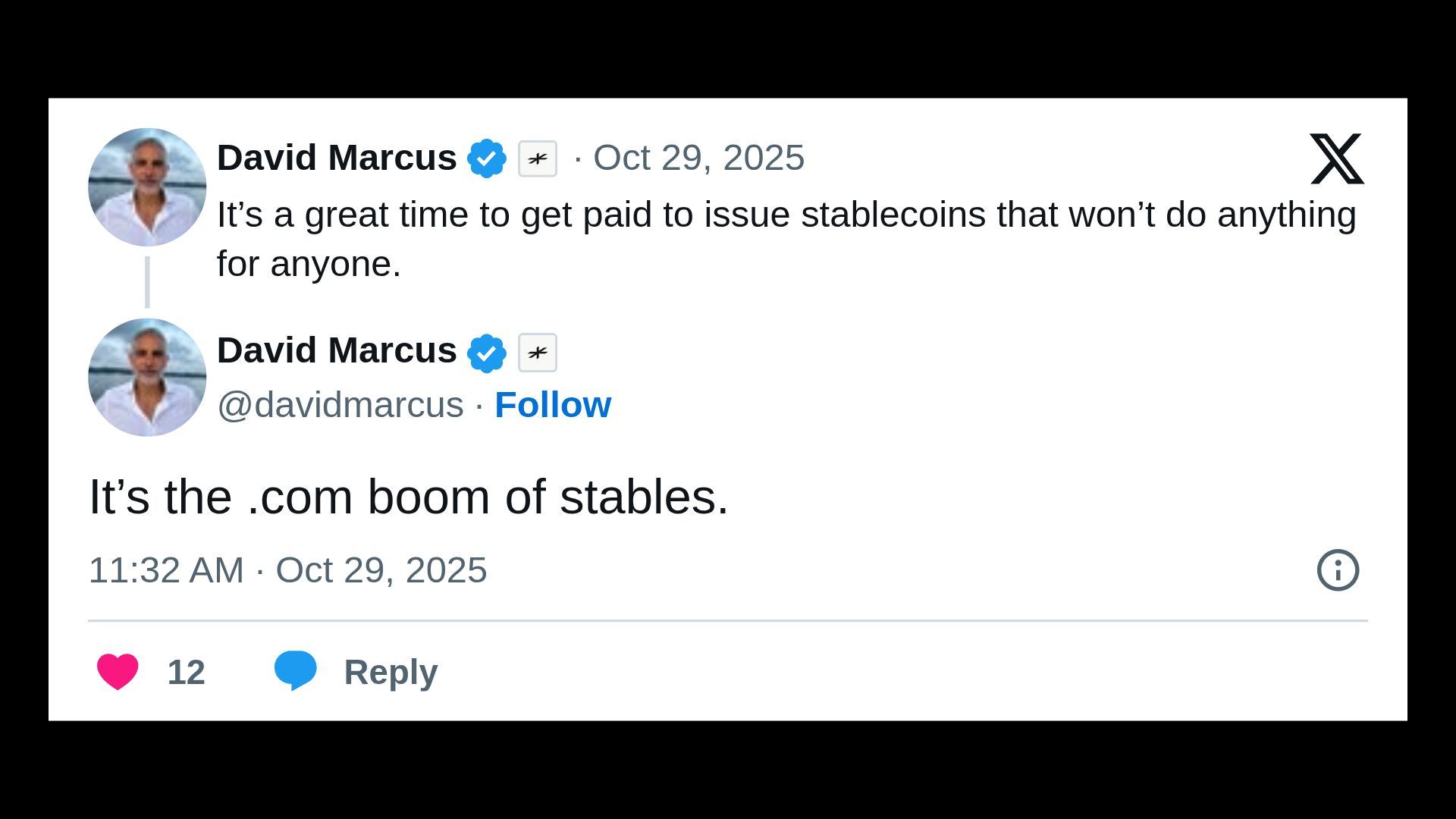
5. Culture hash: Stableshade
David Marcus runs Lightspark now, a payments company built on Bitcoin.
- Previously, he did high-level stints at PayPal and Meta (when it was still Facebook) and on the Coinbase board.
Fun fact: Lightspark has a way to send money that works just like email.
This newsletter was edited by Pete Gannon and copy edited by Carolyn DiPaolo.
Sign up for Axios Crypto