Axios Communicators

August 20, 2026

👋 Hi, communicators! I'm back in Austin and the kiddos are back in school — it's nice to fall back into some familiar routines.
This edition of Axios Communicators, edited by Christine Wang and copy edited by Jay Bennett, is 2,047 words, a 7.5-minute read.
1 big thing: The CEO shift on AI and layoffs
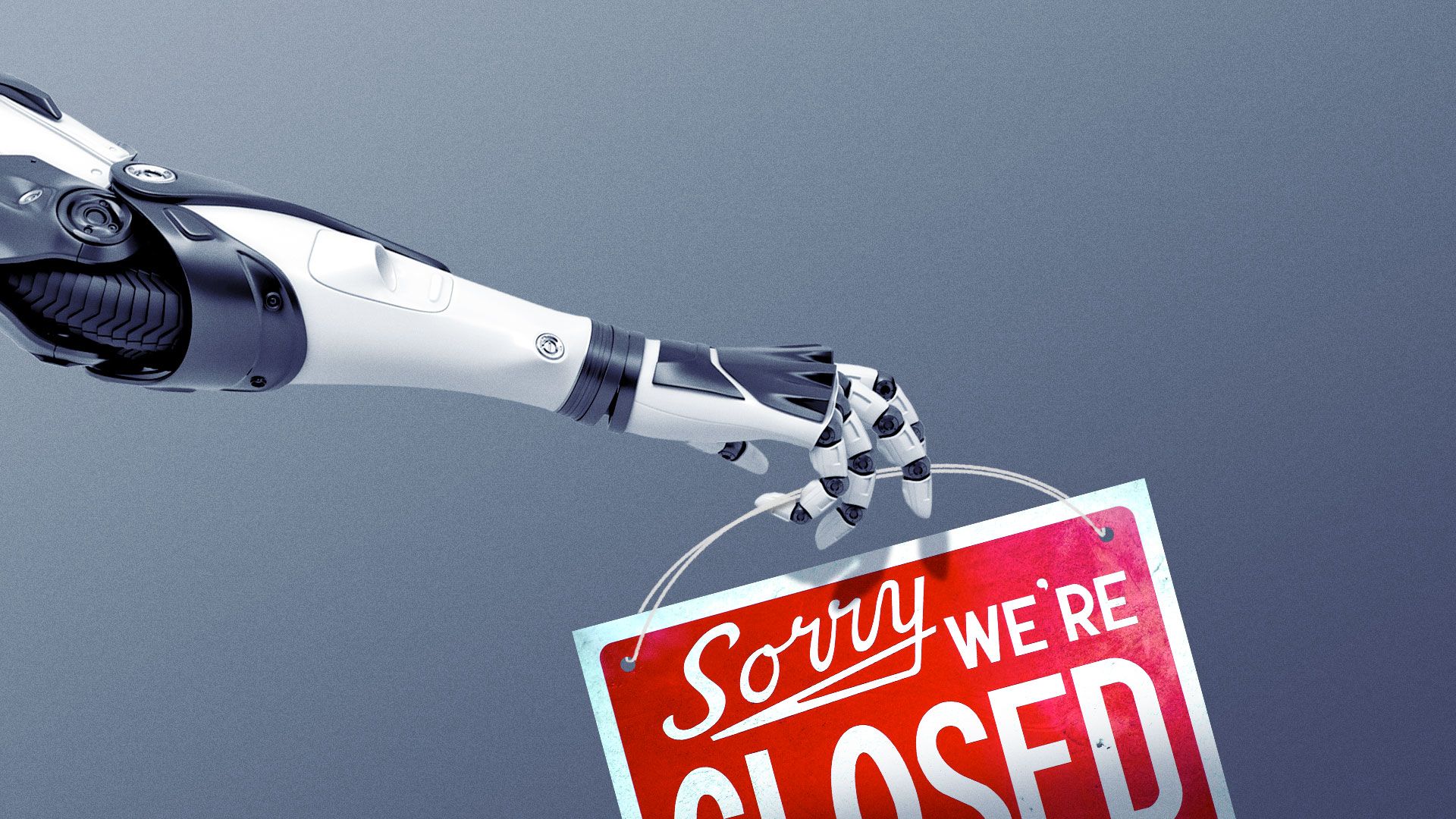
CEOs used to talk up AI progress and efficiency by the number of workers it could replace, but with economic worries climbing, they're being more careful about linking AI to job cuts.
Why it matters: Communicators face competing pressures: Investors want proof AI spending is paying off, while employees don't want to hear that leaders are considering replacing them.
The big picture: The way leaders talk about AI and job cuts has shifted from touting how much labor the technology can replace to more nuanced takes on AI's role in workforce transformation.
- In 2024, Klarna said its AI assistant was doing the work of 700 full-time agents. CEO Sebastian Siemiatkowski later boasted: "Not only can we do more with less, but we can do much more with less."
- Last year, Salesforce CEO Marc Benioff said AI helped reduce support headcount from 9,000 to about 5,000 "because I need less heads."
- In May, Coinbase cut about 700 jobs as CEO Brian Armstrong outlined plans to rebuild around smaller "AI-native" teams.
Between the lines: That rhetoric is increasingly risky as anxiety around AI and employment grows.
- 61% of adults in the U.S. believe AI will ultimately mean fewer economic opportunities for most people vs. 21% who expect more, according to an CBS News and YouGov poll of 2,287 people conducted Aug. 12-14.
- Among Americans under 30, 73% expect it to lead to fewer jobs over the next two decades, according to a Pew survey of 3,488 adults from June 22-28.
- This all contributes to how employees process and think about AI-related news at work, says Gartner senior director analyst Catherine Donnelly.
- "I can't think of a change in my career where the information about it is coming from so many different external sources," she says.
Driving the news: AI was the most commonly cited reason for U.S. job cuts in July, the fifth consecutive month, according to a report by Challenger, Gray & Christmas,
- This year, employers have attributed nearly 113,000 announced job cuts — about 24% of all announced cuts — to AI.
Zoom in: Leaders are now carefully wording their statements to distinguish between "AI is reshaping how we work" and "AI is replacing workers."
- Etsy CEO Kruti Patel Goyal said this month's 220 job cuts "weren't driven by AI" while acknowledging the technology is changing the skills and capabilities Etsy needs.
- Patreon CEO Jack Conte said its 20% reduction wasn't based on a belief AI could replace humans but acknowledged AI had "fundamentally transformed" how Patreon operates.
- Microsoft chief people officer Amy Coleman similarly said the 4,800 roles eliminated last month were "not being replaced by AI," adding that AI was changing how work gets done.
What we're hearing: Etsy landed on this framing intentionally.
- "We wanted to find a way to acknowledge those two truths — this is not a reduction because we're replacing people but also there are skills that are needed as AI becomes expected," an Etsy spokesperson says.
- "This moment is forcing leaders to be very specific and intentional with why they're doing what they're doing, if you don't want to be perceived as just one of the many."
What they're saying: In conversations with practitioners and other C-suite advisers, three lessons for communicators emerged:
- First, begin telling the story before the cuts. Leaders must be open about AI adoption, evolving roles and required skills long before announcing layoffs.
- Give employees the opportunity to adapt "before the email goes out... and before the press release hits the wire," says Kelsie Gwin, former Fortune 500 CEO chief of staff with 15 years of experience in tech comms.
- Second, don't turn layoffs into an AI victory lap. Combining the two messages can turn an ROI story for investors into something that feels callous to the rest of the company and turn off prospective employees.
- Being seen as a place that's "working hard to replace employees with software" can "taint a company with a really negative perception," said Andy Challenger, chief revenue officer at Challenger, Gray & Christmas.
- Third, tell one coherent story. Town hall messages leak and employees pay close attention to earnings calls. The rationale for reorganization must stay consistent across all audiences and align with workplace realities.
- "Employees can handle complexity. What they struggle with is a narrative that doesn't add up," notes Gartner's Donnelly.
The bottom line: The fundamentals of communicating layoffs haven't changed, but AI has made the risk of taking a reputational hit higher.
2. Reddit fades from ChatGPT citations

Reddit's share of ChatGPT citations has dropped in recent days, according to AI visibility platform Promptwatch.
Why it matters: Communicators trying to influence what AI says about their brands are finding that generative engine optimization is a rapidly moving target.
The big picture: Don't pin all of your GEO hopes on one "mythical unicorn," says Steve Rubel, executive vice president for media insights and measurement at Burson.
- "It doesn't exist," Rubel says. "It's a long game, and [brands] need to be engaged on many different channels. Some will go up, some will go down based on citations."
Catch up quick: Reddit accounted for an average 3.83% of ChatGPT Search citations from July 18 through Aug. 7, according to Promptwatch.
- By Aug. 14, it had fallen below 1%, averaging just 0.52% through Monday, an 86.4% drop.
- In Promptwatch's social platform comparison last September, Reddit was by far the most-cited network, at 3.2%, compared with runner-up LinkedIn at 0.3%.
Caveat: Promptwatch cautions that the data points to when the change happened, not why.
- "A shift in ChatGPT's source selection is the obvious candidate," Promptwatch co-founder and CTO Klaas Foppen wrote in a blog post. "But a data-collection issue cannot be ruled out, so treat the size of the drop as provisional while we keep monitoring."
- The drop isn't as steep for other AI platforms. Promptwatch found Reddit citations fell 11% in Google AI Overviews and 31% in Google AI Mode over the same period.
Flashback: Investors have reacted to this metric before.
- Reddit shares fell sharply last October amid concerns about declining user growth and Promptwatch data showing a steep drop in ChatGPT citations.
What they're saying: Reddit said the citation drop has "no meaningful impact" on its business because LLMs account for little of its traffic.
- "For communicators, Reddit's value is in the real conversations that people are having about your brand today, not where it surfaces tomorrow," said Adam Collins, Reddit's chief communications officer.
- "If you're a brand looking at Reddit merely as a way to hack your presence on an AI platform, you risk frustrating your consumers here with no guarantees of a positive result elsewhere."
Between the lines: There isn't one universal GEO playbook, and that's what makes this space rich for debate among marketers and communicators.
- Don't chase whichever source or tactic happens to be winning in GEO today, advises Rubel. Instead, build a durable, diversified information footprint across owned and earned media.
- "It's not just enough to say something. We need to make sure that there's really good information to back that up, whether that's yours or somebody else's," he says.
The bottom line: GEO might not be as formulaic as initially expected, requiring communicators to spread their efforts across multiple bases.
3. 🗞️ Reading list
🏗️ Data centers are a political liability. The Senate GOP campaign arm privately warned AI companies that opposition to data centers is jeopardizing the party's chances in Ohio, Axios' Alex Isenstadt reports.
- Simon's thought bubble: This tangle of policy, regulation and community engagement feels like a problem perfectly suited for the modern corporate affairs practice to have handled way earlier in the process.
Neutrogena is facing renewed ire from consumers after Hayden Panettiere's death resurfaced her account of how the skincare brand allegedly wanted to end their partnership when she publicly discussed her postpartum depression. (E! News)
- As of writing, Neutrogena had not publicly responded to news outlets, and its most recent Instagram posts were filled with critical comments.
🗣️ OpenAI has a CEO communications problem, argues former Square communications executive Aaron Zamost. Communicators can't build goodwill while their CEO reinforces audiences' concerns. (San Francisco Standard)
- Strategist Sam Ogborn raised a similar point with me last week. Commenting on Sam Altman's post about using AI to replace family interactions, she noted: "It starts with him. If that's his perspective on using and implementing AI, then if you're a comms manager, can you really get that far?"
🧱 Iran's propaganda is learning the language of the internet. Recent Lego-style videos are getting attention because they're borrowing the humor, pacing, memes and visual language of familiar online culture. (Irregular Warfare Initiative)
- Whether it's a Duolingo making anime-style videos or state propaganda, messages resonate when they feel native to the culture of the target audience.
4. Communicators spotlight: Marie Sheehy of WME Group

Marie Sheehy has helped steer communications for WME, one of Hollywood's biggest talent agencies, through mergers, acquisitions and a major take-private.
Why it matters: Sheehy's recent promotion after more than two decades with the agency highlights her multifaceted comms skillset, which she describes as "part strategist, part diplomat, part therapist."
- As the new executive vice president and head of corporate communications for the agency, she oversees internal and external communications for WME, IMG Licensing and Pantheon Media Group.
🏃♀️ The path here: She has grown alongside WME as the company expanded into a diversified global operation.
- "On a parallel path, I've experienced the transformation of communications and now my role now is much more multi-dimensional, as the methods for communicating have expanded," Sheehy said.
Zoom in: What's on her to-do list depends on "what's happening, who's asking and what's at stake."
- "It could be managing a significant business transaction, advising a filmmaker client on the rollout of their next film, providing crisis comms support or amplifying the work we do in our community — no day is ever the same," she said.
🫣 Tough lesson: Know when you're dealing with a communications problem vs. a business problem.
- "No matter how carefully a narrative is shaped, sometimes there's only so much we can do to control an outcome," Sheehy said.
🔎 Trendspotting: AI can make communicators more efficient, but "we cannot lose the art of emotional intelligence," she said.
- "WME has been around since 1898. Relationships are fundamental to our business and the ability to sit across from someone, understand their motivations, and ultimately persuade them, are skills that will never be obsolete."
📱 Morning ritual: "The first thing I do is reach for my phone to identify any fires that need to be put out," she said.
- "For better or worse, this sets the tone for the day."
💡 Best advice: Sometimes the best response is silence.
- "With all of the pressure of forward motion and rapid response times, sometimes doing nothing carefully is the best advice until there is further clarity," Sheehy said.
📚 Currently consuming: Part of the job is keeping up with client projects, including "The Odyssey," "Beef" season two, "Widow's Bay," "Diary of a CEO" and "Theo of Golden."
5. ICYMI: Cyclospora comms case study
Mixing Board, powered by Axios, members received my first comms deep dive in their inbox on Monday.
Zoom in: Shortly after I took over Communicators, the cyclospora outbreak headlines took over our social feeds along with memes and misinformation.
- Every other day, a new development upended our understanding of what was happening.
- Wash your produce! Don't, it's pointless! Berries are dangerous! No, they're safe! Taylor Farms is responsible! Wait, I heard it's a false positive?
For the case study, I interviewed health and crisis comms experts as well as some of the players involved and implicated, including HHS, Taylor Farms and Sweetgreen.
- I also dove into social listening data tracking the shifts in the conversation, explaining why this outbreak exemplified the post-COVID breakdown in trust in public health communications.
MB/A members can read the full report here. Not a member? Apply to join and get access to this report as well as future member-exclusive analysis and reporting.
Thanks for reading!
Spot an interesting trend or story? Email or connect with me on LinkedIn.
For exclusive reporting, deep dives and events, apply to join Mixing Board, powered by Axios.
Sign up for Axios Communicators