Axios Communicators

January 08, 2026

👋🏻 Welcome back! It's only Jan. 8 and a lot of reputational drama has already unfolded online. We break it down in 1,935 words, 7.5 minutes.
- 🌉 Join Axios Live for an event Monday, Jan. 12, at 6pm PT alongside the J.P. Morgan Health Care Conference. I'll interview Johnson & Johnson EVP of global corporate affairs Vanessa Broadhurst and others. RSVP here.
Thanks to editor Christine Wang and copy editor Brad Bonhall!
1 big thing: DoorDash responds to AI hoax

A Reddit post by a user masquerading as a food delivery app developer drew millions of views and forced CEOs to go on the record, revealing how AI-generated misinformation is reshaping modern reputational crises.
Why it matters: AI-assisted mis- and disinformation are already fooling audiences and threatening corporate reputations.
Catch up quick: The now-deleted post, which claimed fraudulent business practices by an unnamed major food delivery app, received over 87,000 upvotes and generated roughly 5,000 comments on Reddit as well as more than 36 million views on X.
- DoorDash CEO Tony Xu said on X, "This is not DoorDash, and I would fire anyone who promoted or tolerated the kind of culture described in this Reddit post."
- The company's official X account also replied and shared a blog post explaining "How DoorDash is Different."
- Uber executive Andrew Macdonald posted, "I am responsible for UberEats. This post is definitively not about us. I suspect it is completely made up. Don't trust everything you read on the internet."
What they're saying: While DoorDash was not named as the delivery app in question, its CEO was the first to respond to the fake post — and the company stands by this decision, says chief corporate affairs officer Elizabeth Jarvis-Shean.
- "What was represented is antithetical to how DoorDash operates.… If the conversation is about the industry or a platform like ours, we want to make sure that anybody who is engaging in that conversation and reading that information knows that it's not [about] us," she says.
The intrigue: The Reddit thread caught the attention of journalist and Platformer founder Casey Newton, who reached out to the whistleblower to learn more and verify the post.
- The whistleblower provided Newton with a fake, AI-generated image of an Uber Eats employee badge and fake internal documents.
- Newton was able to identify this as a hoax, but as he writes, "For most of my career up until this point, the document shared with me by the whistleblower would have seemed highly credible in large part because it would have taken so long to put together.… Today, though, the report can be generated within minutes, and the badge within seconds."
Between the lines: After learning that the post was AI-generated, Jarvis-Shean said that DoorDash still would've responded in the same way.
- "It doesn't matter if the fire was started by an accident or by an arsonist, if your house is burning, don't stand around arguing about the cause instead of grabbing a fire hose to douse the flames," she says.
- "You have to be able to respond quickly and tell your story to the millions of people who are reading the disinformation."
Zoom in: You also have to optimize that story for AI chatbots.
- To do that, DoorDash created a blog post to serve as the central source of truth for customers and journalists, and also for large language models.
The bottom line: These fake leaks, made more believable with AI, create huge reputational risks for companies and brands, especially as newsrooms shrink and voices on social media portray themselves as trusted sources of information.
2. Hilton goes on defense


Hilton Hotels started the year on defense after one of its franchisees was called out for canceling the reservations of Department of Homeland Security agents.
Why it matters: This fallout highlights the reputational risk of operating a franchise model and brings into question how much behavioral control a global brand actually has over its franchisees.
Catch up quick: On Monday, DHS posted a screenshot of an email exchange with Hampton Inn Lakeville, in a Minneapolis suburb, that showed that federal agents' reservations were canceled because of their "immigration work."
- MAGA media and influencers across social media descended, creating a media firestorm for the hotel chain.
- Hilton responded Monday evening, stating: "This hotel is independently owned and operated, and these actions were not reflective of Hilton values. We have been in direct contact with the hotel and they have apologized for the actions of their team, which was not in keeping with their policies.… Hilton's position is clear: Our properties are open to everyone and we do not tolerate any form of discrimination."
- Everpeak Hospitality, the independent owner of that specific hotel, also responded, saying the cancellation was "inconsistent with their policies."
Yes, but: Late Monday evening, a conservative journalist posing as a DHS agent tried to stay at the Minneapolis hotel and was denied.
- He recorded the entire exchange and posted it on social media. Hilton responded by "removing the hotel from its systems," per a statement posted on X.
Zoom in: According to PeakMetrics data shared with Axios, much of the online conversation about Hilton was driven by bot activity.
- Nearly 39% of posts came from automated accounts, well above the 20% baseline typically seen in large brand moments, per PeakMetrics.
- The bot-driven content also skewed largely negative (92%), with human-owned accounts mimicking that messaging.
Reality check: Customers, regulators and markets don't always distinguish between corporate-owned and franchise-owned properties.
- "I think the bigger question for these companies is how do you manage that? How do you integrate the franchisees into your communication strategy? At the very least, there must be a rigorous playbook on how you behave as a franchisee," Deirdre Latour, founder of Rebellis Communications, told Axios.
- Following the DHS' original post, share of Hilton dropped about 2% and has since fluctuated.
- Of note, most of Hilton's 9,000 properties are operated by franchisees.
What they're saying: Franchise models accelerate reputational risk and create more opportunities for exposure, says Paul Argenti, professor of corporate communications at Dartmouth's Tuck School of Business.
- "When a franchisee makes a local decision, especially one like related to politics or values, the reputational liability is going to flow upward, even though the economic control doesn't," he says. "And they can't assume the disclaimers about independent ownership are going to inoculate them."
- "It's not just damage control. They have to clearly articulate their values and how they govern franchisees, adherence to those values and what it's going to do to prevent a repeat of that," Argenti added.
3. 📚Reading list
Here are some stories that caught our attention over the winter break …
- 2026 is AI's "show me the money" year, with users seeking to understand when a technology is mature enough to deploy and how to integrate it into human-run organizations without burning money or credibility.
- 🧠 We found the same in our recent Axios-Gravity Research Communications Report. Go deeper
- 📰 The headline of the Google comms teams' dreams: "How Google Got Its Groove Back and Edged Ahead of OpenAI." (WSJ)
- ⚖️ Elon Musk's Grok chatbot continues to generate explicit images, revealing AI's legal ambiguities. (Axios)
- 🤖 Professionals and dabblers alike say Anthropic's AI coding agent, Claude Code, is best for coding and outperforms others. (Axios)
- 🔒 A year after the UnitedHealth CEO killing, spending on corporate security is up, with many bringing it in house. (WSJ)
- ❤️ Bonus: GM comms executive Brandee Barker wrote a smart post about the behind-the-scenes work of communicators. I encourage you all to read it. I think you'll feel seen. (LinkedIn)
4. Communicator spotlight: Catherine Newman of U.S. Soccer

As the chief marketing and communications officer of the U.S. Soccer Federation, Catherine Newman is responsible for helping the sport attract new fans in the region.
- Why it matters: The spotlight will be on soccer with the Men's World Cup this year, the Women's World Cup in 2027 and the Summer Olympics in Los Angeles in 2028.
🗣️What she's saying: "My role is to ignite national passion for the game but also to demonstrate that soccer is more than a sport [and] that it is a force for good," she told Axios.
⏪ Catch up quick: Newman has held marketing roles at the Financial Times, News Corp, Manchester United and WWE.
- She joined U.S. Soccer as chief marketing officer in 2024 and was named chief marketing and communications officer in January 2025.
- "I'm used to bringing the audience's 'why' into the organization and using it to inform everything else that we do, and that includes how we talk to them from our communications. It includes the imagery that we use, the products that we produce and the services that we provide."
🏗️ State of play: Newman oversees the teams responsible for external and corporate communications, integrated marketing, brand, creative, content and social media.
🔍 Zoom in: Ahead of the World Cup, Newman and her team have launched Soccer Forward, a legacy initiative aiming to make soccer the most accessible and impactful sport in America.
- "Effectively, it helps us to keep score of what matters, whether it be community benefits, health benefits, mental health benefits. It's an incredible important part of what we do," she says.
🤖 What to watch: Newman's team is experimenting with AI to determine how the tools can add value to marcomms work.
- "If you use AI and it enables you to reduce costs and be quicker, my question would be, are you better serving your audience? Because if not, what are you optimizing for? And I think that's part of the question that marketing and communications have got to ask."
5. 1 thing to watch
If 2025 was the year of the corporate storyteller, 2026 might be the year of the viral marketer.
State of play: Beast Industries, Sony Music and Kalshi are all hiring for "viral" marketing roles.
- That is to say, these companies are looking for marketers who can hack algorithms, generate engagement and get more views, fast.
- Grabbing attention might be fueled by bot-driven strategies, rage-baiting or court jester-like gimmicks.
By the numbers: Job postings for "viral marketing" or "viral social media" are up 75% since 2023, according to Indeed data shared with Axios.
What to watch: This could create even more tension between comms and marketing teams.
- As one seeks to map out thoughtful storytelling strategies through long-form corporate podcasts or blogs, the other could feel pressure to opt for the quick high of meme-ified virality.
6. 📸 1 picture to go
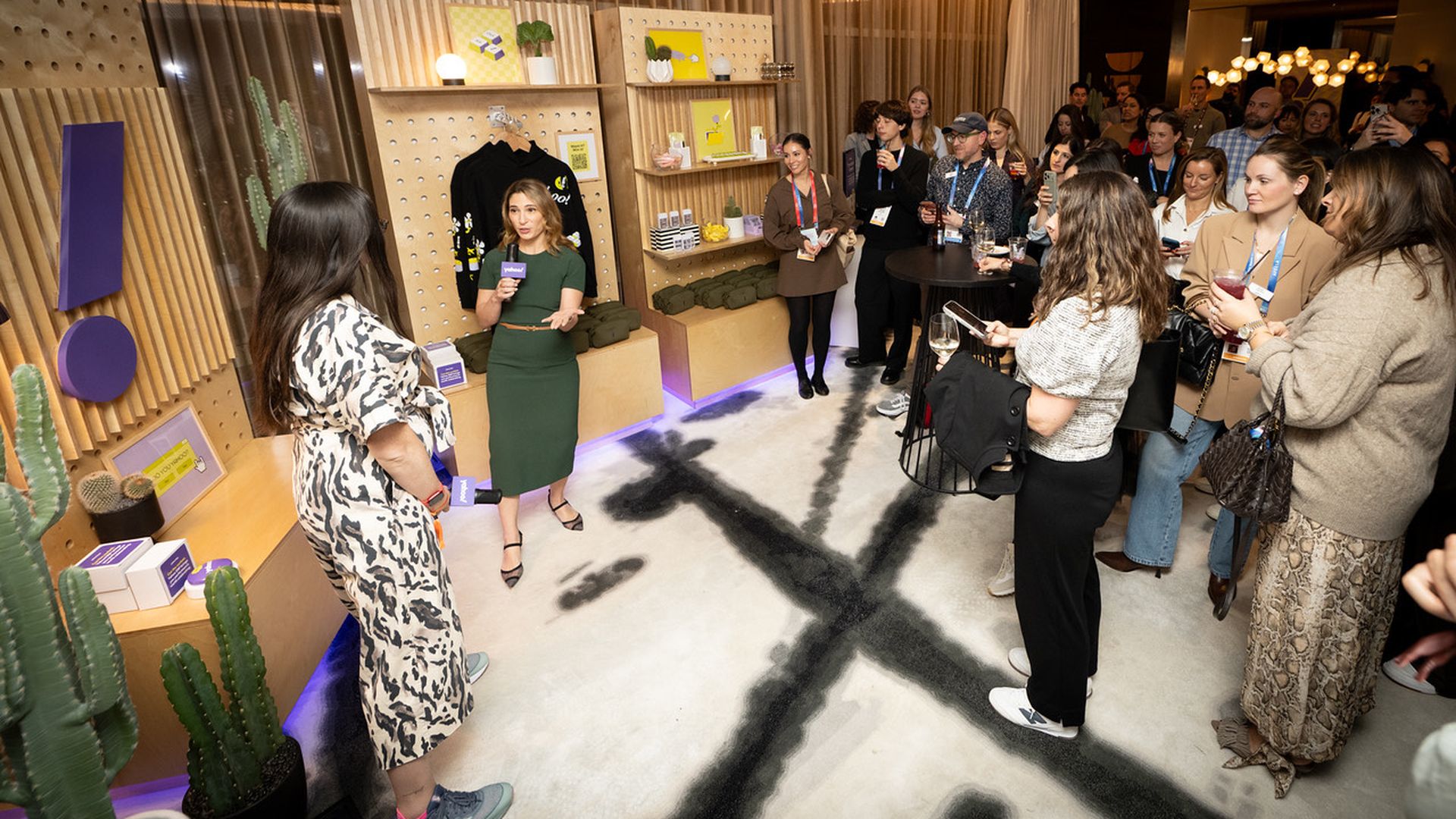
Axios partnered with the communications team at Yahoo to host a happy hour for comms folks attending CES.
- More than 80 of you showed up, representing companies including Samsung, Snap, Netflix, Roku, IBM, L'Oréal, NBCUniversal, Uber, Prosek Partners, Edelman, and Weber Shandwick.
Sadly, I was home with the flu, but here's what my colleague Axios media reporter Kerry Flynn heard during the party …
- CES is finally back post-COVID — and if you have news, it is still the place to announce it.
- Everyone is trying to tell an AI story, even if they don't have one.
- Figuring out GEO is a priority for communications teams right now, with many saying it's going to take both comms and marketing to truly capitalize on this new search channel.
What they're saying: "This year, communications will no longer be the function that simply explains the story — it will be the team that helps design it," Yahoo chief communications officer Sona Iliffe-Moon said.
- "I can see a future where comms will sit upstream of product, policy, and culture, shaping what gets built before it ever has to be communicated."
📧 Did you attend CES and have a comms takeaway to share? Email me.
🙏🏻 Thanks for reading! For exclusive reporting, deep dives and events, apply to join Mixing Board, powered by Axios.
Sign up for Axios Communicators