Axios Communicators

June 11, 2026

🙋♀️ Welcome back! Today's newsletter is led by M13 partner Christine Choi, who Eleanor often refers to as "the most interesting person in comms."
- Before joining M13, she led communications for Sir Richard Branson to launch Virgin Group's North American portfolio and was the first head of brand communications for Virgin Galactic.
- Today, she dives into how kindness is an advantage for leaders during times of crisis or organizational change, including an example from Virgin America.
Situational awareness: Kieran Mahoney, founder of top bipartisan strategy firm Mercury, is stepping back from day-to-day operations to become executive chair. The firm also elevated John Gallagher to CEO and named Michael Soliman president.
Plus, we have some exciting news on the future of this newsletter. Let's get into it.
This edition of Axios Communicators, edited by Christine Wang and copy edited by Kathie Bozanich, is 1,198 words, a 4.5-minute read.
1 big thing: The case for kindness

Many organizations treat hard moments — such as layoffs, acquisitions, leadership transitions or product shutdowns — as messaging problems. They're so much more.
- They're the moments when people decide whether your values are real or well-written. And messaging alone doesn't earn trust.
Why it matters: You can crank out as much content as possible, but people will trust the leaders and organizations whose behavior matches their claims.
- The instinct to manage a hard moment — contain it, control it, get ahead of it — is understandable. It is also the instinct most likely to cost you the trust you were trying to protect if it is not built in sequence.
- Who do you go to first? Do you protect the institution, or the humans inside it? What reality are you willing to feel before managing perception?
The big picture: Kindness is treated like a personality trait or a soft skill. Kindness can't be operationalized: people feel performance immediately.
- Effective leaders can create conditions for kindness by designing for dignity, honor and truth, and creating presence.
Three ways this can be applied:
1) Honor endings. In life, loss without ritual leaves something unfinished for the people who remain.
- Grief lives in organizations too when something meaningful ends, such as a team, product or company.
- We often rush to fill the gap with information, but we must also make room for meaning and acknowledgment. What we built here matters, as do the people who built it.
2) Prepare leaders for presence, not protection. The CEO quoted in prepared remarks produces content. The CEO in the room during the difficult conversation earns trust.
- Kindness in leadership is showing up when it would be easier not to.
- Our job is not to shield leaders from reality. It is to help them stay close enough to it so that people believe them when it matters.
3) Match the medium to the moment. In deeply human moments, low-human-touch communication can erode the very credibility leaders are trying to build. An AI-generated video, mass email or scripted call can contradict the message before it is even received.
Yes but: Kindness can feel inefficient during a crisis. It isn't. Rebuilding trust starts with the human step first, like showing up.
- Slow is smooth and smooth is fast. First things first. What does this moment deserve? It's almost never the press release.
The bottom line: Kindness is not soft. Organizations that demonstrate it, especially under pressure, earn trust that holds when everything else is uncertain.
2. 📝 Saying thanks
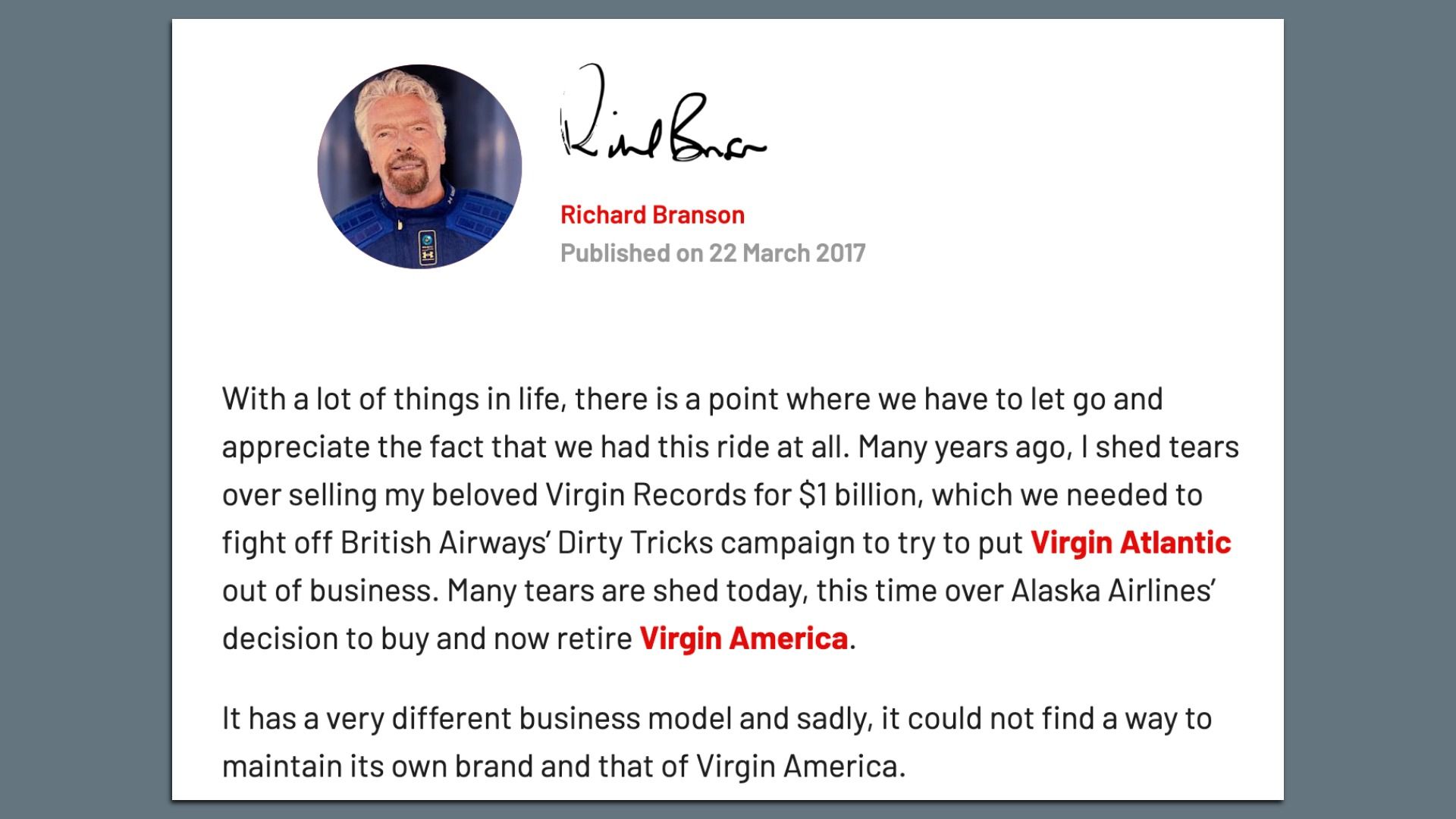
When Alaska Airlines acquired Virgin America, I was devastated. A colleague who designed Virgin America's award-winning experience and had every reason to be more upset than I was said, "They can buy the planes. They can't buy what the planes proved."
- Acquisitions often focus on assets, customers and integration plans. Employees think about something else: Did the years I invested here matter?
That insight inspired a public farewell letter to Virgin America by Branson that thanked the employees and customers who built an airline that, yes, won awards annually but was also beloved, talked about and changed the industry.
- People don't just need information during a transition. The letter didn't change the outcome; it changed how people understood it.
The bottom line: Endings deserve recognition. They deserve meaning. What we built here matters. The people who built it matter too.
3. 🎉 Our next author

Simon Hernandez-Arthur will be the next author of Axios Communicators.
- "I'm thrilled to join Axios and author this vital newsletter for comms leaders and practitioners," he said. "This profession is helping steer companies, nonprofits and other major institutions through turbulent times, and I look forward to covering it all: from audacious wins to lessons learned when things go wrong."
Catch up quick: Simon joins Axios after nearly six years leading internal content strategy at PayPal. He previously handled media relations at The Nature Conservancy and Oxfam.
- Before communications, Simon worked in journalism — spending over five years at CNN as a newsroom assignment editor.
- A graduate of George Washington University, Simon resides in Austin, Texas.
What he's saying: "Right now, the easiest thing to do is turn to AI for immediate advice," he said. "Instead, I'd rather grow this community of seasoned pros who can share and debate strategies pressure-tested in real life."
- "Your voice will be essential in strengthening Communicators, and I'm eager to hear from you and earn your trust and continued readership."
- "I'm deeply grateful to the team at Axios for this incredible opportunity and to Eleanor Hawkins for building Communicators from the ground up. I can't wait to get started."
What's next: Simon's first day will be on the ground at Axios House for Cannes Lions on June 22.
- Details on our events and programming are here.
4. 📚 Reading list
🤖 Artificial intelligence may be masking low literacy rates among working Americans, Axios' Russell Contreras writes. AI tools allow workers to complete tasks they may not fully understand, which can hide deeper skill gaps until they are asked to make judgments, solve problems or evaluate AI-generated answers. (Axios)
🏛️ New York is welcoming AI regulations, with a law requiring ads to disclose the use of "synthetic performers" taking effect Tuesday. Another bipartisan bill has been sent to Gov. Kathy Hochul that would mandate news outlets disclose when content has been "substantially or wholly generated" by AI. (amNY)
🧑💻 LinkedIn creators are inking lucrative deals as more celebrities, athletes and other influencers outside the typical corporate realm engage in thought leadership on the platform. But posts that lean into the "bro-etry" or "LinkedIn-ese" risk coming off as insincere or cringe. (New York Times)
🚀 SpaceX is upending the typical IPO process, with a "take-it-or-leave-it price of $135" a share following a shortened roadshow. Elon Musk's space company also reportedly stopped taking orders a day early to map out allocations as it targets distributing 30% to retail investors. (CNBC)
👀 Hunter Biden is staging one of the most unlikely reinventions in politics, attempting to charm and disarm the internet trolls who feasted on the darkest moments of his life, Axios' Zachary Basu writes. (Axios)
- Now seven years sober, Biden has re-emerged with a raw, self-deprecating candor that is drawing grudging respect — and even empathy — from some of his former tormentors.
5. 🤖 Quote to go
We recently submitted a confidential S-1. We expect it to leak so we're just announcing it.— OpenAI in its announcement that it had filed draft IPO paperwork.
Sign up for Axios Communicators