Axios Communicators

July 24, 2025

🎉 Today marks the three-year anniversary of Axios Communicators. Thanks for welcoming us into your inbox each week.
- 📌 Mark your calendar: Axios' inaugural Media Trends Live event will take place in NYC on Sept. 18, featuring ESPN chairman Jimmy Pitaro, Paramount Global chair Shari Redstone, Snap CEO Evan Spiegel and more. Find event info and purchase your ticket here.
Today's newsletter, edited by Christine Wang and Kathie Bozanich, is 1,495 words, a 5.5-minute read.
1 big thing: What's informing the bots
News stories or content generated by external sources like journalists, influencers, customers or the general public are the top sources for AI bots like ChatGPT, Claude and Gemini, a new Muck Rack report finds.
Why it matters: AI is increasingly being used for search, and how a brand, company or public figure shows up in AI-generated responses could affect its ability to attract customers, investors and talent.
By the numbers: 96% of links cited by AI sit squarely within the purview of communications and corporate affairs, per the report.
- 37% of inquiries cite external corporate blogs or content (those not owned by the company or product targeted in the query) and 27% cite news stories produced by journalistic entities.
- 9% cite owned content and government or NGO websites, 7% cite aggregators and 6% cite academic research.
- Social media and marketing content each make up 2% of the results, while press releases 1%.
Between the lines: A key difference between AI-generated search results and traditional SEO is that paid marketing and sponsored links rarely populate.
- "Based on the data, we can see that the models are pretty clearly avoiding marketing materials," says Matt Dzugan, senior director of data at Muck Rack. "Essentially, the models are trying to earn the trust of [its] audience and don't want to regurgitate salesy materials."
- Instead of paid marketing, owned content like thought leadership, fact sheets or corporate blogs "seem to be the sweet spot for getting your content cited by these models," he added.
Zoom in: Fact-based queries and prompts are more likely to cite news outlets in the responses, the report found.
- The outlets most cited include Reuters, Financial Times, Time, Axios, Forbes and Associated Press.
- Of note, most of these outlets have publisher partnerships with OpenAI, however, many are cited regularly across the other LLMs too.
Yes, but: New media, like Substack newsletters and podcasts, are also showing up but in more indirect ways.
- As of now, this content is populating through social citations. For example, if "the podcast is on YouTube, and then YouTube generates a transcription file, then Google, in particular, will cite it," says Dzugan.
- "If you're a PR person evaluating which podcasts to go on, it's important to know that if you go on one that's also publishes on YouTube, you have a better shot at influencing Google Gemini than you would with an [audio only] podcast," Muck Rack CEO Gregory Galant said.
- LinkedIn, Reddit and Glassdoor — or other such places in which user-generated content and reviews can be found — can also influence an LLM's response, he added.
The intrigue: To handle this new reality, Muck Rack will launch Generative Pulse, a tool that monitors how brands are represented in generative AI platforms, says Galant.
What they're saying: "In this new GEO [generative engine optimization] world, recent content or news stories are what's driving the answers," says Galant.
- "Journalism and [third-party] articles really affect the outcome, and that impacts the work of the PR function much more than marketing."
Disclosure: Axios and OpenAI have a licensing and technology agreement that allows OpenAI to access part of Axios' story archives while helping fund the launch of Axios into four local cities and providing some AI tools. Axios has editorial independence.
Keep reading ... story continues below.
2. Zoom in: The prompt matters

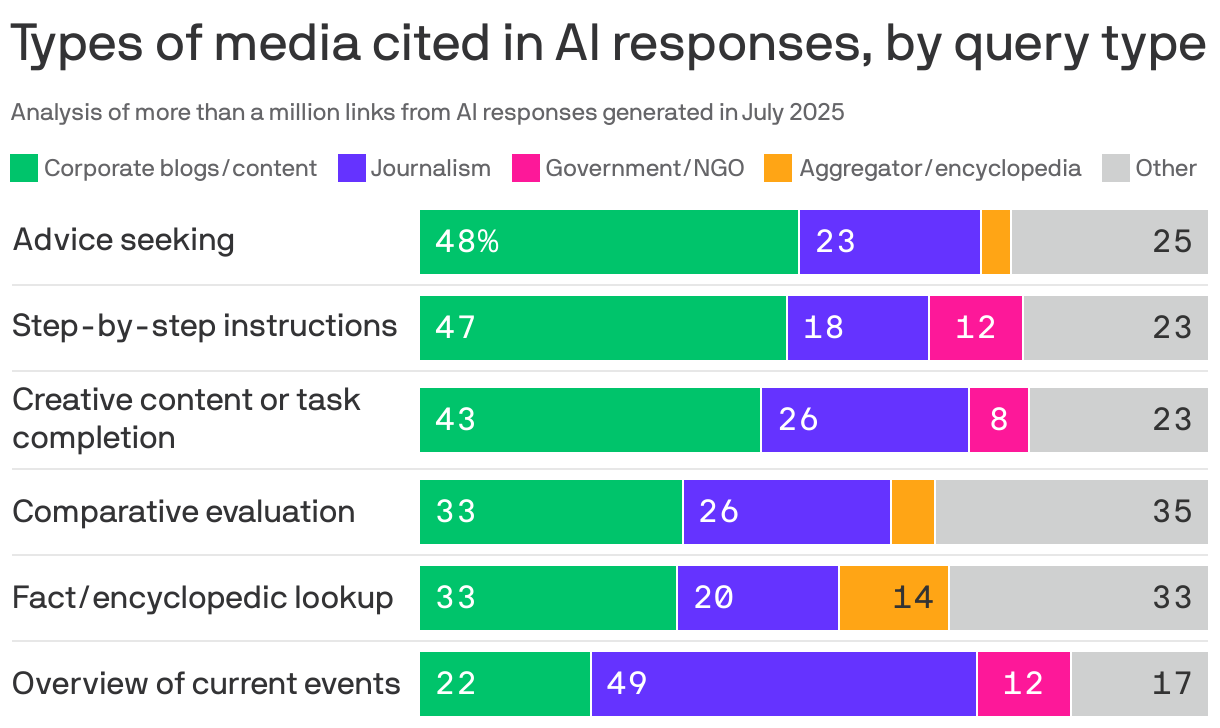
Citations can change based on how the query is asked and each LLM has its own habits when responding, says Dzugan.
How it works: Muck Rack input more than 1 million realistic user prompts into Chat GPT, Gemini and Claude and analyzed the citations.
- Questions were framed as seeking advice or opinion, fact searching, current event updates, comparative analysis, instructions or brainstorming and creative content or task completion.
Zoom in: Objective queries — those searching for recent updates or facts — cite news sources 49% of the time, per the report.
- However, the report found Claude uses media outlets the least and is more likely to pull from academic, federal and technical sources.
- ChatGPT is the heaviest user of news citations, pulling from mainstream publications like Reuters, AP, Financial Times, Time and Axios.
- And Gemini pulls from news sources but also regularly cites Wikipedia, Coursera, Quora and its own platforms like YouTube.
Between the lines: This means that communication teams should have a unique strategy for each model, says Galant.
3. Bonus chart: Industry breakdown


Niche websites, trade publications and web encyclopedias are also infiltrating AI-generated responses, the report finds.
Zoom in: Wikipedia is cited most across all industry-specific inquiries, according to the Muck Rack report.
- Scientific and medical databases are frequently cited in AI-generated responses relating to health care and education, while government sites are most likely to inform responses related to energy.
- Inquiries about government will see federal agencies cited in responses from Claude and Gemini, while ChatGPT incorporates news sources too.
The bottom line: These citations are not random, says Dzugan. "If you study it, you can find the patterns and identify [the] niche journalists, publications or even which Wikipedia pages to prioritize within your industry."
- "It's on the comms professionals to learn the patterns and then take action on them."
4. Kiss cam case study


Astronomer, a relatively unknown dataops startup, became one of the most talked-about companies of the summer after a video of its CEO, Andy Byron, and chief human resources officer, Kristin Cabot, embracing during a Coldplay concert went viral.
Why it matters: It's the type of scandal few communication teams would have a preexisting playbook for.
- Yes, but: They do now.
By the numbers: The video first spread on TikTok, racking up 125.8 million views.
- The saga was mentioned in roughly 850,000 posts on X, 13,000 Facebook posts, 6,000 times on Instagram, in 3,000 TikToks and 2,300 Reddit posts, according to data from PeakMetrics.
What they're saying: "This isn't the first time a CEO has done something stupid like this, but the stakes are so different given the speed and virality of the environment," said corporate communications consultant Paul Catherwood.
- "From a communicator's point of view, the incident points to the need for including the unimaginable and uncomfortable in your crisis playbook."
- Plus, companies — even small, private ones — should have an "emergency, break glass" succession plan. This allows for an interim CEO to be named faster, enabling a company's timely response.
Keep reading ...
💡 To learn who Astronomer hired to manage this crisis and review this case study in its entirety — featuring readership data, public polling, a misinformation breakdown and more — become an Axios Communicators Pro member.
5. 💞 1 nice thing: PR firms unite for good
Communication professionals are leveraging their expertise to help raise awareness for businesses in need or those affected by natural disasters.
Driving the news: Following the recent wildfires in Los Angeles, several communication and PR firms united to form the LA Strong Comms Coalition to support small businesses that have been affected.
- The 40-member coalition is made up of freelancers, boutique agencies like JSA+Partners, Karsha Chang Public Relations and Hustle & Co, and big firms like Zeno Group and Weber Shandwick.
Zoom in: LASCC has secured over 30 media stories for its pro bono clients in the past six months, helping businesses recover.
- For example, This Girl Walks Into A Bar secured a feature on the "Today" show in May, and within 20 minutes of airing, sales driven by the story paid for two months of warehouse fees, says owner Jordan Catapano.
- A local TV segment led to a significant uptick in online sales and in-store foot traffic for PlayLab Beauty, which lost its office and inventory of Korean and Japanese beauty supplies in the Eaton Fire.
Zoom out: Many community PR chapters provide pro bono support to charities or nonprofits in their regions.
- For example, every two years, Washington Women in Public Relations picks a nonprofit organization to provide with free communications and PR support.
- This year, it partnered with Running Start, a nonpartisan organization for young women running for political office.
What they're saying: "As a society, the news cycle moves quickly but many small businesses are left with nothing and need to pick up the pieces after the cameras leave," Jennifer Stephens Acree, founder and CEO JSA+Partners, told Axios.
- "We saw this with the LA fires and it will likely be the same for the victims in the terrible Texas floods. But with sustained media relations, PR professionals can continue to highlight how resilient business owners are rebuilding."
6. 💭 1 quote to go
"Reputation is earned in drops and lost in buckets."— Sally Susman, Pfizer chief corporate affairs officer and author of Breaking Through
Thanks for reading. Want more communicators content? Become an Axios Communicators Pro member
Sign up for Axios Communicators