Axios Communicators

August 14, 2025

1 big thing: CEOs attempt to reset workplace culture

2. Intel CEO appears to win over Trump

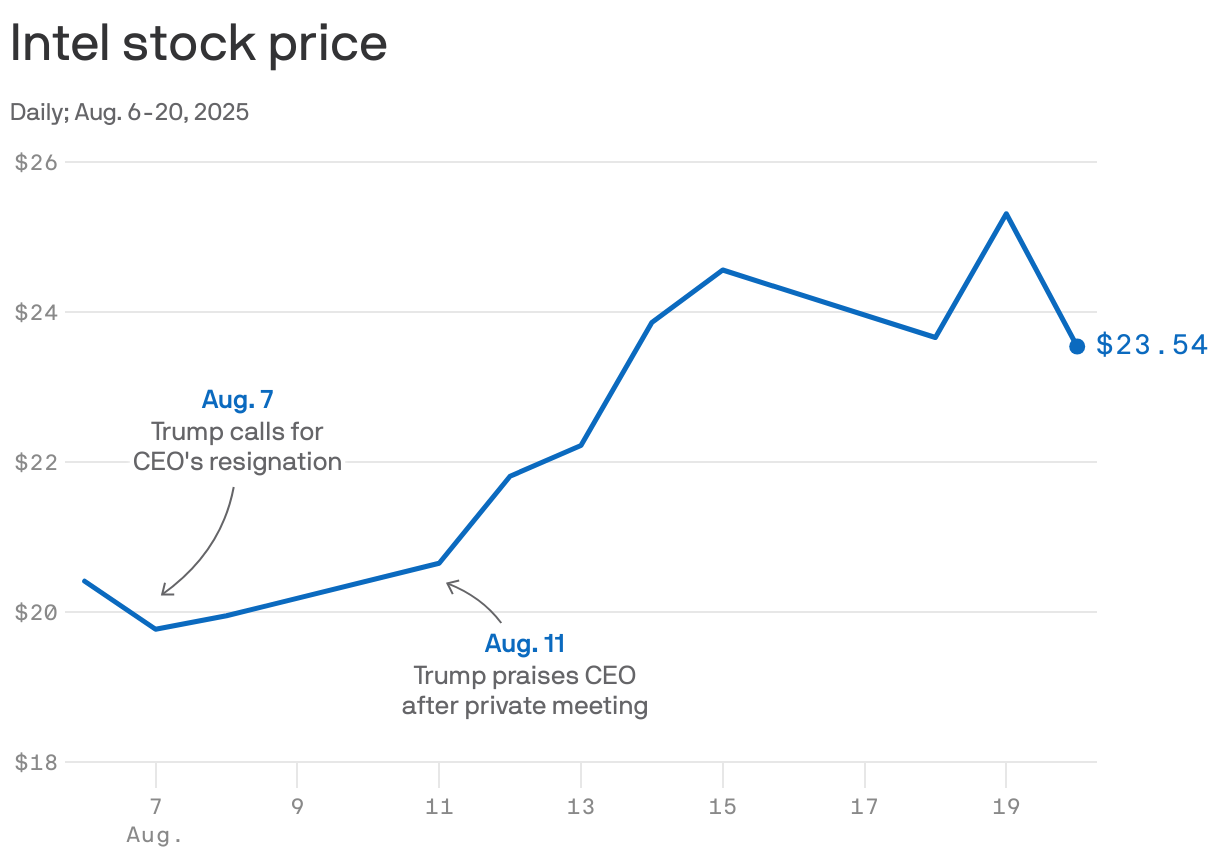
Just four days after demanding Intel CEO Lip-Bu Tan resign, President Trump has described a meeting with Tan as "a very interesting one."
Why it matters: The president's resignation call over Tan's alleged Chinese ties had threatened to waylay the chip maker's turnaround effort.
What they're saying: After a meeting Monday at the White House, Trump posted on Truth Social that Tan's "success and rise is an amazing story. Mr. Tan and my Cabinet members are going to spend time together, and bring suggestions to me during the next week."
The bottom line: By moving quickly to engage the White House and to endorse its priorities, Tan has taken a page from Apple CEO Tim Cook and other corporate chieftains on how to best navigate being caught in the Trump spotlight.
💭 Eleanor's thought bubble: As we've pointed out, every company and leader is just one Truth Social post away from being thrown into the political crosshairs. Tan modeled how CEOs can take control of the narrative.
Go deeper: Each month, Axios Communicator Pro members receive a case study ripped from the headlines. This month, we will go deep on the Trump crisis comms playbook. Become a member today!
3. Communicators embrace tools like AI and LinkedIn at rapid pace
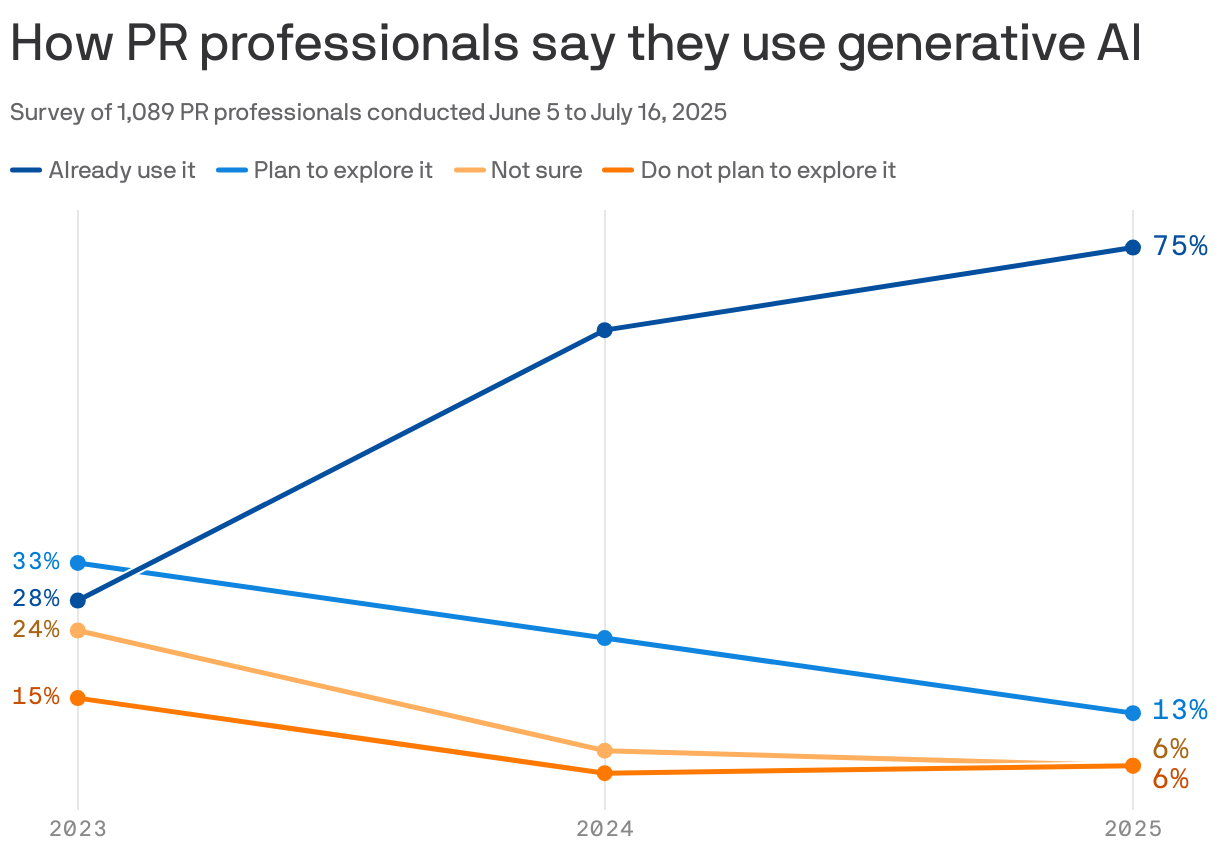
3 in 4 public relations professionals have incorporated AI into their work, up from 28% in 2023, per a Muck Rack report out today.
Why it matters: AI is supercharging the communications function, which has evolved from straight media relations to a more strategic advisory role.
By the numbers: Muck Rack surveyed 1,089 PR professionals between June 5 and July 16 and found that roughly 6 in 10 say AI will grow in importance over the next five years.
- Other future priorities for communications teams include media relations (35%), strategic planning (33%) and reputation management (29%) followed by influencer marketing and owned content (28%).
- Of note, only 4% cite DEI or ESG communications as a future priority.
State of play: Currently, 84% say media relations is the top job function, however, securing media placements has never been more difficult, per the survey.
- 72% cited low response rates from journalists as a key obstacle to securing media, while 62% pointed to shrinking newsrooms and 48% cited shorter news cycles.
As such, many are turning to owned platforms to generate interest or appeal directly to consumers, investors and employees.
- LinkedIn is the most valuable social platform for PR pros (56%) by a long shot, followed by Instagram (16%) and X (11%).
- Only 2% view TikTok as valuable, and only 1% say Reddit and YouTube is valuable for their PR efforts.
The intrigue: 39% of PR pros say they've stopped using X for professional purposes in the past year, making it the most frequently abandoned platform by a wide margin.
- However, rival platforms like Bluesky and Threads have not replaced it.
What to watch: As communicators rely more heavily on social media platforms, they must also re-evaluate how they are monitoring the conversation and measuring the impact of these efforts.
- A whopping 53% of PR pros say they don't use social listening tools.
4. Mentor spotlight: Jane Hynes of Google


In the three years I've spent covering communications, I've noticed a couple of things:
- This world is small. Everyone knows everyone in comms, and most roads seem to lead back to Outcast, Apple or Salesforce in Silicon Valley and Brunswick, GE or Burson among East Coasters. (Don't come for me! I'm sure there are others too — and if there are share them).
- Cultivating talent is rare. Executive recruiters tell me they are concerned that younger colleagues aren't gaining the skills needed to step into the top roles, and many comms leaders feel they don't have the bandwidth to mentor like they want to.
🥁 Which is why I'm excited to introduce a new feature highlighting communicators who have built a reputation for mentoring top talent.
Why it matters: The communications function is changing at a rapid pace, and those in the role are expected to serve as key advisers to the business.
- The guidance, experience and exposure that Jane Hynes — vice president of communications at Google Cloud — provides has prepared her mentees for this.
Catch up quick: Hynes started her career in agency, working for Hamilton Ink and Outcast. It was there that she worked with two of her future mentors, Outcast co-founders Caryn Marooney and Margit Wennmachers.
- "I had this experience of working for these powerhouse women, and it gave me the opportunity to see myself in leadership roles and to feel like I had a voice that mattered," Hynes told Axios. "And these are women that weren't afraid to make big decisions or tough calls and weren't afraid to be the only woman in the room. That was just very motivating for me."
- Hynes joined Salesforce in 2003, where she helped grow the comms function and supported the company through its IPO, quickly climbing the ranks to senior vice president, communications.
- In 2017, she joined Google Cloud, where she has scaled the team more than 10x.
Here are key ways Hynes builds talent, according to her mentees:
- Creates opportunities. "She's really good at giving people ownership of things that might feel slightly beyond their comfort zone, allowing them to rise to the occasion," says Cynthia Trejos, senior director of communications at Salesforce. "It's big to have that vote of confidence from a leader like her."
- Plus, "if you lead a project, she'll put you in front of the executives. It doesn't matter if it's [Google Cloud CEO] Thomas Kurian or [Alphabet CEO] Sundar Pichai or whoever else, if you're involved and you're leading, then you're a key part of driving the project forward," Trejos said.
- Doesn't gatekeep. Hynes has a reputation for sharing information and key stakeholder relationships.
- For example, "She would go into a meeting with [Salesforce CEO] Marc Benioff, who was very notorious for coming up with some new strategy or plan on a whim, and she would just write up detailed notes and blast it out to the team," says Ted Ladd, senior director of go-to-market communications at Google. "It was clear she thought it was important to share what she knew with her people."
- "She has an incredible way with transparency. She's the opposite of a gatekeeper and she keeps the ego out of it," says Allie Cefalo, marketing partner at Kleiner Perkins. "Which makes it so much easier to get to a solution quickly."
- Gives credit. Hynes defines her success by her team's success, says Trejos.
- "Part of that is giving people visibility, showcasing their wins and giving them credit publicly, which not every leader does."
- Hynes also credits her agency partners for wins, says Cefalo. "When an internal stakeholder would say, 'thanks for something' or 'how did this get placed?' Jane gave credit to the agency and made sure that the credit was passed back to the people who made it happen."
- Stays close. Once you're in her orbit, Hynes is intentional about maintaining the relationship, says Ladd.
What they're saying: "The only way to scale is to give people the opportunity to do good work. And if you're micromanaging them or trying to control how they are going to get it done, they're not going to be able to bring their full power to bear," Hynes says.
🧠 Best advice from Hynes: "When I left Google, she said, 'Don't forget that your people are your power, and to always take care of your people,'" Trejos said.
5. 🚩 1 quick flag
6. 💭 1 quote to go
Axios Communicators