Axios Communicators

February 27, 2025

1 big thing: Musk's reputation ripple effect


I've long wanted to write about the correlations between CEO and corporate reputations and market value, but I needed data to accompany the vibes.
- Look no further than Elon Musk and Tesla.
Driving the news: Investors are questioning whether Tesla's recently weakened stock and slipping sales are due to its CEO's political involvement and online presence.
Why it matters: A vocal CEO can cast a halo or dark cloud over the company they lead, impacting their ability to attract customers, employees and investors.
State of play: Musk's political activities have triggered a partisan divide regarding consumers' views of Tesla.
- Favorability of Tesla among Republicans hit an all-time high this month, while Democratic favorability dropped to an all-time low. This strongly suggests Musk's ties to President Trump are influencing consumer sentiment across party lines, per Morning Consult Intelligence data.
By the numbers: 49% of Americans hold negative views of Musk and 32% of U.S. buyers "would not consider" buying a Tesla, up from 27% a year ago, per Morning Consult.
- Repeat Tesla buyers in blue states dropped from 72% in 2023 to 65% in 2024, according to CNN.
- Meanwhile, Tesla sales are down 45% year over year in Europe and 15% year over year in China, per a recent Barron's report.
Reality check: Increased competition and macroeconomics could also be playing a part in the EV maker's tumbling sales numbers.
💭 Thought bubble from Axios' auto expert Joann Muller and energy reporter Ben Geman: Tesla has grown up and now faces the same trials as legacy automakers.
- What is unusual is bumper stickers on your customers' cars that say things like "Anti-Elon Tesla Club." One has to wonder what Musk is doing to protect Tesla's brand while he's busy attacking Washington's bureaucracy.
What they're saying: "I am completely convinced that the CEO's reputation goes along with the success of the company," says Paul Argenti, a communications professor at the Tuck School of Business at Dartmouth College. "A well-respected CEO allows you to have a stronger management team, a clear strategic vision for the organization and they significantly influence how the company is perceived. There's no question about that."
- "It's really important to understand just how critical that senior person is as the spokesperson for the organization, the person who is responsible for and associated with the strategy of the company, and the symbol for how the company is going to perform."
Yes, but: A company's brand equity shouldn't be solely tied to one individual executive, says Argenti.
- "You don't want the CEO to be the only source of brand equity for the company," he says. "That's a disaster, and we've seen that happen before with examples like Elon Musk, Steve Jobs or Martha Stewart."
- Tesla did not return Axios' request for comment.
The big picture: CEOs across industries have become more proactive communicators — whether by embracing community engagement across social channels, modernizing earnings reports or conducting more personal, nontraditional media interviews.
What to watch: All CEOs are tasked with sharing their company's transformation stories, ensuring confidence and providing stability during these uncertain times.
- The power of strategic communications could come into play for those individual CEOs leading corporate turnarounds — such as Brian Niccol at Starbucks, Kelly Ortberg at Boeing and Gil West at Hertz.
Case in point ... 👇🏻
2. Bonus chart: CEO stories that stick


News stories about CEOs saw a readership of more than 133 million in 2024, according to a new report by media monitoring platform Memo.
State of play: Stories about CEO compensation saw high readership, particularly in cases in which executive pay sharply contrasted with company performance, according to the report.
- Boeing's CEO pay amid the company's safety crises and Tesla's board revisiting Musk's massive compensation package were among the most widely read.
- Of note, the fatal shooting of UnitedHealthcare CEO Brian Thompson generated 75% of the topic's total readership in December.
Zoom in: Musk has generated endless press coverage and social media attention as the owner of X and leader of DOGE.
- More than 300,000 media stories have been written about Musk and his DOGE activities since Jan. 1, according to Muck Rack data.
- Also since the start of the year, stories mentioning Musk and DOGE have had a readership of more than 387 million, with most of the spikes around legal proceedings and budget cut recommendations, per Memo data shared with Axios.
What to watch: Stories about AI's impact on business strategy, automation and job displacement received particularly high readership, which is likely to continue as more businesses incorporate AI into workflows.
Go deeper ... Read Memo's State of the Media report.
3. 📚 Reading list
4. Where companies are posting
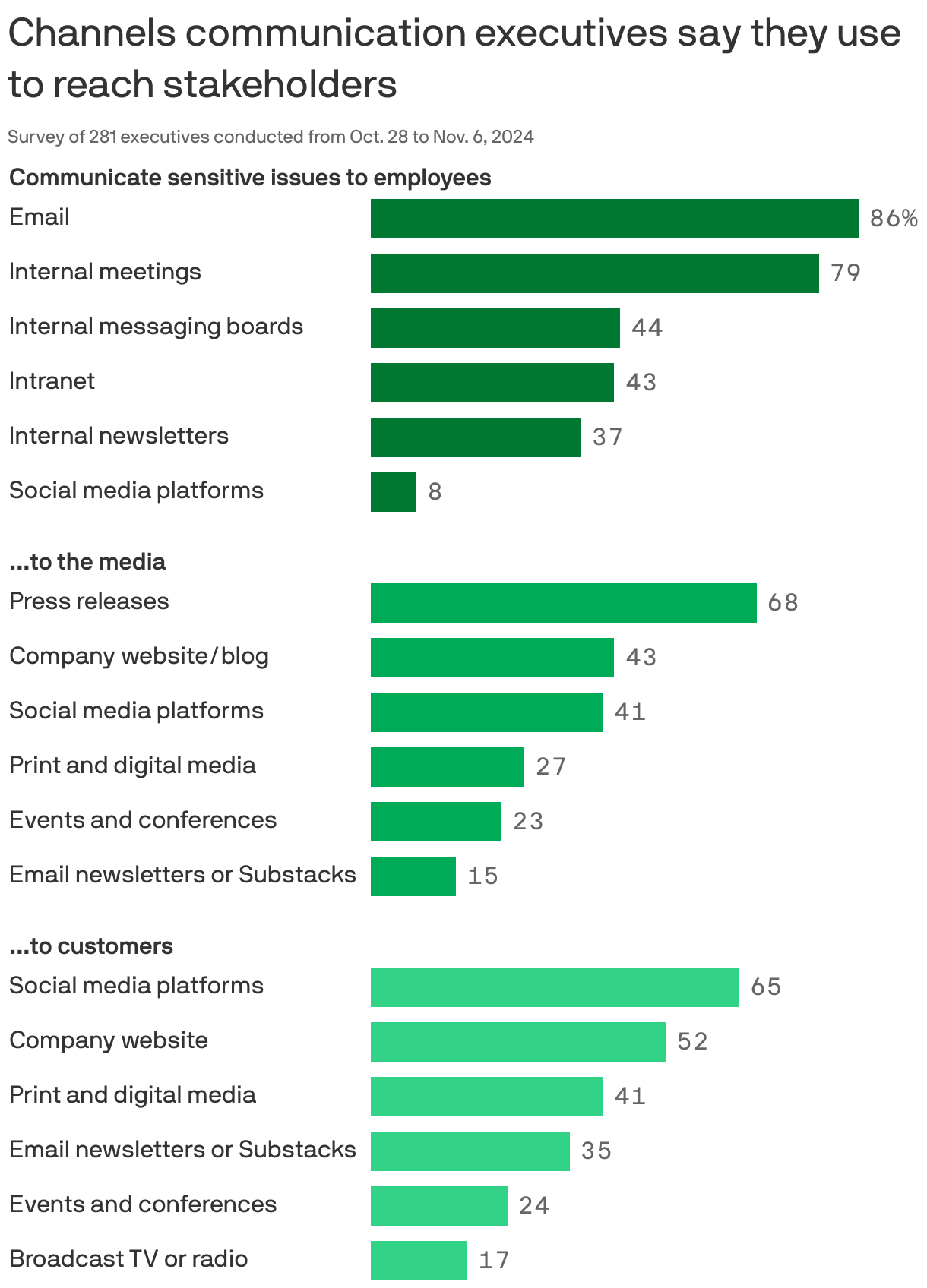
As social media platforms deprioritize news and links and begin to look more like ideological neighborhoods than town squares, corporate communicators are rethinking how they use the platforms.
Why it matters: Audience fragmentation is a major challenge for modern communication teams.
State of play: Based on an analysis by reputational risk management platform The Know, Fortune 500 companies are pivoting away from sharing corporate statements on X.
- Corporations post to LinkedIn 2.7 times more frequently than X, while 28% of organizations post statements to a corporate blog.
Yes, but: Social media remains a powerful communication lever for reaching consumers and the media.
- 94% of those surveyed use LinkedIn for external communications, followed by Instagram (47%), X (36%) and Facebook (24%).
- Email, all-staff meetings and intranets remain the most-used channels for communicating with employees.


Throughout 2024, those surveyed experimented with more social and video content, as well as message personalization— which they expect to continue.
- Of note, these companies engage only minimally on platforms that are most popular with younger generations — including YouTube (19%), TikTok (10%) and Reddit (1%).
What to watch: Audience fragmentation is likely to continue as newsrooms shrink, social media sites fluctuate, and personal news and information bubbles begin to form with Substacks, podcasts and algorithmic social media feeds.
Go deeper ... To see the full report, become and Axios Communicators Pro member.
5. Communicator spotlight: Kim Chappell of Bobbie
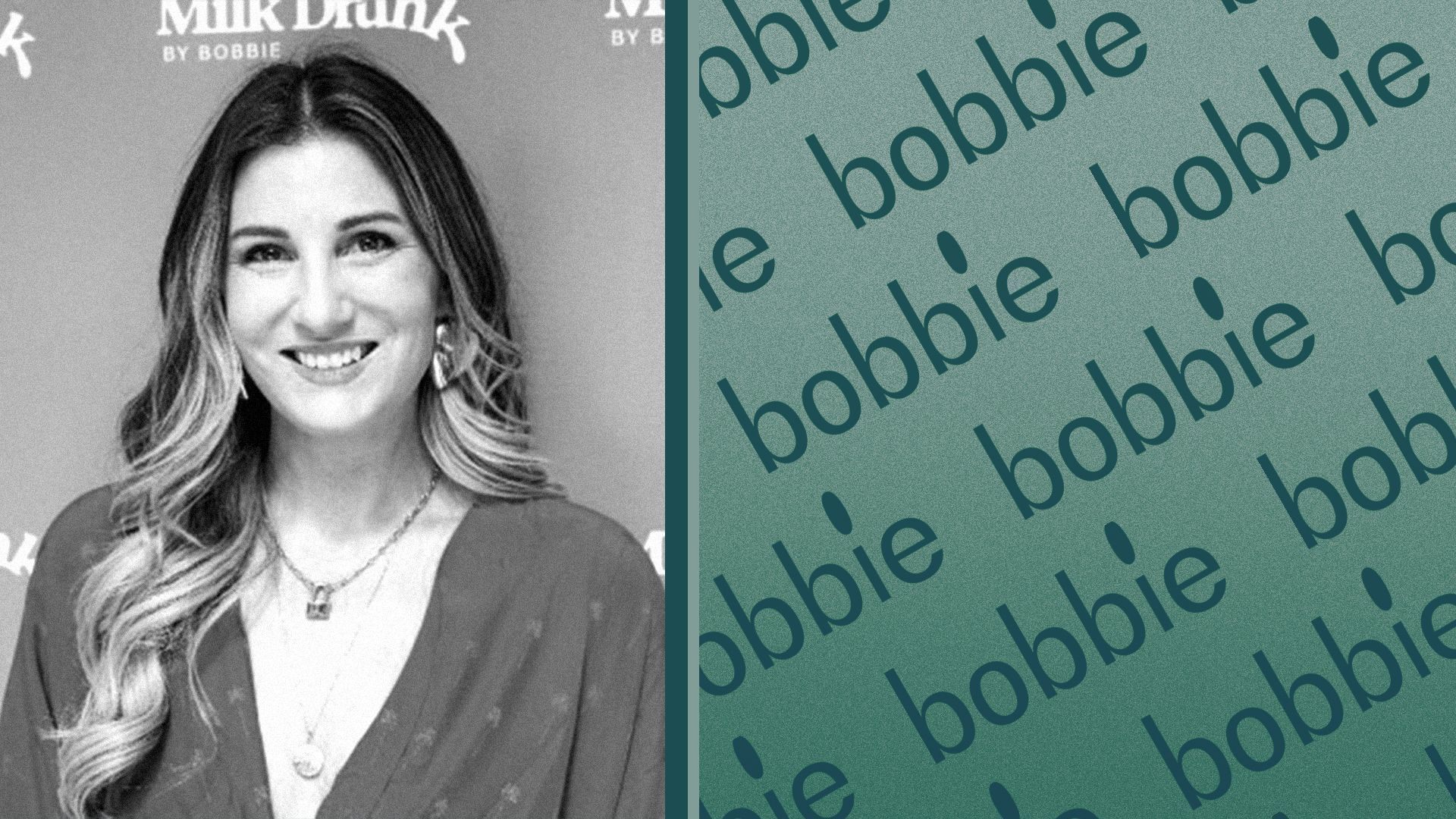
As chief brand officer of Bobbie, it's Kim Chappell's responsibility to help people understand the purpose of the organic baby formula company.
- Why it matters: The female-founded Bobbie has surpassed $100 million in revenue and disrupted its industry.
🗣️ What she's saying: Chappell and her team take a more aggressive approach to communications, she says.
- "An absence of comms allows the conspiracy theories to swirl, it allows people to create the narrative, or it looks like you're avoiding something, and I just think it's always best to get out in front of it," Chappell said.
- "For example, during the 2022 infant formula shortage crisis, Laura [Modi] was the only CEO of an infant formula company to talk to media during that crisis. She's also the only mom-founder in this industry in the U.S. and she continues to speak to that crisis in a way that I don't think anybody else in our industry can."
🔍 Zoom in: Bobbie recently partnered with professional tennis player Naomi Osaka for a campaign around paid parental leave and worked with singer Meghan Trainor to address postpartum mental health.
📍How she got here: Chappell worked in local news for more than a decade before pivoting into communications and marketing.
- She led communications at Weebly, which was acquired by Square in 2018. She then joined Square's product and brand team before taking a role at Bobbie in 2020.
- Chappell found out she was pregnant with her third baby two days after Bobbie's first product was launched in January of 2021: "It was really awesome because I was the customer. I was living and breathing the experience of going back to work, turning to formula and subscribing to the product."
🏗️ How it's structured: Chappell reports to Modi and oversees the team responsible for creative content, impact and nonprofit work, communications and publicity, marketing, social media, and partnerships.
- "I lean into my background as a reporter and run the team a little bit like a newsroom," she says. "What is the story that we need to be ahead of? How are we turning out content every day? How are we getting to the emotion and making sure that we're telling the stories of our customers in the way that no one else in our industry is doing?"
📈 Trend watch: She's paying close attention to the evolution of search and how it might change how brands are discovered.
🧠 Best career advice: Remember that no one is great at everything.
- "There are a lot of smoke and mirrors, egos and pomp and circumstance around the marketing industry — and what I've realized is no one is actually that great at everything, and that's OK."
- "We have to go into these roles with a bit of humility, lean into our strengths, learn everything we can and hire great people who can round out our expertise."
6. 🎬 1 Hollywood thing to go

Axios Communicators