
Axios Communicators

December 04, 2025

đź—˝Greetings from NYC! We are about to kick off Axios Communicators Live, so this newsletter is on the lighter side given tonight's big event.
- 🗂️ Reminder: Monthly Moves hits inboxes tomorrow. Share your job moves here.
This is 1,755 words, a 6.5-minute read edited by Christine Wang and copy edited by Kathie Bozanich.
1 big thing: Social media users flee X, flock to TikTok and Reddit
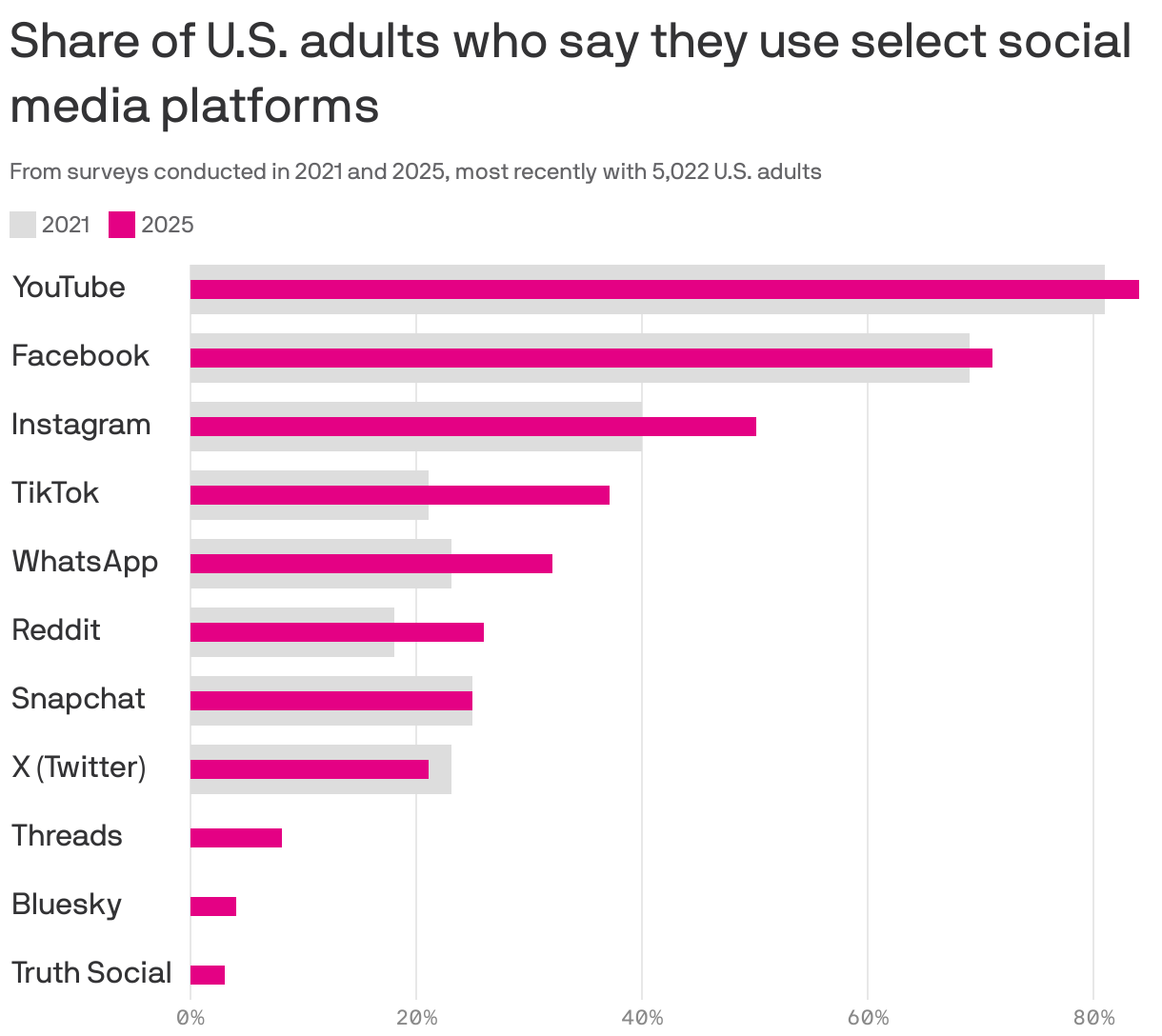
Americans' social media habits are splintering in ways that echo the fractured traditional news landscape, according to a new Pew Research Center report.
Why it matters: The same fragmentation that reshaped news is now reshaping social media, making it harder for companies, brands and public figures to reliably reach large swaths of the public.
By the numbers: Pew Research Center surveyed 5,022 U.S. adults between Feb. 5 and June 18 and found that YouTube (84%), Facebook (71%) and Instagram (50%) remain the most widely used social platforms.
Between the lines: Facebook, YouTube and Instagram are some of the earliest platforms to establish the social media movements, having been founded between 2004 and 2010, and thus have had more time to become part of a person's routine or media diet.
- Reddit and Twitter, now known as X, were also founded in 2005 and 2006, respectively, but have smaller user bases.
Yes, but: While the number of X users has decreased since 2021, Reddit has seen an uptick.
- 26% report using Reddit today, compared to 18% four years ago.
- Reddit is most popular among those ages 18 to 29, with roughly half saying they use the platform regularly.
Zoom in: YouTube remains the most widely used platform among U.S. teens and those ages 18-29 (95%) and 30-49 (92%), though TikTok is on the rise.
- 63% of those under 30 use the short-form video platform regularly, and roughly half say they go on TikTok at least once a day.
- A majority of those under 30 (58%) are also active on Snapchat, the report finds.
- Meanwhile, Truth Social (1%), Bluesky (6%) and Threads (15%) are the least used platforms among young people.
Of note: WhatsApp is also steadily increasing in popularity among U.S. social media users — with 32% saying they use the platform, up from 23% in 2021. It is most popular among Asian and Hispanic users, per the report.
What to watch: Content on social media platforms is increasingly informing large language models like ChatGPT and Gemini.
- According to a recent Muck Rack report, Google's LLM, Gemini, is most likely to cite content or pull transcripts from YouTube.
- Reddit remains a top source for ChatGPT, Perplexity and Google AI overviews, according to research by marketing platform Profound.
2. Exclusive: Honeyjar AI raises $2 million in seed funding

Former comms executive Michelle Masek has launched an AI operating system for communications and public relations professionals called Honeyjar AI, Axios is first to report.
Why it matters: It's an AI platform for communications, by communicators and backed by leading VC, media and communications executives.
Driving the news: Honeyjar AI has raised $2 million in a pre-seed funding round, led by Heather Hartnett, general partner and CEO at Human Ventures, and Kevin Mahaffey, founder of SNR Ventures.
- Former a16z partner Margit Wennmachers, former New York Post CEO Jesse Angelo and TechCrunch's former editor-at-large Josh Constine have also made meaningful investments in the startup.
The big picture: Communications executives are jumping at the chance to invest in AI-powered comms tech, which can automate much of the work.
- This week, Clipbook announced its seed round, which was supported by former White House communications director Dan Pfeiffer, Narrative Strategies CEO Ken Spain and Mike Kempner, founder and CEO of MikeWorldWide.
Details: Honeyjar, which Masek describes as an AI-powered comms workspace, is supported by OpenAI, Anthropic and Grok, has access to LexisNexis data, and pulls from an API ecosystem across social media sites, Substacks, podcasts and more.
- The platform creates a collaborative workspace where prompt-driven AI copilots can help PR professionals build media lists, curate speaking and event calendars, generate coverage reports and create content — like media briefs, press releases, pitches, blogs, FAQs or social posts.
Between the lines: "The vision is to allow comms folks the ability to focus on strategy, counsel, relationships and the parts of the job that only humans can do, but apply AI in a really thoughtful way," says Masek.
- AI agents are built into the platform and take sequential steps in the comms workflow using the information they have.
What they're saying: Masek and her co-founder Nadia Jamshidi sought to build a product they wish existed to support their work as comms professionals.
- "Part of the opportunity we see is that, comms people everywhere are playing around with AI," Masek says. "There are multinational agencies that are creating bespoke solutions that most of the industry will never see, and then there are in-house teams that are hacking together tools."
- "But there's just a huge gap in really solving that last mile of AI for the industry, and so that's what we've raised some money to go do."
Zoom in: Honeyjar currently costs $250 per seat per month for early adopters.
- Masek says the AI-powered workspace is built for boutique to mid-size agencies, small in-house teams, solo heads of comms and individual consultants.
- "In many ways, it's a PR firm in a box, and the ability to, you know, really have that [AI-powered] teammate support on the grunt work, so that you can double and triple our capacity, while spending more time with clients," she says.
What's next: Masek anticipates the business model will scale for enterprise memberships and will be able to assist communications teams across other functions like internal communications, issues management and eventually the marketing suite.
- "If you have an agent that understands the context of your goals, [is] messaging your institutional knowledge around previous decisions made, and is agnostic for content type, and can be prompted to do different things, like you could do media red teaming, crisis communications, internal comms and ballooning out into different aspects of the marketing function," she says.
3. Communicator Spotlight: Tom Channick of Scale AI

Scale AI made headlines after Meta took a 49% stake in the AI app development company and poached its co-founder and CEO Alexandr Wang to serve as its chief AI officer.
- As head of communications, Tom Channick is responsible for telling the story of Scale's next phase, with former chief strategy officer Jason Droege taking the reins as CEO.
Why it matters: Channick's team is working to embrace the past while explaining what's next for the company.
What they're saying: Channick says Meta's investment is "a big vote of confidence."
- Since Wang departed, it has "created an opportunity that very few companies have, which is, how do you tell the story of the next chapter?" Channick says. " And so that's a big focus of the communications team."
- "What we're focused on is, how [can] the communications team be like a vessel to tell the story about where we're going, so that we aren't just defined by our past."
Zoom in: One way they are doing that is by taking control of the outbox, he says.
- "Can we tell more stories than stories that come into us? That's a metric that we measure," says Channick. "You don't want to play kids' soccer," i.e., chasing the ball everyone else and leaving the rest of the field — proactive storytelling — uncovered.
- "As a leader, it's about making sure that you have people that can feel insulated from the inbox so they can focus on actually telling the stories you want to tell."
Catch up quick: Throughout his career, Channick has bounced between supporting tech startups and working at Meta.
- He started working in the agency space before joining the ad tech company Sharethrough.
- Channick also led communications at the crypto company Ripple and did two stints at Meta, where he supported business products and advertising.
What to watch: The modern media mix that's needed to break through with the most important audiences.
- "You can't just do one of them," he says. It has to be a thoughtful combination of social, niche media and mainstream media.
Best advice: Embrace the 70-30 rule.
- "If 70% of work gets you out of bed in the morning and is work you're excited to do, and 30% is work that you just have to do, that's the perfect equilibrium," says Channick.
Go deeper ... read this spotlight in its entirety.
4. ICYMI: United's shutdown bounce


"A crazy thing could happen at a chain hotel and nobody would care, but if it happens onboard an airplane, it's going to be leading to the 'Today' show the next day," United Airlines comms executive Josh Earnest said at a previous Axios Communicators event.
Why it matters: Communicators in the aviation industry are forced to navigate some of the biggest crises, customer service demands and reputation challenges.
- The latest was the recent government shutdown, which created a make-or-break communications moment for airlines leading into the busiest travel period of the year.
State of play: Mixing Board, powered by Axios members, received a case study examining how United Airlines communicated during the flight reductions prompted by the government shutdown.
What they're saying: "Nothing that we did or said, nor the timeliness in which we did it and said it, would have happened without the active participation and management of our CEO," says Steven Restivo, vice president, global corporate communications at United Airlines.
- "[Scott Kirby] rolling up his sleeves and being in the trenches with the team ... helped not only set the course for our operational strategy and our communication strategy, but it also set the tone for how we were going to try to show up in the days ahead."
By the numbers: According to Morning Consult data, United has maintained a stable reputation score since 2021, averaging around 69 out of 100.
- The airline saw the biggest jump in reputation performance this month, in the wake of the government shutdown, indicating very favorable public sentiment.
Zoom in: The airline's net promoter score (NPS) — a customer loyalty and satisfaction metric — remained strong throughout the month of November.
- In fact, 7 of the 10 highest NPS days of the year have been in the wake of the shutdown.
- "That's a direct reflection of our people and the way they went about communicating with and treating customers during a disruptive stretch of time," says Restivo.
5. 📸 1 photo to go
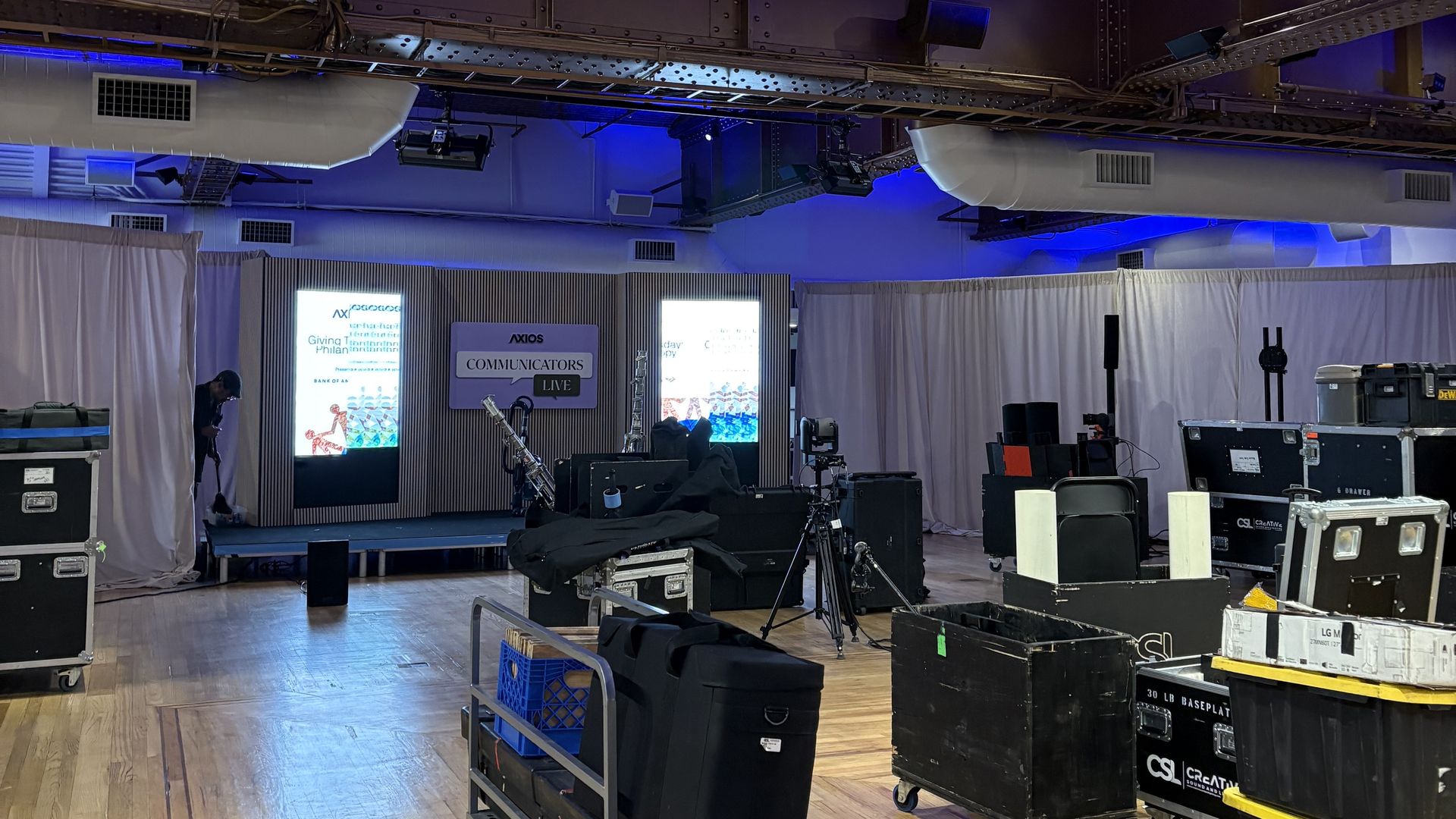
The calm before the storm. Excited to see many of you tonight at Axios Communicators Live!
- đź§ And I'll share a write-up next week for those who couldn't make it.
đź’Ą Thanks for reading! Was this forwarded to you? Subscribe here.
Sign up for Axios Communicators