Axios Columbus

February 17, 2026

Good morning! We're here with a special newsletter sharing how to stay ahead of AI tools our youngest generations are using.
- Like internet access in the '90s and smartphones that followed, kids are using AI in ways that could change them forever.
☁️ Today's weather: Mostly cloudy, with a high of 58 and a low of 47.
💙 Consider supporting your newsroom by becoming a member today.
Today's newsletter is 1,036 words — a 4-minute read.
1 big thing: "The new imaginary friend"

Screens are winning kids' attention, and now AI companions are stepping in to claim their friendships, too.
Why it matters: The AI interactions kids want are the ones that don't feel like AI, but instead feel human. That's the most dangerous kind, researchers say.
State of play: When AI says things like, "I understand better than your brother ... talk to me. I'm always here for you," it gives children and teens the impression they not only can replace human relationships, but they're better, Pilyoung Kim, director of the Center for Brain, AI and Child, told Axios.
- In a worst-case scenario, a child with suicidal thoughts might choose to talk with an AI companion over a loving human or therapist.
The latest: Aura, the AI-powered online safety platform for families, called AI "the new imaginary friend" in its State of the Youth 2025 report.
- Children reported using AI for companionship 42% of the time.
- Just over a third of those chats included violent themes, and about half of those instances also involved sexual role-play.
Even with safety protocols in place, Kim found while testing OpenAI's new parental controls with her 15-year-old son that it's not hard to skirt protections by opening a new account with an older age.
OpenAI told Axios it's in the early stages of an age prediction model, in addition to its parental controls, that will tailor content for users under 18.
- "Minors deserve strong protections, especially in sensitive moments. We have safeguards in place today, such as surfacing crisis hotlines, guiding how our models respond to sensitive requests, and nudging for breaks during long sessions, and we're continuing to strengthen them," OpenAI spokesperson Gaby Raila told Axios.
Character.AI, which restricts users under 18 to chat with characters on the platform, similarly is using "age assurance technology."
- "If the user is suspected as being under 18, they will be moved into the under-18 experience until they can verify their age through Persona, a reputable company in the age assurance industry," Deniz Demir, head of safety engineering at Character.AI, told Axios. "Further, we have functionality in place to try to detect if an under-18 user attempts to register a new account as over-18."
The bottom line: The more human AI feels, the easier it is for kids to forget it isn't.
2. Slow-moving policies, fast-moving bots
Kids' AI habits are outpacing adult oversight, raising concerns about privacy, development and online safety.
By the numbers: Seven in 10 teens used generative AI last year, and 83% of parents said schools haven't addressed it, a Common Sense Media survey found.
- A 2025 Pew survey shows that among teens who reported using chatbots, about 3 in 10 do so every day.
State of play: Conversations about children's safety and AI are just now coming to the forefront.
- OpenAI launched parental controls last fall.
- Character.AI launched "parental insights" last March and then tightened them in October, saying users under 18 won't be allowed to have open-ended chats.
On the policy front, the landscape recently shifted.
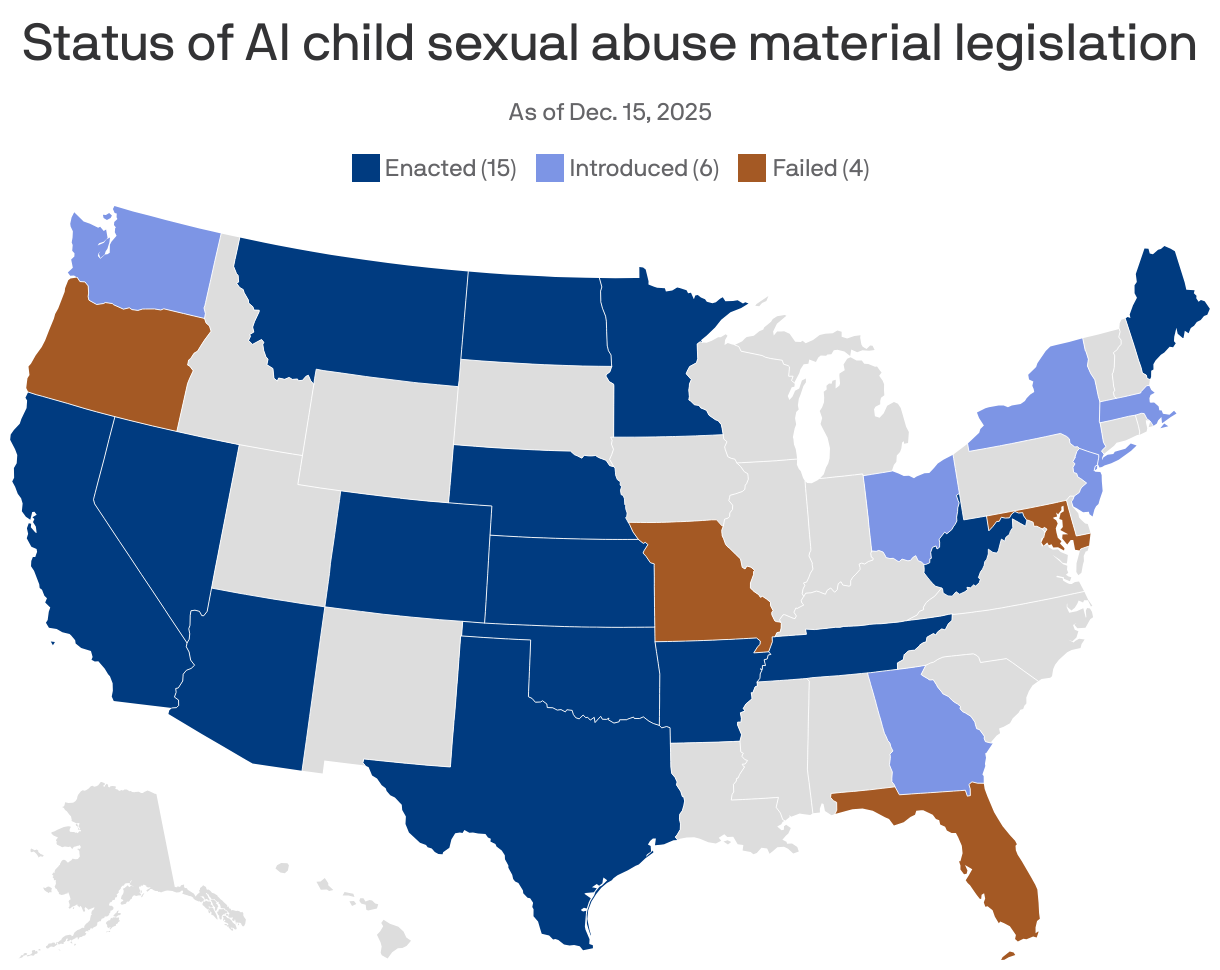
- Trump signed an executive order to override state AI laws — including those aimed at protecting children — in favor of a single national framework. The move could weaken or delay emerging state protections, like California's, and sets up high-stakes legal battles.
What they're saying: "There really does need to be more overarching policy to move the needle towards safer online experiences for kids, including AI," Tiffany Munzer, a developmental behavioral pediatrician, tells Axios.
- Munzer is working on the American Academy of Pediatrics' AI policy. It's expected to publish at the end of 2026.
3. AI fuels faster abuse


The National Center for Missing & Exploited Children's CyberTipline saw a 1,325% increase in reports involving generative AI from 2023 to 2024.
Why it matters: AI tools are being weaponized to accelerate and scale child exploitation tactics.
Catch up quick: In late 2023, NCMEC noticed that blackmailing children was getting a lot faster, Fallon McNulty of NCMEC's exploited children division told Axios.
- Previously, interactions lasted days or even years. Now, financial sextortion (using nude images to coerce someone to send money) happens within hours.
- Children who have never sent photos are being contacted with sexually explicit images created using AI. The scammer will say: "No one is going to believe this isn't you. You might as well do what I say." It looks scary real, McNulty says.
Education is critical to protecting families, McNulty says.
4. Safeguard the latest tech

Kids are smart, and most teens can bypass parental controls if they want to.
- Think you've locked your kid out of their phone at night? They'll change the time zone to get around that.
There's no universal playbook for keeping kids safe online.
- So Axios asked Kristin Lewis — chief product officer of Aura, an online safety platform for families, and mom of two boys under 10 — for her advice.
Her top tips:
⏰ Track actual screen time. Don't guess. It's incredibly easy for hours of screen time to slip past.
💬 Talk about it. These conversations are when you lay out the basics — screen limits, expectations and the real risks kids face online.
📝 Create a safety contract. Think about:
- How much time should be spent on social media?
- Whom do we talk to online?
- What are the rules about downloading new apps?
The bottom line: Rules must be clear, Lewis notes.
5. One last hopeful thing
"I see that often companies are portrayed as bad guys that don't care and I don't think that's the full story. I see many companies that are super motivated, that are also parents … they want to be able to use the products they're working on with their kids."— Mathilde Cerioli, chief scientist at everyone.AI, tells Axios.
Thanks to Shane Savitsky for editing today's newsletter.
Our picks:
🤖 Alissa is reminiscing about SmarterChild.
📅 Andrew is out of office.
👀 Tyler is reading the latest AI+ newsletter.
Sign up for Axios Columbus