Axios Codebook
September 06, 2024

😎 TGIF, everyone. Welcome back to Codebook.
- 📚 If you have feedback for our new book club, this is your last chance. Reply to this email with your thoughts.
- 📬 Have other thoughts, feedback or scoops to share? [email protected].
Today's newsletter is 1,163 words, a 4.5-minute read.
1 big thing: What a Harris administration could mean for cybersecurity

If Vice President Kamala Harris wins the presidential race, she's likely to put her own prosecutorial spin on the Biden administration's already tough cybersecurity policy agenda, experts say.
Why it matters: With two months until Election Day, cybersecurity experts are eagerly reading the tea leaves to determine how a Harris-Walz administration would approach cybersecurity issues like nation-state attacks and critical infrastructure protections.
The big picture: Unlike other issues, cybersecurity is mostly nonpartisan.
- Meaning Harris' approach might not differ from Biden's — or even Trump’s — in many ways.
Between the lines: However, Harris' track record on tech and cybersecurity issues in the Senate and as California's attorney general paints a picture of where she might stand out, former government officials told Axios.
- In 2012, Harris created the California Justice Department's privacy enforcement and protection unit, which focuses on protecting consumer and individual privacy rights.
- That year, she also cracked down on mobile app developers who were pulling users' sensitive data without consent.
- And cybersecurity has been one of Harris' top foreign policy priorities as vice president.
- "She might be stronger on some of these issues" than the Biden administration, a former Obama official told Axios. That includes efforts to hold tech companies liable for security flaws in their products.
Flashback: A group of hackers and other cybersecurity professionals already showed their support for Harris' campaign at a fundraiser on the sidelines of the DEF CON hacker conference.
Driving the news: Russian President Vladimir Putin said yesterday he'd like to see Harris become the next U.S. president.
- The campaign responded by saying it rejected "any foreign interference in this election at all, from any side, from any country."
- Putin's comments came a day after the U.S. Department of Justice seized 32 domains tied to Russian influence campaigns targeting the 2024 presidential election.
Zoom in: Harris' track record suggests she'll also prioritize cracking down on scammers, cybercriminals and even nation-state hackers, Nicole Tisdale, a former Biden White House and congressional staffer, told Axios.
- Harris has prosecuted people behind cyber exploitation rings, partnered with the AARP to educate seniors about scams, and teamed up with tech companies to better fight online sex crimes.
The intrigue: Even Harris' focus on affordable internet for marginalized communities could have outsized impacts for cyber policy, Tisdale added.
- "When people don't have reliable access to internet, they learn insecure practices," she said. "They don't use password managers, they are not using trusted websites, they are not doing automatic updates."
Yes, but: Both the Harris and Trump campaigns are historically behind schedule for transition planning, according to the Partnership for Public Service.
- "People are thinking it will be pretty much the same until a new team gets in place," James Lewis, director of the strategic technologies program at the Center for Strategic and International Studies, told Axios.
- The Harris campaign did not respond to a request for comment.
What we're watching: Biden's top cyber officials aren't guaranteed jobs in a new Harris administration.
- Experts anticipate some carryover in the White House and even at the Cybersecurity and Infrastructure Security Agency — but others say Harris may want to start anew with her own cast of characters in top roles.
- The Harris transition team has already started thinking about how to broach the "three-headed problem" of the White House's National Security Council, the Office of the National Cyber Director and CISA, Lewis added.
2. Kaspersky offloads U.S. antivirus customers
Cybersecurity company Pango Group is acquiring all of Kaspersky Lab's U.S. antivirus customers following the Commerce Department's ban on sales of the Russian antivirus software.
Why it matters: Without the deal, existing Kaspersky U.S. customers would have stopped receiving software updates to the antivirus tool later this month.
Zoom in: Pango is acquiring roughly 1 million new users through the deal, Neill Feather, president and chief operating officer at Pango, told Axios.
- Pango owns and offers a portfolio of cybersecurity products, including virtual private networks, antivirus software and identity theft protection tools.
- Kaspersky customers will transition to Pango's antivirus brand, UltraAV, and were informed of the transition yesterday.
- Feather declined to disclose the deal's financial terms. Kaspersky did not respond to a request for comment.
What they're saying: "The good news is that there's really no action required by customers," Feather said.
- "Those things that they do need to be aware of and need to know, we'll lay out for them in a series of email communications, and then we also have our customer support team ramped up and ready to assist."
Catch up quick: The Commerce Department banned all new sales of Kaspersky Lab's antivirus software in the U.S. starting July 20.
- Current customers were still legally allowed to use the products, but updates would have stopped after Sept. 29.
- As a result of the ban, Kaspersky Lab started winding down its U.S. operations in July and laid off U.S.-based employees.
The intrigue: Once the transition takes place, former Kaspersky U.S. customers will be completely offloaded from the Russian company's IP.
- The U.S. government had worried for years that the Kremlin could pressure Kaspersky into allowing government spies to tap U.S. customers' devices.
The big picture: Pango also became a standalone company this week after Aura, a company known for online safety tools for families and individuals, spun the unit out.
- "It was operating sort of as two separate companies within a holding company," Hari Ravichandran, founder and CEO of Aura, told Axios. "We just went through the actual act of separating it out
Go deeper: Why it took the U.S. nearly 10 years to ban a Russian cyber vendor.
3. Catch up quick
@ D.C.
🏛️ The Office of the National Cyber Director released its road map to shore up the Border Gateway Protocol, the routing system that underpins the modern internet. (The Register)
📲 Hackers appear to have hacked the social media accounts belonging to Lara and Tiffany Trump this week to share posts about a fake family cryptocurrency venture. (Politico)
🏥 A recent legal win for hospitals that use website trackers highlights the limitations of the country's patient health privacy law. (Axios)
@ Industry
👀 Telegram CEO Pavel Durov said in his first public comments since his arrest last week that he believes it was "misguided" and "surprising." (Axios)
🧳 DarkTrace CEO Poppy Gustafsson is leaving the company amid private equity firm Thoma Bravo's takeover. (Bloomberg)
🤝 Palo Alto Networks has acquired IBM's QRadar software-as-a-service assets as part of a $500 million deal. (Bloomberg)
@ Hackers and hacks
⚠️ Planned Parenthood of Montana confirmed it was the target of an apparent cyberattack late last month. (CyberScoop)
🔑 The YubiKey 5 — a widely used two-factor authentication tool — has a cryptographic flaw that could make it susceptible to cloning, security researchers have found. (Ars Technica)
🚌 Disabled passengers in London are unable to book their free door-to-door trips after hackers took down key systems that run the Transport for London's Dial-a-Ride service. (Forbes)
4. 1 fun thing
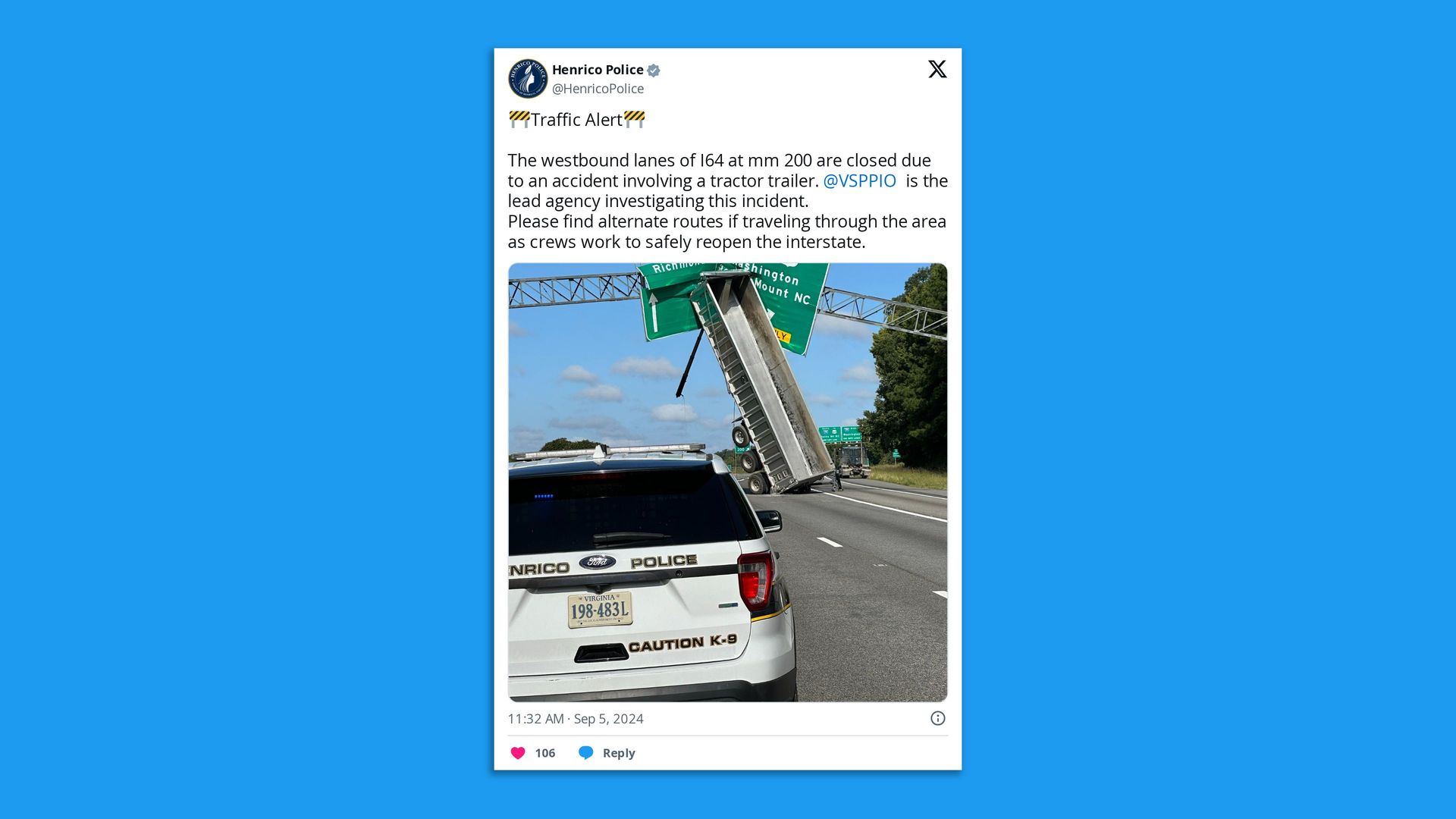
I would pay a lot of money to see the footage of how this traffic incident happened.
☀️ See y'all Tuesday!
Thanks to Megan Morrone for editing and Khalid Adad for copy editing this newsletter.
If you like Axios Codebook, spread the word.