Axios China

September 06, 2022

Welcome back to Axios China. Today we're looking at mass surveillance in China, more lockdowns, the UN's Xinjiang report, play-dough mooncakes and lots more.
- New here? You can subscribe to Axios China to receive weekly updates about China's role in the world.
Today's newsletter is 1,660 words, a 6-minute read.
1 big thing: Beijing's digital surveillance-based governance model

Illustration: Sarah Grillo/Axios
A new book by two China correspondents argues that the Chinese government is pioneering a new governance model based on mass surveillance.
Why it matters: China's huge population, economic heft and global sway mean the country's domestic surveillance architecture could have ramifications far beyond its borders.
- Mass surveillance can oppress, but it also offers the promise of more livable cities and seamless digital services, which is what makes digital authoritarianism as a governance model so seductive, the authors state.
What's happening: Hundreds of millions of surveillance cameras blanket China, information from billions of digital payments are scooped up weekly, online speech is scrutinized, and people's movements are tracked through satellite location systems connected to their phones.
- But the Chinese government has bigger plans for all of this data than just weeding out individual crimes or acts of political dissent, Wall Street Journal reporters Josh Chin and Liza Lin write in "Surveillance State: Inside China's Quest to Launch a New Era of Social Control."
- Instead, the Chinese government aims to replace a social contract based on economic growth that now appears unsustainable with one powered by digital surveillance.
- Surveillance-enabled social control is the "China solution" they are creating and beginning to sell to the rest of the world as an alternative (and superior) governance model, they write.
What they're saying: "By mining insight from surveillance data," the authors write, the party "believes it can predict what people want without having to give them a vote or a voice. By solving social problems before they occur and quashing dissent before it spills out onto the streets, it believes it can strangle opposition in the crib."
Between the lines: Western media coverage tends to portray the Chinese government's mass surveillance regime as purely oppressive, but AI-powered systems can also create more convenient cities and easier lives, the authors write.
- The book explores "both the totalitarian darkness of Xinjiang and the breezy techno-utopias on the country’s wealthy coast to show how the same algorithmic controls can terrorize or coddle depending on who and where you are.”
- In Hangzhou, for example, data-based traffic surveillance has allowed the city to refine its traffic management to resolve the chronic traffic jams that made life there tedious for many residents, the authors write.
Behind the scenes: The idea for the book began with a visit to an ambitious startup, Chin and Lin told Axios in an interview. That startup turned out to be SenseTime, now one of the world's largest facial recognition technology companies, which is sanctioned by the U.S. government for its complicity in human rights violations in Xinjiang.
- "We walked into the office, and it was like walking into 'Minority Report,'" Chin said, referring to the 2002 science fiction film with Tom Cruise.
- "You had to scan your face to go in, there was a camera trained on the street outside that was labeling cars and people and bicycles in real time. It was science fiction. It was mind-blowing."
- SenseTime employees said they were selling their technology to police departments. Chin and Lin soon realized the company was at the forefront of a new state-encouraged effort to link surveillance technology with policing at a mass scale.
What to watch: How these technologies spread around the world, and how that affects the shape of human society and governance.
- "Are we all headed for a world where the China Solution reigns supreme?" the authors ask. "Or is there a way to somehow reconcile machine-powered government audits of human behavior with the preservation of individual liberty?"
Go deeper: Hikvision cameras help Xinjiang police ensnare Uyghurs
2. COVID lockdowns once again sweep China
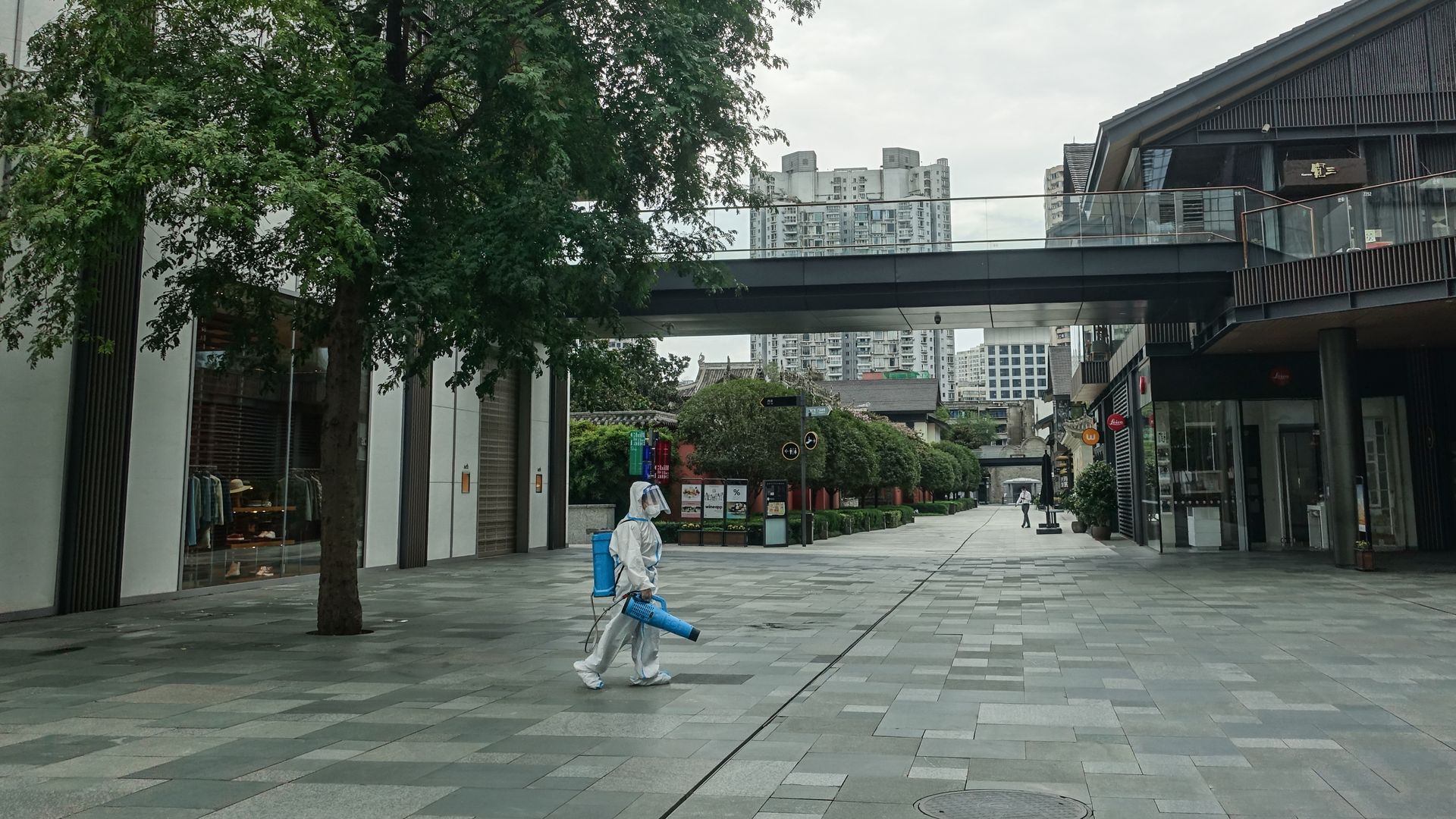
A volunteer disinfects an empty street in Chengdu on Sept 3. Photo: CFOTO/Future Publishing via Getty Images
Several major cities in China have entered full or partial lockdowns amid a rise in COVID cases, affecting some 60 million people across the country.
Why it matters: The highly unpopular lockdowns are likely to add further downward pressure on China's already struggling economy.
What's happening: The southern Chinese tech hub of Shenzhen closed public transportation and required its more than 17 million residents to stay indoors over the weekend, with some restrictions being eased on Monday, Reuters reports.
- The central Chinese city of Chengdu, population 21 million, shut down over the weekend as well.
- Guiyang, the capital of Guizhou province, placed movement restrictions on part of its population of 6 million.
- There are about 1,500 total COVID cases in China — very low compared to many other countries, but considered a high number in China, where the government implements a zero-COVID policy.
Zoom out: Since late August, more than 300 million people in more than 70 cities around China have faced COVID-related restrictions, CNN reports.
3. Catch up quick
1. The Chinese Communist Party announced that its party congress, an important meeting held once every five years, will start on Oct. 16, Reuters reports.
- Chinese President Xi Jinping is expected to be selected for a precedent-defying third five-year term.
2. A 6.6-magnitude earthquake hit China's southwestern province of Sichuan, with the death toll at 65 so far, the BBC reports.
3. The U.S. will hold its first U.S.-Pacific Islands forum later this month in Washington, as China's ties to the region grow closer, Politico reports.
4. The Taiwanese military said it shot down a Chinese civilian drone for the first time, Reuters reports.
- The drone had entered Taiwan's airspace near the island of Kinmen, which is close to China's coast.
5. Taiwan will again offer visa-free entry to citizens of the U.S., Australia, Canada, the U.K. and some other nations beginning Sept. 12, after more than two years of mostly closed borders due to COVID restrictions, Taiwan News reports.
- Visitors are still required to observe a period of quarantine upon entry.
4. UN releases long-delayed Xinjiang report
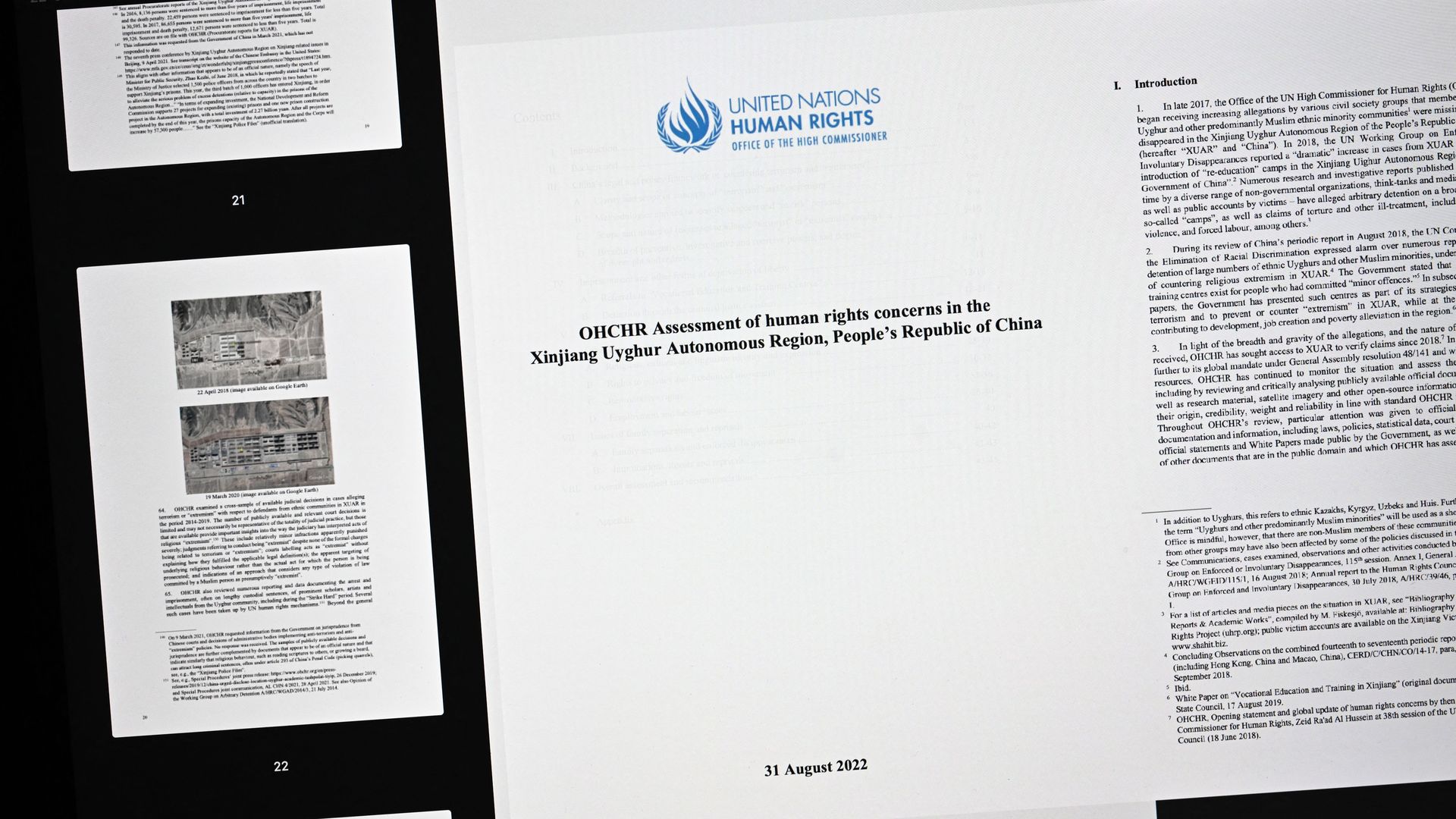
A computer's screen shows pages of a report on human rights in China's Xinjiang region released just minutes before UN rights chief Michelle Bachelet left her post. Photo: Fabrice Coffrini/AFP via Getty Images
The United Nations' top human rights office released a long-delayed report about the Chinese government's treatment of the Uyghurs just minutes before its top official, Michelle Bachelet, was due to leave office.
Why it matters: The 10-month delay in publishing the report, after Beijing reportedly lobbied to prevent its publication, raises concerns about China's influence at the UN.
Details: The report, published by the UN Office of the High Commissioner for Human Rights, relied on an extensive review of evidence compiled by researchers and journalists and from OHCHR interviews with former Xinjiang residents and detainees.
- It determined the Chinese government's actions in Xinjiang "may constitute international crimes, in particular crimes against humanity." The report does not refer to China's actions as genocide.
- The report also found “allegations of patterns of torture, or ill-treatment, including forced medical treatment and adverse conditions of detention, are credible, as are allegations of individual incidents of sexual and gender-based violence.”
The other side: The Chinese government issued a lengthy response, saying the report "distorts China's laws and policies, wantonly smears and slanders China, and interferes in China's internal affairs."
The drama: Bachelet, who served as UN High Commissioner for Human Rights until the end of August, was expected to publish the report in December 2021.
- But the report did not appear, despite calls by activists and politicians. In late August, Bachelet said her office was "trying very hard" to get the report out before her term ended. "I have been under tremendous pressure to publish or not to publish but I will not publish or withhold publication due to any such pressure," she said.
- In late 2021 and early 2022, Bachelet was also planning a visit to China and to Xinjiang, which was opposed by human rights activists who expressed doubt she would be given access to make independent assessments of the situation there.
- During her trip, Bachelet appeared with Chinese Foreign Minister Wang Yi and gave a speech that only lightly criticized human rights in Xinjiang and did not demand an end to the genocide, leading to harsh condemnation of Bachelet from Uyghur advocates and human rights activists.
What they're saying: "I am hopeful that this may compel further action from the international community. It is valuable in that it has the UN stamp on it," Nury Turkel, chair of the U.S. Commission on International Religious Freedom, told Axios.
- But by not calling China's actions a genocide, "Bachelet made it easier for states not to act, suggesting that the situation for the Uyghurs is horrible, but it has not reached to the level of a legal obligation under the genocide convention," Turkel said.
- Though the report itself was well done, publishing it just as the commissioner was stepping down reflects poorly on OHCHR, said Kelley Currie, who previously served as U.S. representative to the UN Economic and Social Council.
5. What I'm reading
No end in sight: As China imposes more COVID lockdowns, "Everyone is scared" (New York Times)
- "To many, the panic buying in Chengdu underscored how deeply previous lockdowns — especially the grueling two-month shutdown of Shanghai earlier this year — had shaken people. Though Chengdu officials have tried to reassure residents that food supplies are ample, Shanghai had offered similar assurances, only to see widespread reported shortages of food and medicine."
Strange bedfellows: U.S. pressure drives Russia, China and Iran closer together (Axios)
- "Russian and Chinese forces began major military exercises Thursday in Russia's far east. Meanwhile, Russia has received an initial batch of drones from Iran to deploy on the battlefield in Ukraine," my colleague Dave Lawler writes.
- "The relationships among these three countries are defined not by deep bonds or shared values, but by specific interests and the mutual desire to challenge Washington."
6. 1 fun thing: Play-dough mooncakes

Photo: Bethany Allen-Ebrahimian
Mid-Autumn Festival is upon us here in Taiwan. This Chinese holiday brings families together and was traditionally celebrated by giving thanks for a good harvest and gazing at the full Moon.
- Mooncakes (月饼), small pastries stuffed with various fillings like lotus seed, peanut and egg yolk, are a ubiquitous sight around China and Taiwan this time of year.
What's happening: My 3-year-old son attended his first day of preschool in Taiwan today, and he came home with a plate of play-dough mooncakes that he and his classmates made to celebrate Mid-Autumn Festival.
- For comparison, here are what real mooncakes look like. Not bad!