Axios China

May 18, 2021

Welcome back to Axios China. Today we are looking at China's antitrust exceptionalism, Huawei's cloud services, a Uyghur writer behind bars, and lots more.
- If a friend forwarded this email to you, you can subscribe here to receive Axios China in your inbox every Tuesday.
Today's newsletter is 1,387 words, a 5-minute read.
1 big thing: Beijing's antitrust push poses a challenge to the West
Illustration: Sarah Grillo/Axios
The Chinese government's anti-monopoly machinery presents a major challenge to U.S. and European regulators, a new book argues.
Why it matters: China's huge markets are attracting investment from multinational corporations and shaping the behavior of its own globe-trotting companies — giving international heft to the country's idiosyncratic antitrust enforcement and putting it on a collision course with Western-style regulation.
- Anti-competitive practices in China's domestic markets, such as pervasive but opaque state ownership, can make Chinese companies difficult for Western institutions to regulate while enabling China's own antitrust regulator to sometimes target Western companies for political reasons.
Driving the news: The Chinese government has launched a high-profile anti-monopoly campaign against domestic tech firms, including Alibaba, Ant Group, Meituan and others.
Details: In her new book "Chinese Antitrust Exceptionalism: How the Rise of China Challenges Global Regulation" (Oxford University Press, May 2021), legal scholar Angela Huyue Zhang makes three key points:
1. The anti-competitive behavior of some Chinese state-owned and private enterprises as they trade with the rest of the world is often due to China's complex domestic economic environment, rather than intentional, top-down orders from Beijing, as some have speculated.
- The takeaway: U.S. pressure on Beijing to change its laws so that they more closely resemble Western antitrust law isn't effective, because bureaucratic and economic complexities have shaped how China's antitrust law is carried out.
- Instead, America's "top priority should be to help China promote structural reform of its bureaucracy and enhance due process in administrative enforcement," Zhang writes.
2. The Chinese government sometimes uses its muscular domestic antitrust regime to support its larger international interests and exert pressure on foreign firms and governments — a type of extraterritorial influence that the U.S. has long wielded, though often in different ways.
- The U.S. has used its extraterritorial influence to shape the global regulatory environment, whereas the Chinese government has sometimes used its growing regulatory clout to pursue geopolitical interests, such as pushing back on boycotts.
- The takeaway: The line between antitrust action and national security has become blurred, especially since the U.S.-China trade war under the Trump administration saw both governments take economic actions against each other's companies for what appeared to be underlying security interests.
3. China's antitrust laws are superficially similar to Europe's but their enforcement is vastly different, a result of the fundamentally different political-economic systems of China and the West — a tension that presents a major challenge to globalization.
- Western regulators often require a "clear delineation of a firm’s boundaries at the outset," Zhang writes, but Chinese firms may be partially or fully state-owned, and even private Chinese companies know they have to court the Chinese government to get ahead.
Zhang's solution: Zhang says she is still optimistic the two different systems will eventually arrive at a live-and-let-live kind of compromise.
- "As Chinese antitrust agencies hold foreign businesses hostage through the aggressive enforcement of antitrust law, foreign regulators can do the same by holding Chinese firms hostage, not necessarily through antitrust but also via other regulatory rules such as investment and trade," Zhang writes.
- "It is this reciprocal exchange of hostages that gives me hope for a peaceful resolution of the conflict."
2. Map: Huawei's cloud services find government buyers
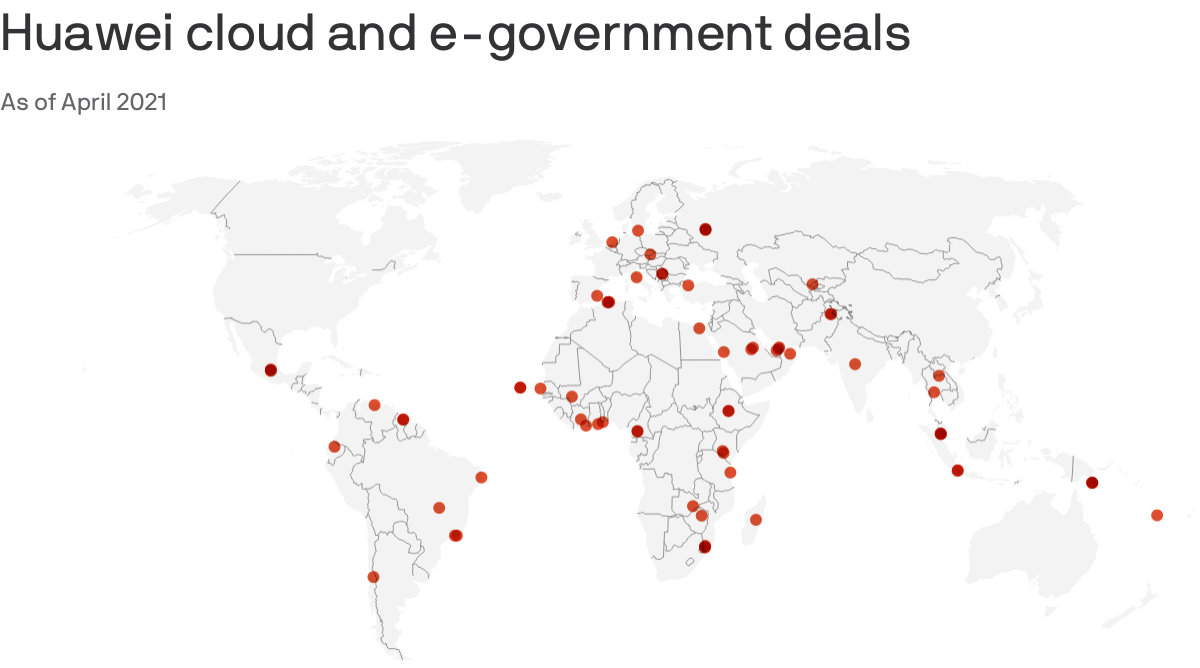
Chinese telecom giant Huawei is finding plenty of government buyers for its cloud services despite growing suspicion of the company, according to new data compiled by the Center for Strategic and International Studies' Reconnecting Asia Project.
The big picture: Middle-income countries without strong civil freedoms are the most common customers for Huawei's cloud and e-government services.
By the numbers: CSIS researchers found 70 agreements in 41 countries between governments (or state-owned enterprises) and Huawei.
- 77% of those agreements occurred in countries that Freedom House has ranked as either "not free" or "partly free," such as Saudi Arabia and Zambia.
- 72% of agreements were in middle-income countries, including Mexico and Malaysia.
3. Catch up quick
1. China's economic recovery slowed in April as consumer spending missed expectations, the Wall Street Journal reports.
2. The Uyghur birth rate in Xinjiang experienced the most dramatic drop of any region in recent world history, the Associated Press reports.
3. China opened a new office called the National Bureau of Disease Control and Prevention to help stop future epidemics, the Global Times reports.
4. China criticized the U.S. for blocking a UN Security Council call for an Israel-Palestine ceasefire, the South China Morning Post reports.
5. Lawmakers urged the State Department to work with China on easing the adoption process for American families. Go deeper.
4. The novelist now locked away in Xinjiang's security state
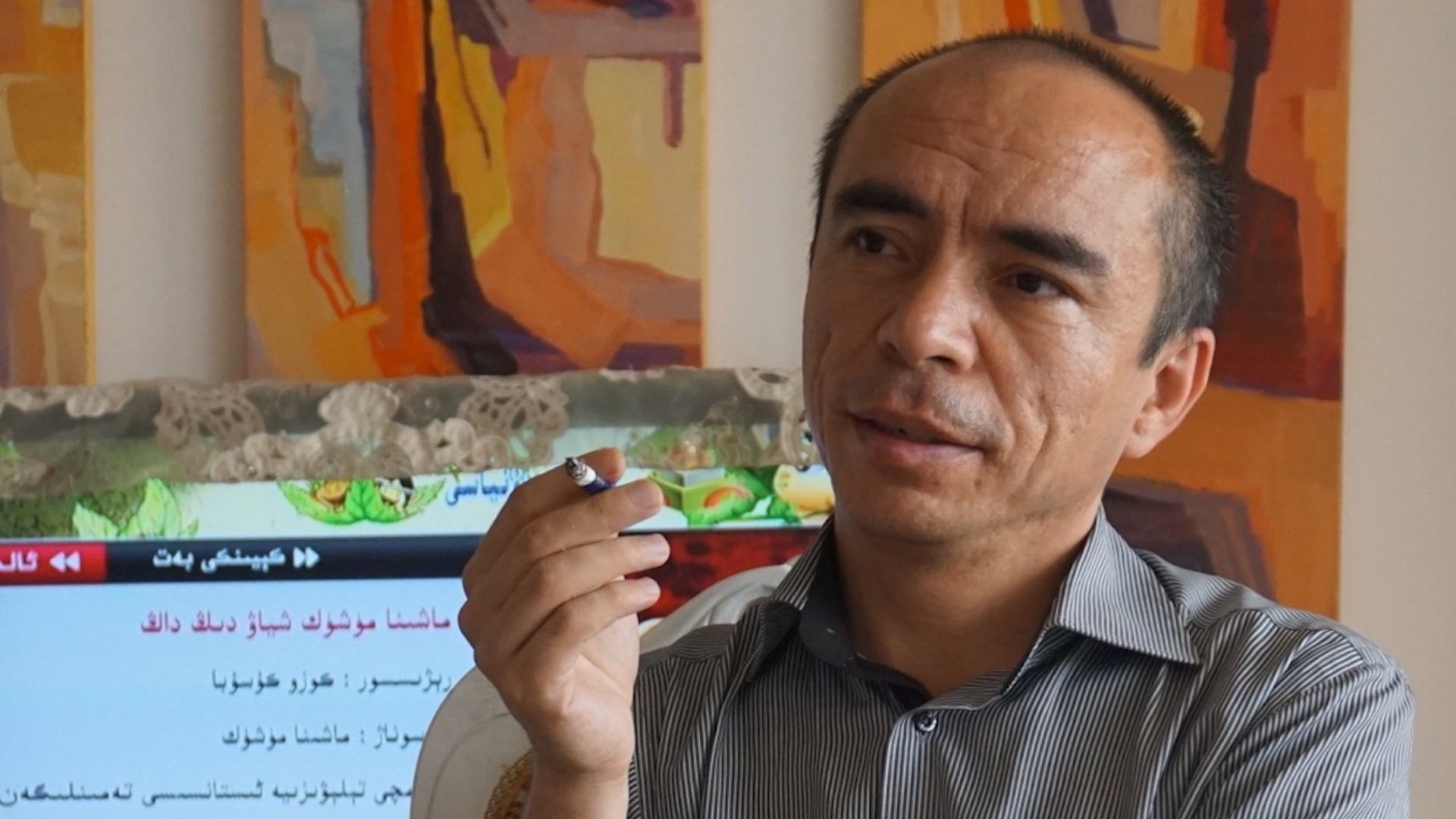
Perhat Tursun in his apartment in Urumqi, China, in 2015. Photo: Bethany Allen-Ebrahimian
Perhat Tursun is a prominent modernist writer in Xinjiang whose work is inspired by Kafka and Rumi — and who is now serving a 16-year sentence in a Chinese prison.
Why it matters: Perhat is one of the hundreds of Uyghur intellectuals jailed by the Chinese Communist Party as it seeks to erase an independent Uyghur culture.
- Joshua Freeman, a lecturer in East Asian studies at Princeton University who has translated some of Perhat's poems and short stories, described him as one of the "foremost living writers in the Uyghur language."
- Perhat has drawn comparisons to Salman Rushdie, after Uyghur conservatives in Xinjiang denounced his 1999 novel "The Art of Suicide" as heretical, leading to book burnings and death threats.
Driving the news: A growing number of legal scholars and governments have come to the conclusion that the CCP's actions in Xinjiang constitute genocide — most recently the UK parliament, which passed a resolution on April 23 making that declaration.
Background: Perhat's close friend Tahir Hamut Izgil, who fled Xinjiang in 2017 and now lives in the U.S., first got to know Perhat in the 1980s when they were both students in Beijing.
- At that time, Uyghur literature was heavily influenced by Chinese and Soviet literature, while Western writers were largely unknown, Tahir told Axios. But Perhat led a Uyghur student group that met twice weekly to discuss literature, and the "books he was introducing to us were completely different from what we had ever read before — Kafka, Nietzsche, Dostoyevsky."
- Perhat's own writings explored symbolism and modernist themes in new ways, inspiring devoted fans as well as critics.
- "So few people can give Uyghur literature that aesthetic sense," Tahir said. "He is truly unique. There is no one like him."
What happened: In 2017, Chinese authorities began rounding up hundreds of thousands of Uyghurs and putting them in mass internment camps.
- Before he left China, Tahir encouraged Perhat to leave as well. But Perhat said he believed the Chinese government had placed an exit ban on him.
- In early 2018, Perhat's friends abroad received word he had been detained.
- In 2020, he was reportedly sentenced to 16 years in prison. He will be 66 years old if he is released on that timeline.
Tahir said he now tries to promote Perhat's work so the world doesn't forget him. "That's all I can do now."
Go deeper:
5. What I'm reading
Popularity contest: Army of fake fans boosts China's messaging on Twitter (Associated Press)
- "China’s rise on Twitter has been powered by an army of fake accounts that have retweeted Chinese diplomats and state media tens of thousands of times, covertly amplifying propaganda that can reach hundreds of millions of people — often without disclosing the fact that the content is government-sponsored."
Surveillance tech: Italian state news investigates Hikvision (IPVM)
- "This represents the most scrutiny Hikvision has ever received in Italy, where Hikvision faces zero restrictions and is installed across sensitive government and infrastructure locations."
Islam dispossessed: China’s persecution of Uyghur imams and religious figures (Uyghur Human Rights Project)
- Researchers have compiled 1,046 known cases of imams and other religious figures in Xinjiang detained for their religious work since 2014.
- "That 41% of the individuals in our dataset have been given prison sentences illustrates the intention of the Chinese government not just to criminalize religious expression or practice, but also to consider imams criminals by virtue of their profession."
6. 1 space thing: China makes history with successful Mars landing

Technical personnel celebrate at the Beijing Aerospace Control Center on May 15. Photo: Rao Aimin/Xinhua via Getty Images
A Chinese lander carrying a rover successfully touched down on Mars for the first time, Axios' Miriam Kramer writes.
Why it matters: This is the first time China has landed a spacecraft on another planet, and it launches the nation into an elite club of only a few space agencies to successfully make it to the Martian surface.
What’s happening: The rover arrived in orbit around the Red Planet in February with the country's Tianwen-1 mission.
- The rover is reportedly designed to search for water, ice and possible signs of life.
- This was China's first attempt to land on Mars.
The big picture: This mission fits into China’s broader plans in space.
- The nation is currently building a space station and is aiming to develop a research station on the Moon with Russia.