Axios China

November 09, 2021

Welcome back to Axios China. Today we're looking at a Chinese American scientist's lawsuit against the U.S., Europe's China critics, pandas in snow, and lots more.
- Send tips and feedback my way. Email me at [email protected], or just hit reply to this email.
Today's newsletter is 1,688 words, a 6-minute read.
1 big thing: Exclusive — ACLU joins Sherry Chen lawsuit against U.S.

Photo illustration: Aïda Amer/Axios. Photo: Saul Loeb/AFP via Getty Images
The American Civil Liberties Union has filed an administrative complaint to the U.S. Departments of Commerce and Justice, asserting claims of false arrest and civil conspiracy on behalf of a Chinese American scientist who was cleared of espionage-related charges in 2015.
Why it matters: Hydrologist Sherry Chen's ordeal has spanned three presidential administrations and is adding to growing concerns about U.S. government profiling of Chinese American scientists.
Driving the news: In September, the U.S. Commerce Department announced plans to shutter an internal security office — the Investigations and Threat Management Service (ITMS) — after a Senate report found the office had gone beyond its authority to pursue law enforcement investigations.
- The report said the office had become a “rogue, unaccountable police force” that "broadly targeted departmental divisions with comparably high proportions of Asian-American employees."
- The investigation of Chen had originated at ITMS, according to the report.
- The ACLU's administrative complaint joins Chen's original lawsuit, first filed in 2019, and adds new claims incorporating the information revealed in the Senate report.
Background: In October 2014, Chen, who worked for the National Weather Service in Ohio, was arrested on espionage-related charges. But five months later, federal prosecutors dropped all charges.
- Chen later filed a complaint with the U.S. Merit Systems Protection Board and a judge ruled in Chen's favor, writing that federal investigators “found no evidence that Ms. Chen had ever provided secret, classified, or proprietary information to a Chinese official or anyone outside of the agency.”
- Even so, the Commerce Department, which oversees the National Weather Service, placed Chen on administrative leave and has refused to reinstate her ever since.
- The Commerce Department did not respond to a request for comment.
- The Justice Department did not respond to a request for comment.
What she's saying: "The government’s wrongful investigation and prosecution upended my life and shattered my career," Chen told Axios in a statement.
- "I was devastated to learn about the long-running abuses committed by this rogue security unit and the extent of its discrimination against Asian Americans like me. I want the government to be held accountable for how it’s treated me and so many other dedicated federal employees," Chen said.
The big picture: Chen's case is part of a larger problem that spans decades.
- During the Cold War, the FBI surveilled Chinese students and scientists, and the U.S. deported a talented U.S.-trained scientist named Qian Xuesen who later helped China launch its space program.
- In 1999, Taiwanese American scientist Wen Ho Lee was charged with passing information about U.S. nuclear weapons to China, but most charges were eventually dropped and he received a $1.6 million settlement.
- More recently, the Department of Justice's China Initiative, launched in November 2018 to combat economic espionage, came under scrutiny when its first prosecution fell apart and a judge acquitted Anming Hu, a professor at the University of Tennessee at Knoxville, of all charges.
Between the lines: "Ms. Chen’s case is part of a disturbing pattern of government discrimination against scientists of Chinese descent, spanning the Obama, Trump, and Biden administrations," Ashley Gorski, a senior staff attorney with the ACLU, told Axios in a statement.
- "Under the ‘China Initiative,’ federal agencies have unjustly investigated and prosecuted Chinese American scientists on the basis of their heritage, upending lives only to have many cases fall apart," Gorski said.
Go deeper: The FBI is walking a tightrope on China
2. Key meeting of China's political elites underway in Beijing
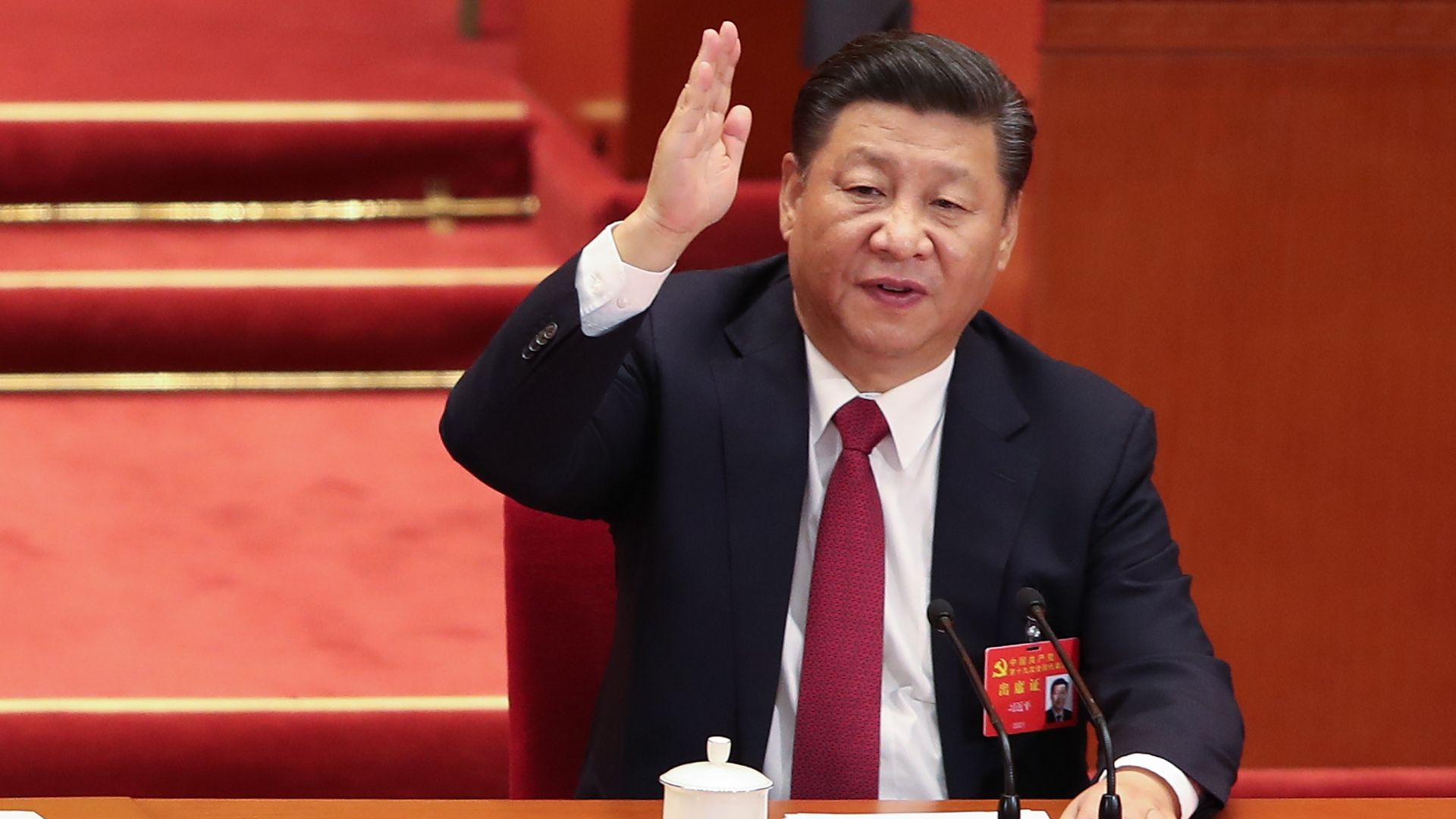
Chinese President Xi Jinping votes at the closing of the 19th Communist Party Congress, Oct. 24, 2017, Beijing. Photo: Lintao Zhang/Getty Images
Several hundred top members of the Chinese Communist Party are meeting behind closed doors this week in Beijing, where they will map out key plans for the nation's future.
Why it matters: It's the last major meeting before next year's party congress, when Chinese President Xi Jinping is expected to be appointed for a third term after he successfully pushed to abolish term limits in 2018.
- The meeting, known as the sixth plenum, is imbued with special significance, as it is occurring in the same year as the CCP's 100th anniversary.
What to watch: Xi is expected to deliver a resolution on the party's history — becoming only the third Chinese leader to issue such a proclamation, after Mao Zedong and Deng Xiaoping.
- “The 1945 resolution affirmed Mao’s leadership in the CCP, and the 1981 resolution was about turning a new page from the decade-long destructive chaos of Cultural Revolution Mao created,” Dali Yang, a political scientist at the University of Chicago, told The Guardian.
- “This year’s resolution will be somewhere in between — the party’s past and Xi’s future.”
Details: The CCP's Central Committee, comprised of more than 300 top party members, meets for a plenary session each year.
- The members of the current Central Committee were selected in 2017; this is the current committee's sixth plenary session.
- A new committee will be selected next year at the party congress.
Go deeper: At 100, Chinese Communist Party claims credit for the Chinese dream
3. Catch up quick
1. International companies are still expanding their footprint in China, according to an HSBC survey, Bloomberg reports.
2. A Chinese citizen journalist jailed for her reporting on the COVID outbreak in Wuhan is near death after going on hunger strike, The Guardian reports.
3. The U.S. is testing the Iron Dome missile defense system in Guam amid concerns about China's missiles, the Wall Street Journal reports.
4. Wang Yaping became the first female Chinese taikonaut to complete a spacewalk, Insider reports.
4. Holocaust Museum report warns China "may be committing genocide"
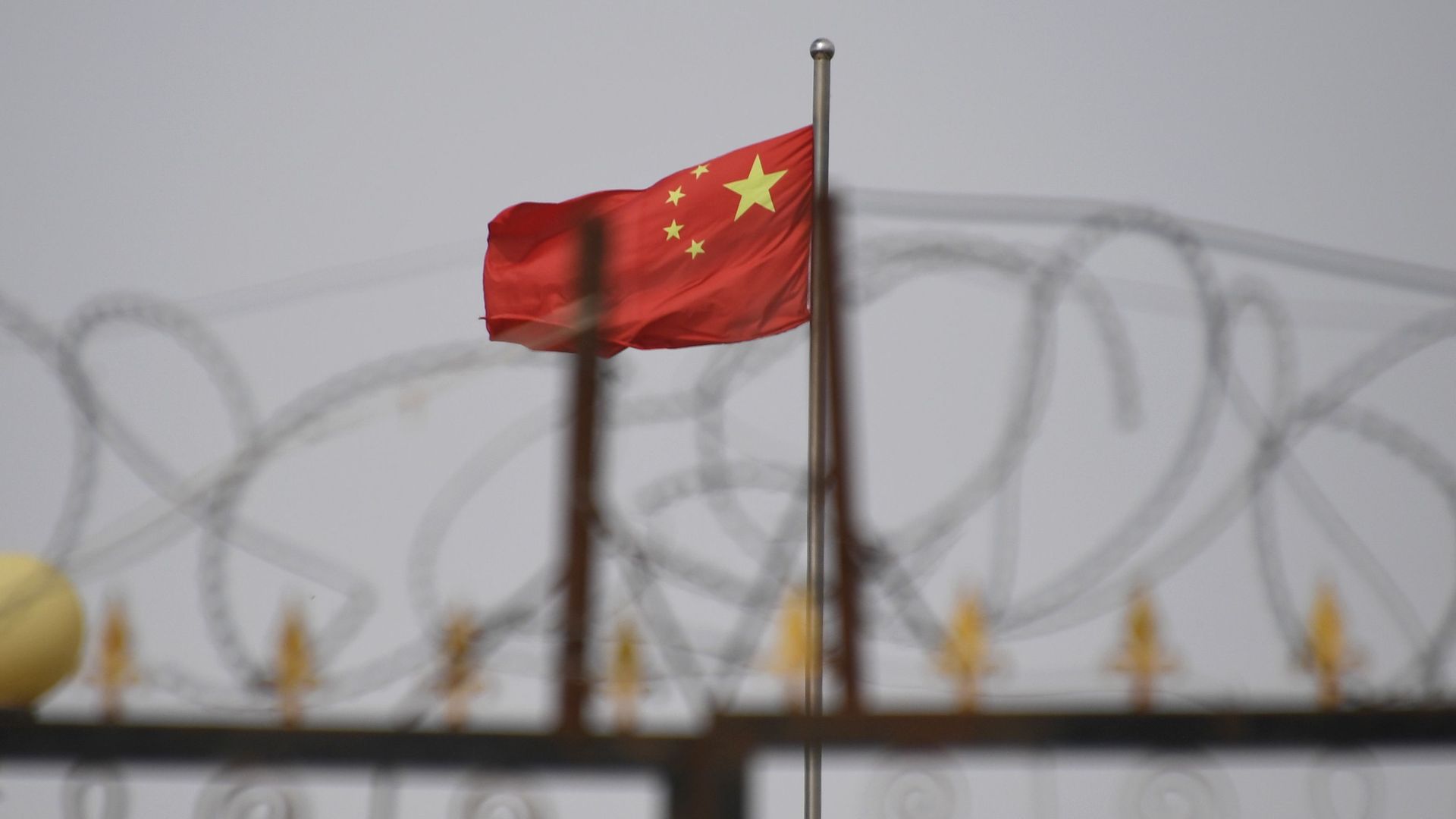
The Chinese flag behind razor wire at a housing compound in Yangisar, south of Kashgar, in China's western Xinjiang region. Photo: Greg Baker/AFP via Getty Images
A report released today by the U.S. Holocaust Memorial Museum states the museum is "gravely concerned" the "Chinese government may be committing genocide against the Uyghurs."
Why it matters: A growing number of governments and other institutions are concluding the Chinese government's policies toward the Uyghur ethnic minority aren't just repression, but in fact constitute genocide.
- Once a government has made a legal determination of genocide, it has an obligation under international law to take action.
- The report was published by the museum's Simon-Skjodt Center for the Prevention of Genocide, which states in the report that it "seeks to do for victims of genocide today what was not done for the Jews of Europe."
Details: The 56-page report, titled "To Make Us Slowly Disappear," documents Chinese government policies targeting Uyghurs, including mass surveillance, restrictions on Uyghur religion and culture, forced sterilization, mass incarceration, forced labor, destruction of Uyghur cultural and religious sites, and transfer of Uyghur children away from their families.
Context: In 2020, the U.S. Holocaust Memorial Museum assessed the Chinese government was committing "crimes against humanity" in Xinjiang, where many Uyghurs live.
- The museum's assessment of the situation has now changed. Recent information shows "the Chinese government’s conduct has escalated beyond a policy of forced assimilation," the report states.
- "This includes, in particular, a deepening assault on Uyghur female reproductive capacity through forced sterilization and forced intrauterine device (IUD) placement as well as the separation of the sexes through mass detention and forcible transfer."
- Those policies raise "legitimate questions about the existence of the intent to biologically destroy the group, in whole or in substantial part," which is an important part of the definition of genocide, the report states.
Go deeper: "Clear evidence" China is committing genocide against Uyghurs
5. Europe's China critics

Taiwan President Tsai Ing-wen (right) next to member of the European Parliament Raphaël Glucksmann at Taiwan's Presidential Office. Photo: AFP photo / CNA Photo
Two weeks after the European Parliament voted 580-26 on a resolution to strengthen EU-Taiwan relations, an official delegation of lawmakers traveled to Taiwan for the first time to deliver a simple message: "You are not alone."
Why it matters: Taiwan is a prosperous democracy that has faced growing military intimidation from the Chinese government, which views the self-governing island as a breakaway territory that must be brought under its control, Axios' Zach Basu reports.
- The visit by European lawmakers last week sparked outrage from China's Foreign Ministry, which has warned that any country attempting to bestow international legitimacy on Taiwan will "pay a price."
The big picture: A vocal, cross-border cadre of Europeans is seeking to ensure there is no ambiguity about where the EU stands in the clash between authoritarianism and democracy.
- One way is by building ties with Taiwan, whose foreign minister paid a secret visit to Brussels last month after stopping in other EU capitals.
State of play: The EU's official stance is that China is simultaneously a partner, a competitor and a systemic rival — a dynamic that has drawn allegations of "fence-sitting" from some critics.
- EU leaders say they do not wish to be dragged into a no-win conflict between the U.S. and China and that the world must deal with China how it is, not how they wish it to be.
- But like many countries whose views of China have soured over the last two years, that attitude of nonconfrontation may slowly be starting to shift.
- French member of the European Parliament Raphaël Glucksmann told Taiwan's Premier Su Tseng-chang during last week's visit: "You have shown that in this region, democracy can flourish and that authoritarian regimes are not the future."
The backdrop: Lithuania is a tiny Baltic nation whose economy is 1/270th the size of China's, but it's been at the forefront of European efforts to confront Beijing's authoritarianism.
- That's made it the target of an unprecedented campaign of economic coercion by China.
- Dovilė Šakalienė, a Lithuanian lawmaker who led parliamentary efforts in the country to designate China's treatment of Uyghurs as genocide, was among those people China blacklisted.
- "I believe that the European Union, probably for the first time in decades, is now understanding more and more how dangerous the People's Republic of China is," Šakalienė told Axios in an interview.
What to watch: Much of Europe's hardline rhetoric on China comes from members of the European Parliament, which has little control over the EU's executive institutions, or national lawmakers who aren't in government.
- Lithuania aside, there's "a tendency to be critical of China when you're not holding the reins of power," says Noah Barkin, an expert on Europe-China relations at the Rhodium Group.
- That theory will be tested by the next German government, in which a pair of junior parties are pushing the coalition to take a harder line on Beijing, rather than continue Angela Merkel's pro-engagement legacy.
6. 1 fun thing: Panda enjoying the snow

A giant panda plays in the snow at Jinan Zoo on Nov. 8 in Jinan, Shandong Province. Photo: Yan Haining/VCG via Getty Images
Unseasonably early snow covered parts of northern China over the weekend, including a zoo in Shandong Province — much to this panda's delight.