Axios China

September 27, 2022
Welcome back to Axios China. Today, we're looking at Taiwanese citizens preparing to fight a possible online war, the weakening yuan, baseless Xi Jinping coup rumors, and a whole lot more.
- Axios' "Smart Brevity" book is now available on Amazon, Barnes & Noble, Bookshop.org and at your local bookstore.
Today's newsletter is 1,602 words, a 6-minute read.
1 big thing: Taiwanese citizens prepare for possible cyber war
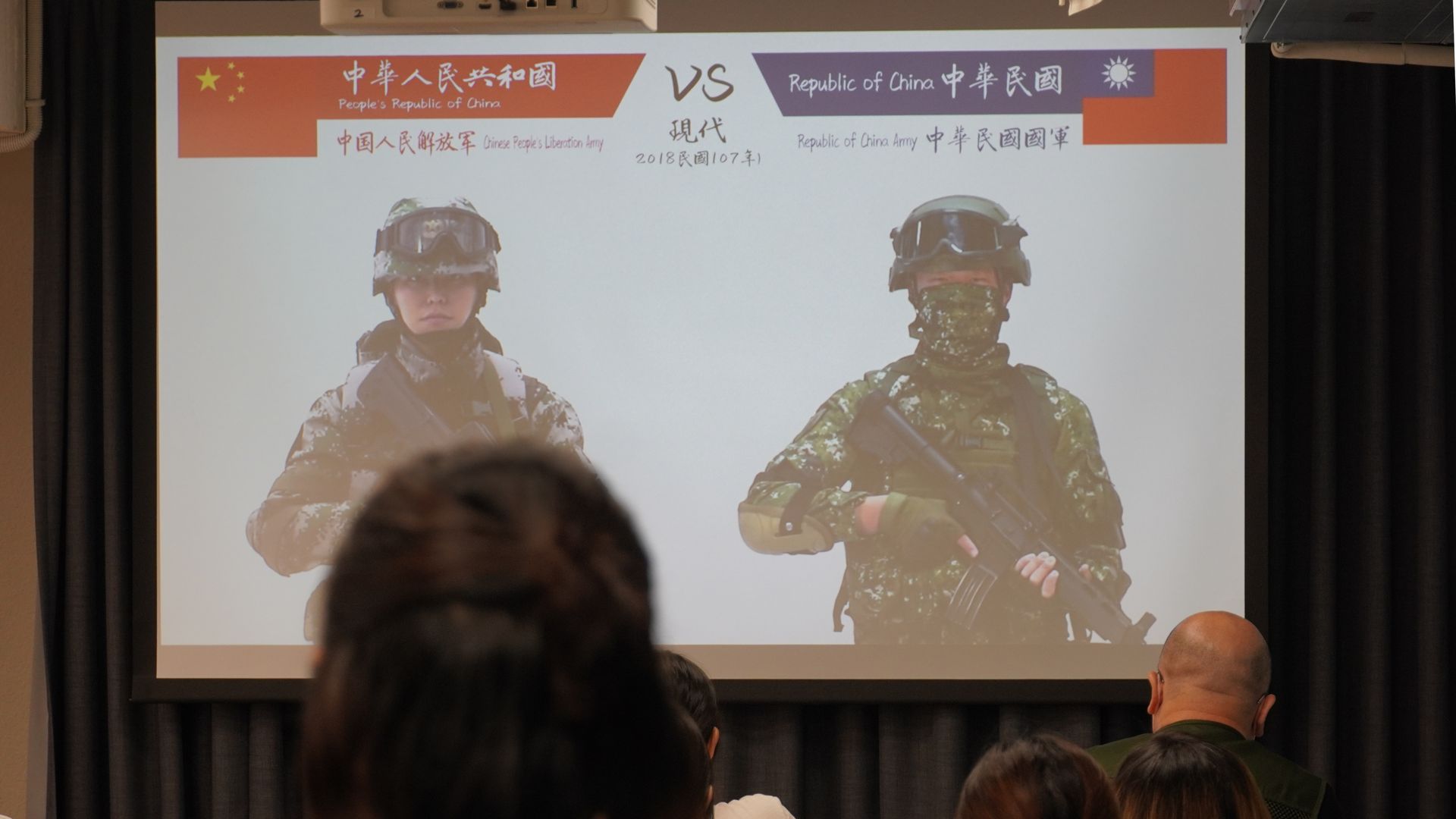
Students learn to distinguish between Chinese and Taiwanese military uniforms at Kuma Academy in Taipei, Taiwan, on Sept. 18. Photo: Sebastian Kjeldtoft
An infusion of cash from a Taiwanese semiconductor magnate is helping fund new cyber defense training for Taiwanese citizens.
Why it matters: The goal is to fight online disinformation and hybrid warfare that could accompany a potential Chinese military assault on the self-governed island democracy.
What's happening: Taiwanese tech tycoon Robert Tsao recently pledged approximately $20 million in funding for Kuma Academy, a company founded last year to help Taiwanese people prepare for a potential Chinese invasion.
- The academy plans to provide civilian military training for 3 million people over the next three years.
- Part of the training includes basic courses in identifying and publicly debunking online disinformation, and the academy plans to launch advanced courses on open-source intelligence gathering (OSINT) taught by volunteer hacking groups.
Details: OSINT can include using publicly available satellite images to track troop movements, analyzing databases, and assessing social media posts from people claiming to have witnessed important events.
- Using OSINT isn't that popular in Taiwan despite the many hacking groups operating on the island, Puma Shen, co-founder of Kuma Academy, said in an interview after training sessions held this month in Taipei.
- "Even with all these hackers, if they are voluntarily doing something during the war, it won’t be enough," Shen said, referring to a potential future war with China. "We want to expand."
- Shen plans to train participants in how to tailor general OSINT practices for a Taiwanese context — such as compiling lists of words typically used by netizens in Taiwan but not in China, which could help determine the identity of social media users posting information while claiming to be Taiwanese.
- The classes also teach participants to debunk fake news and identify Chinese military uniforms and weapons, which can be useful for distinguishing between true and false information posted online in a wartime environment.
The big picture: The classes aim to foster a sense of hope among Taiwanese people by showing them how they can play a part in the national defense and pointing out the limitations China faces if it were to attempt an invasion, the co-founders said.
- In his presentation, Ho Cheng-hui, also a Kuma Academy co-founder, sought to push back against the common belief in Taiwan that if China were to invade, Taiwan would have no choice but to surrender immediately.
- Ho explained the difficulty of amphibious assault, the struggles Chinese troops on Taiwan would face in their supply lines across the Taiwan Strait, and shared historical examples of smaller countries successfully repelling invaders from a much larger country.
The information battlefield has featured prominently in the Russian invasion of Ukraine, and a growing number of people in Taiwan are studying Ukrainian resistance tactics.
- Russian-affiliated media, online groups and organizations have spread propaganda and targeted disinformation intended to weaken the wills and disrupt the decision-making processes of Ukraine and its allies.
- Ukrainian citizens, as well as groups and individuals from around the world, have worked together to fight Russian online disinformation, including by using OSINT to track military maneuvers and gather evidence about alleged war crimes.
What they're saying: Rumors can “destroy our will to resist," Ho said during the class.
- "War is, at its most basic nature, a contest of wills," Ho said. "The two sides use a variety of methods to try to force the other to obey its will. Armed conflict is only one form of modern warfare."
2. The yuan weakens

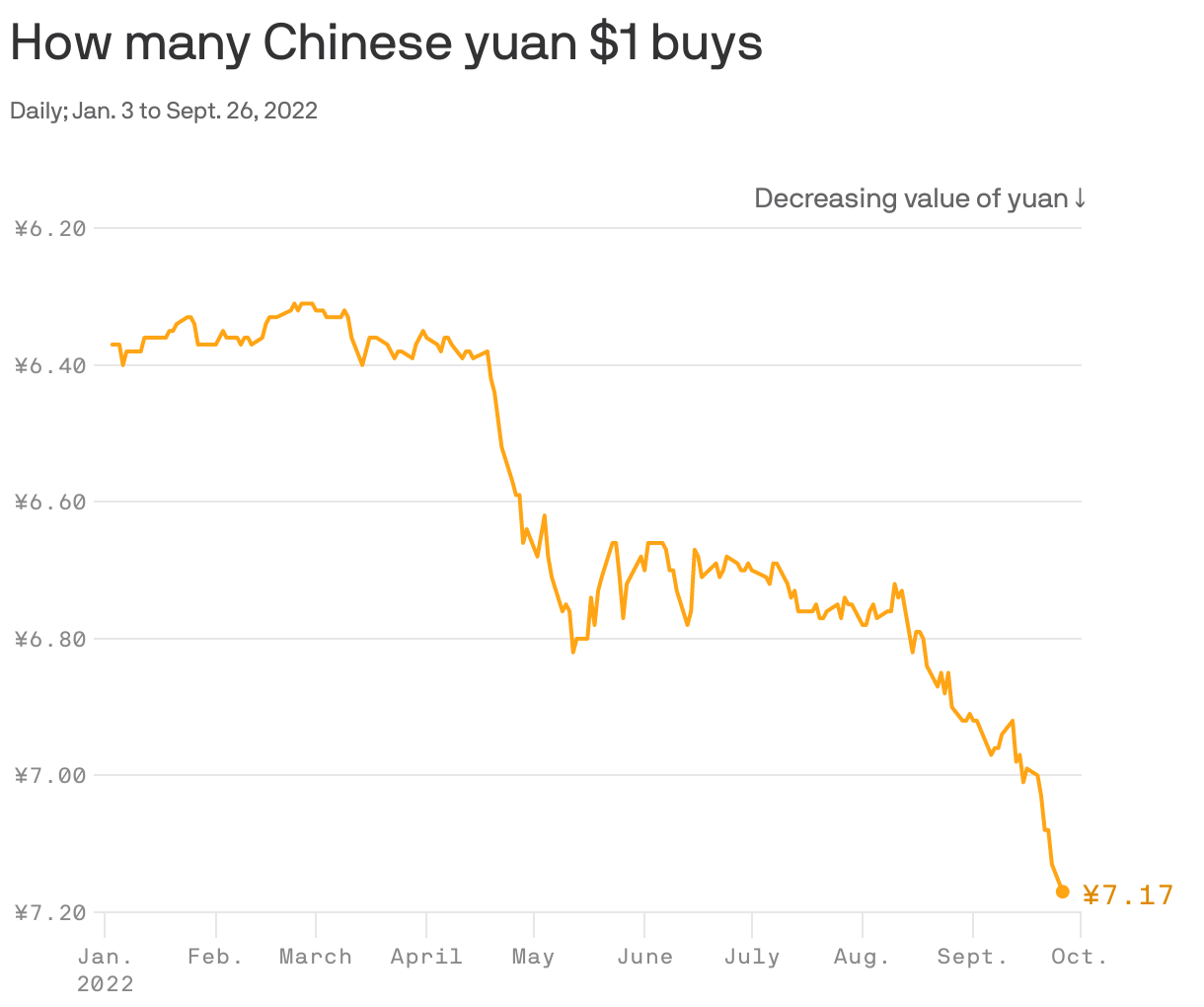
China's yuan passed a key line in the sand last week against the U.S. dollar, and it continues to tumble, Axios’ Kate Marino writes.
The big picture: The weakening yuan is a sign that policymakers and investors are growing more concerned about the world's second-largest economy, which continues to struggle under COVID-related disruptions.
- In the recent past, Chinese officials have been leery of letting the yuan cross the 7-per-dollar threshold, only doing so in periods of intense stress like the Trump trade war and the early COVID days.
- But that level was breached last week, and yesterday $1 could get you as much as about ¥7.17 at times.
- A weaker yuan will make Chinese exports to the U.S. more attractive since they'll be cheaper for U.S. buyers — potentially giving a lift to China's exporters.
State of play: The value of the yuan is tied to an official price the government sets each day, after which the currency is allowed to fluctuate 2% in either direction in trading markets.
- China set the official price for the yuan at 7.0298 per dollar yesterday, the lowest since July 2020.
Yes, but: While policymakers are allowing the depreciation, they don't want it to happen too quickly.
- To that end, the Chinese central bank yesterday announced a new rule that'll make it more costly for investors to sell yuan and buy dollars under certain foreign exchange contracts, WSJ reports.
3. Catch up quick
1. At least 22 people died of starvation in a single day in one city in Xinjiang amid harsh COVID lockdowns and insufficient government support for those forced to quarantine, Radio Free Asia reports.
- China's strict information controls make it difficult for outsiders to assess the extent of the crisis. A few weeks ago, Uyghurs in Xinjiang began posting on Chinese social media that they were facing extreme food shortages in lockdown, but those posts were quickly removed by censors.
2. Hong Kong lifted its mandatory hotel quarantine for incoming travelers for the first time in more than two years, the BBC reports.
3. China warned world leaders gathered at the UN General Assembly that "external" interference in Taiwan will lead to a "forceful" response. Go deeper.
4. The value of goods shipped from Xinjiang to the United States hit a 10-month high of $56.8 million in August, despite the new U.S. ban on imports made with inputs from the region, the South China Morning Post reports.
- Analysts said the surprising figure likely indicates either U.S. customs doesn't yet have the capacity to enforce the ban or Chinese government-provided export data may be inaccurate.
5. China's economic growth rate is expected to fall behind that of the rest of Asia for the first time since 1990, according to a new forecast by the World Bank, the Financial Times reports.
- Strict lockdowns from the zero-COVID policy and a collapse in the real estate sector have weighed heavily on China's GDP growth.
4. Dispelling coup rumors
Illustration: Aïda Amer/Axios
Over the weekend, rumors without evidence swirled on Twitter of a coup in China that had seen Chinese President Xi Jinping placed under house arrest.
Driving the news: Today, Xi made his first appearance in public since his visit to Central Asia earlier this month, indicating the rumors were false.
What they're saying: "The rumor was originally hyped by an account with a track record of making bogus claims, and in the frenzied amplification no one has presented any credible sourcing or evidence, just lots of wishful thinking," Bill Bishop, an analyst with expertise on Chinese elite politics, wrote it his newsletter Sinocism on Sept. 25.
- "The inherent opacity of the system just gives these rumors more room to spread, even if not based on reality," Bishop wrote.
Between the lines: "The rumor that Xi Jinping has been arrested has legs because it is such a sensitive political moment in China, and the recent trials (and convictions) of long-serving senior officials creates a hothouse atmosphere," Drew Thompson, visiting fellow at the Lee Kuan Yew School of Public Policy at the National University of Singapore, tweeted on Saturday.
5. What I'm reading
"We’re on that bus, too": In China, a deadly crash triggers COVID trauma (New York Times)
- "After a bus accident killed at least 27 people being transferred to a COVID quarantine facility on Sunday, the Chinese public staged a widespread online protest against the government’s harsh pandemic policy. It was a moment of collective grief and anger, with a heavy dose of shame, guilt and despair."
- "The bus itself was a symbol of their collective “zero Covid” destiny: the country’s 1.4 billion people heading to an unknown destination. They felt they had lost control of their lives as the government pursued its policy relentlessly, even as the virus has become much milder and much of the world is eager to declare the end of the pandemic."
Big chip plans: China hit some bumps on its road to semiconductor dominance (Wall Street Journal)
- "A recent Stanford study showed that industries targeted by China’s five-year plans see a surge in new Chinese firms and significant declines in U.S. firm creation, output, employment and earnings."
- "These lessons of history apply to semiconductors too. By certain measures Beijing’s policy is finding success. China now produces more chips than the U.S., accounting for about 15% of global output. Its chip-manufacturing giant, SMIC, recently produced a 7-nanometer chip. That is behind the global cutting edge, which is 3 nanometers and smaller, but it may rival U.S. leaders such as Intel."
Living word: Tibetans fight to keep their language alive (Foreign Policy)
- "The Chinese Communist Party (CCP) has ratcheted up its efforts in restricting Tibetans under its control from exercising their language rights. This language restriction is part of a longer trend of ethnic cleansing and minority suppression—seeking to strike at Tibetans’ ability to access their heritage and identity through their language."
- "The diaspora has thus been charged with carrying the flame of the language — but the pressures on minority communities can be intense. The literacy rate of Tibetan refugees is higher than of Tibetans residing in occupied Tibet, and Tibetan schools in India educate thousands of Tibetan youths every year."
6. 1 photo to go: China's National Day
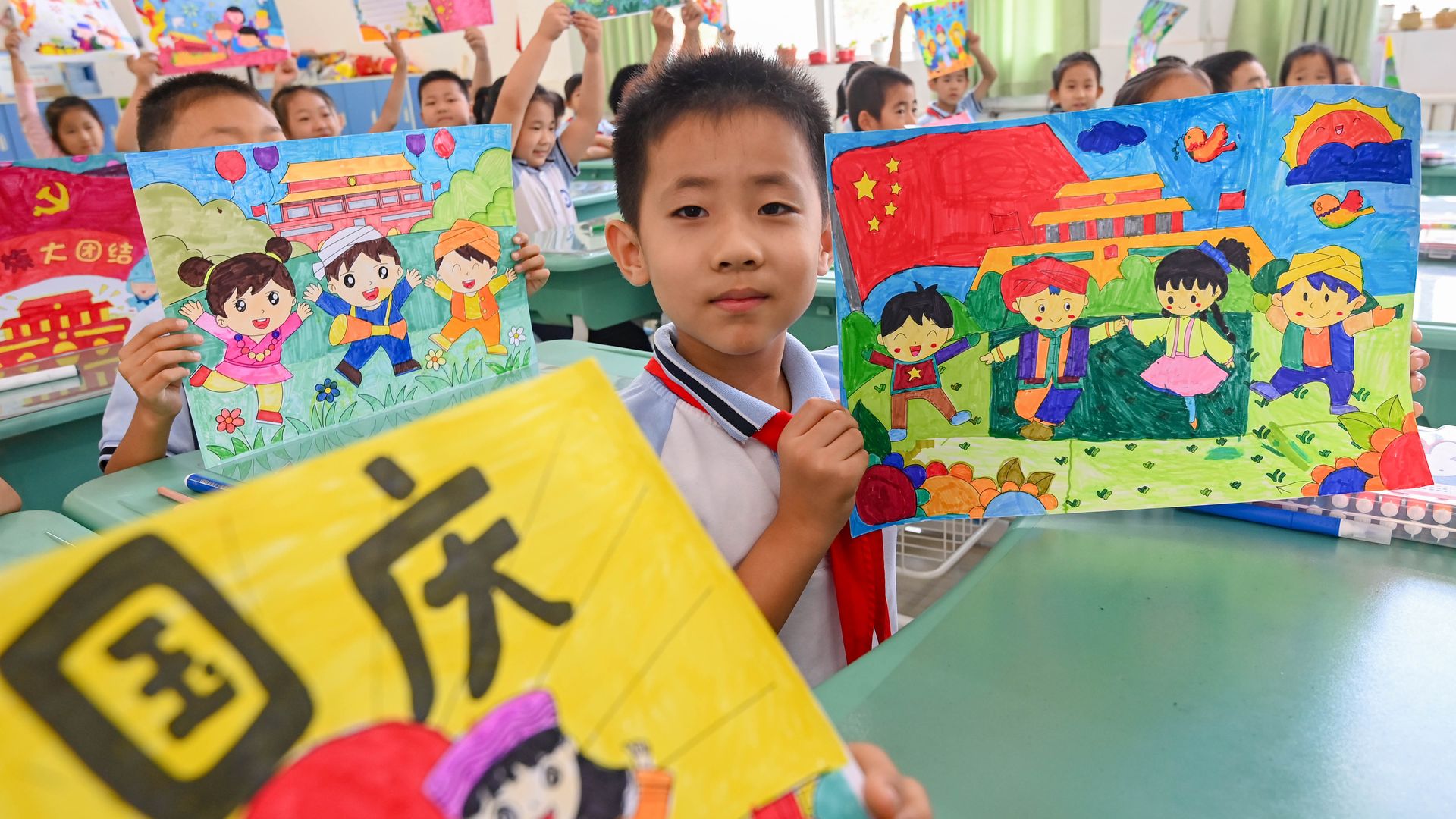
A student displays a painting celebrating National Day in Qingzhou, Shandong province, China, Sept. 27. Photo: CFOTO/Future Publishing via Getty Images
Oct. 1 is National Day in China, when the country celebrates the official founding of the People's Republic of China in 1949.
A big thank you to Alison Snyder for edits and Sheryl Miller for copy edits.
Sign up for Axios China

Analysis and intel from Bethany Allen-Ebrahimian, authority on Beijing intrigue and intentions.