Axios Charlotte

April 04, 2026

Good morning! We're coming into your inbox today with a special edition from our colleague Carly Mallenbaum, who writes about a growing path to parenthood that's colliding with rising costs, uneven laws, and ethical debate.
๐ฅ๏ธ Today's weather: High of 81 ยฐF. Mostly cloudy with a chance of showers in the afternoon.
๐ Happy birthday to our Axios Charlotte members Patricia Crawford, Erika Ross, Cc Arizmendi and April Koda!
- ๐คWe're this close to 1,500 Axios Charlotte members! Just 100 more people needed to hit our milestone. Be part of the moment โ join Axios Charlotte today for as little as 50ยข a week and help fuel local journalism.
This newsletter is 1,011 words โ a 4-minute read.
1 big thing: Surrogacy goes more mainstream


More Americans are turning to surrogacy to build their families, making ethical, legal and cultural tensions harder to ignore.
How it works: A surrogate carries a pregnancy for intended parents โ typically via IVF with an embryo that uses a donor or the intended mother's egg.
- That's called gestational surrogacy, and the surrogate can be referred to as the gestational carrier.
It's an option for people who want biological kids but can't โ or can't safely โ carry a pregnancy.
- It's "not something I would recommend for somebody who doesn't have a medical indication or a reason to do it," says Laura Meyer, reproductive endocrinologist at Illume Fertility.
By the numbers: U.S. clinics reported more than 11,500 gestational carrier cycles in 2023 โ nearly seven times as many as were done in 2004, when the ASRM began tracking the data.
- Yes, but: Less than 2% of all fertility treatment cycles are meant for genetic carriers.
State of play: Surrogacy has become something more people actually picture for themselves, because there are more public figures talking about pregnancy challenges and surrogacy, Meyer says.
The latest: Olympic figure skater Alysa Liu was born via surrogacy. And singer Meghan Trainor recently shared that medical complications from her first two pregnancies led her family to surrogacy for their third child.
- But the headlines on surrogacy aren't all celebratory: Reaction to Trainor's baby news was mixed, and a recent criminal investigation involves the surrogate births of more than 20 children.
The big picture: The topic of surrogacy remains fraught, because it involves complex health and rights implications for everyone involved โ surrogates, intended parents, donors, and the children born.
Support Local journalism

We believe strong communities start with clear, reliable local news.
๐ก Become an Axios Charlotte member today. You'll help power the reporting that keeps you informed on what matters most around your city.
Together, we can ensure our community stays informed.
2. Laws are all over the map

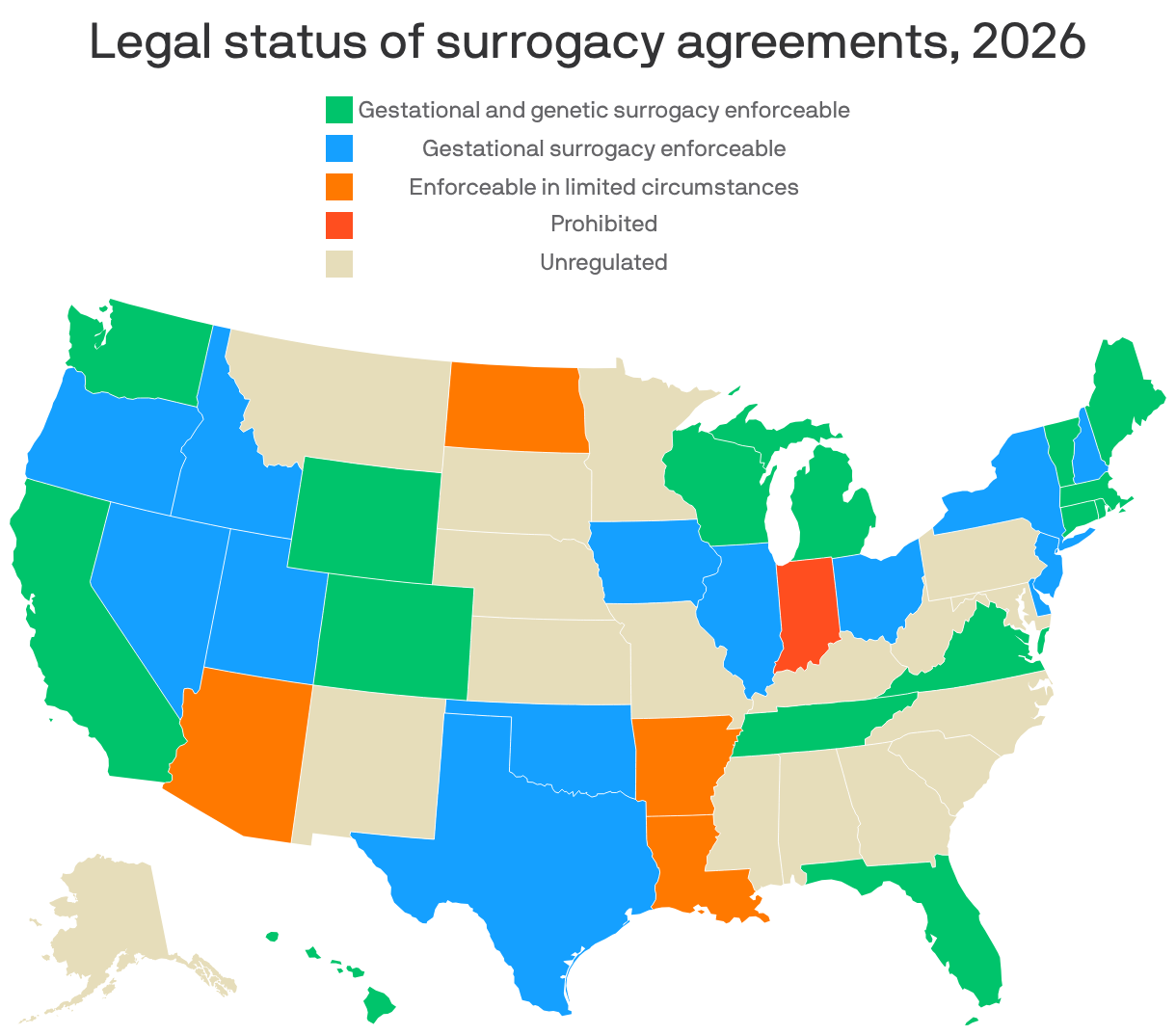
Without a federal law, surrogacy in the U.S. is governed by a patchwork of state regulations that can determine everything from whether agreements are legally binding to who is recognized as a parent at birth.
By the numbers: As of 2026, surrogacy agreements are enforceable in 31 states (with some limitations), void in one, and unregulated in 17, Surrogacy360 tells Axios.
Major differences between state laws include:
- How a surrogate must be compensated (if not considered "altruistic").
- Who becomes the legal parents of a child born via surrogate.
- And whether genetic surrogacy (when the surrogate uses her own egg) is even allowed.
Between the lines: Some state regulations have barriers for intended parents who are single, unmarried, not a heterosexual couple and/or not genetically related to the child.
- And, often, surrogacy agreements happen across state lines, so multiple state laws might need to be considered.
What they're saying: A growing number of lawyers "have begun to specialize in advising either intended parents or being the separate counsel for a surrogate," says Ming Wong, an attorney and the director of community justice and access at the National Center for LGBTQ Rights.
The latest: New surrogacy regulation was enacted in Massachusetts, Michigan and Illinois last year, and in Oregon and Hawaii this year.
3. The steep cost

Surrogacy in the U.S. can cost from $100,000 to more than $250,000, making it inaccessible for many.
By the numbers: According to data compiled by fertility benefits company Carrot, average costs for surrogacy include:
- Surrogacy compensation through an agency: $30,000- $65,000 (doesn't include additional expenses like travel).
- Agency fees: $15,000- $45,000 (could include legal and other services).
- Legal fees: $15,000-$20,000 (includes representation for all parties).
- IVF and other medical expenses: $25,000- $50,000 (more if you do multiple cycles and transfers).
4. Why she wants to become a surrogate

MaRiahh Hodgkinson knows she has "unique" origins: She grew up with a mom and dad โ and an "auntie" who gave birth to her in 1999.
The big picture: Hodgkinson's origins have "always been a part of my family and story," she says. She doesn't even remember a time she was sat down and told about her parentage.
Between the lines: The surrogate is not only Hodgkinson's biological mother but also her aunt โ the wife of a half-brother her adoptive father only discovered as an adult.
- When she learned Hodgkinson's parents had struggled with fertility for years, she offered to help. Their first IUI cycle worked.
"I was just the oven," her auntie would tell her. "You were always your mom's bun."
- Years later, that philosophy is also guiding Hodgkinson's surrogacy journey, this time as the oven.
Her turn: After birthing her own kids โ a son and then twins 19 months later โ Hodgkinson wants to be a surrogate for somebody else.
- "I got whatever crazy gene that is of loving being pregnant," she says. "I want to do it a million more times."
What's next: Hodgkinson already matched with intended parents and is in early talks about carrying their baby โ she's just waiting for her doctor's clearance, at least a year postpartum, before moving forward.
- She found the family not through a Facebook group for intended parents and surrogates.
- Her base compensation: $45,000. "I don't want to get rich off of this," she says.
The bottom line: "I want to bless somebody's family," she says.
๐ฅณ Carly is attending multiple birthday parties.
๐ง McKenzie found this podcast on "The Wild West of the Fertility Industry" from the Washington Journal to be a really interesting listen.
๐๐ปโโ๏ธ Ashley is excited for a long run this weekend.
๐บ Alexis can't wait to stream "The Testaments" on Hulu next week.
๐ Alex really enjoyed the doc "Secret Mall Apartment" and thinks OG NoDa people may find it interesting.
๐ Laura, who edited this newsletter, is currently reading "Little One" by Olivia Muenter.
Sign up for Axios Charlotte