Axios Capital

March 18, 2021
Situational awareness: If you've ever wondered what it's like to participate in a direct-listing roadshow, now's your chance. Coinbase is doing its roadshow as a Reddit AMA.
- In this week's newsletter: How to fund the infrastructure bill, Fed policy in rhyming couplets, a surprising small-business stat, the convergence of stock-market valuations, the problems with measuring the "S" in ESG, Goldman Sachs becomes a boringly profitable bank, the potential for NFTs in the music industry, and much more. All in 1,733 words, a 7-minute read.
1 big thing: The optimism of tax hikes
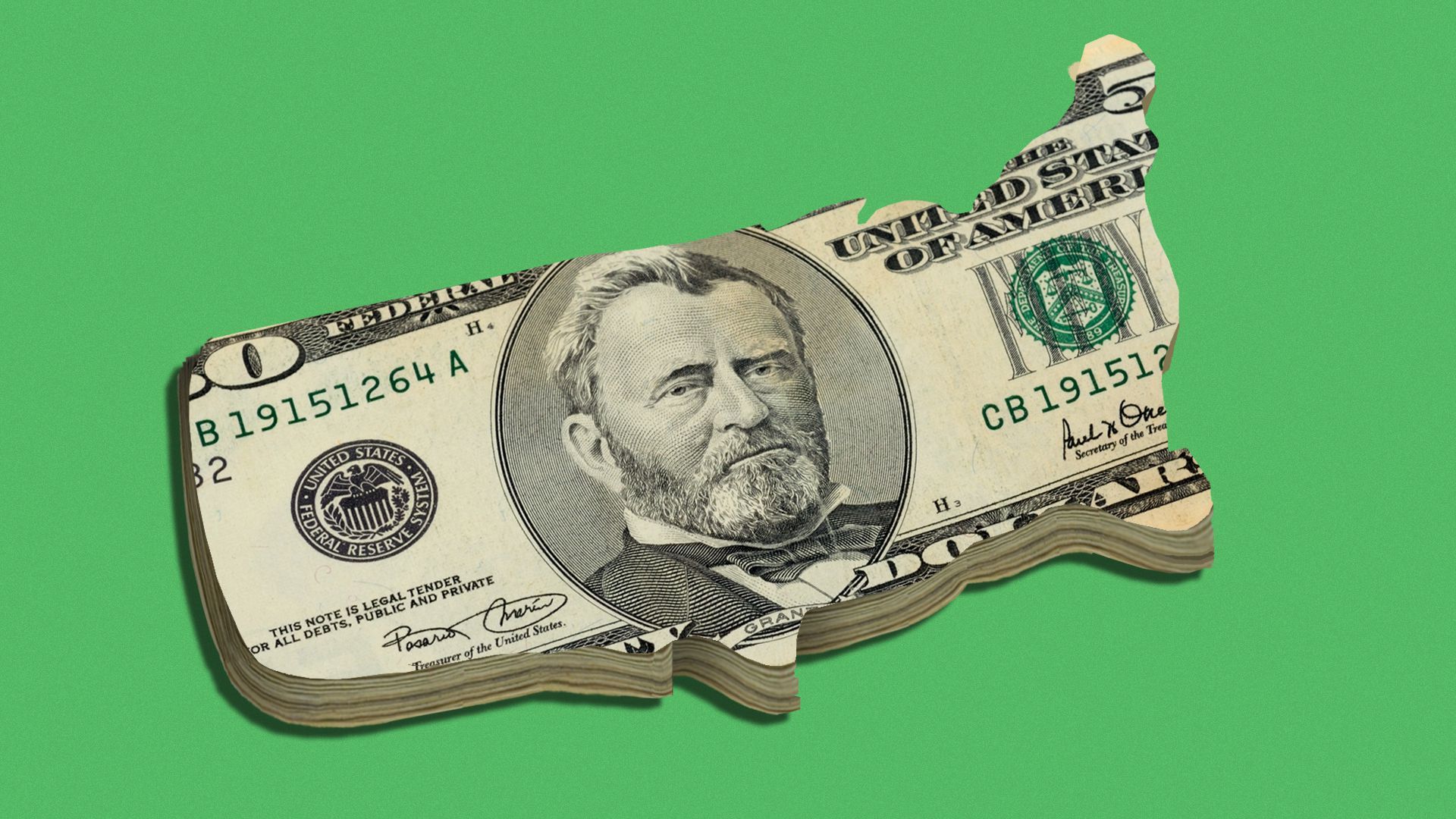
Illustration: Annelise Capossela/Axios
There's optimism in the air. We're vaccinating 2 million people a day, the number of new COVID-19 cases has dropped by 80% in the past two months, and the Federal Reserve now forecasts GDP growth of 6.5% this year — up from a prediction of 4.2% in December.
Why it matters: President Biden's Build Back Better plan was sold as a way to get the nation back to work. Now the Fed says we're already on the road to full employment. That has important implications for how Biden's infrastructure agenda might be financed.
The big picture: Now that he's signed the American Rescue Plan into law, Biden is looking to his next big legislative achievement — a major infrastructure bill.
- The multi-trillion-dollar question is where the money's going to come from.
- Biden has two choices — although in reality he'll end up choosing a combination of both.
Option A is to simply borrow the money. That's a common way to pay for government spending like wars or stimulus programs; it's also the way that Trump's $2 trillion tax cut was paid for.
- Borrowing would, by its nature, be a fiscal stimulus, and would cause inflation hawks to worry that the economy might overheat.
- It would also expand the deficit and the national debt, at a time when both are already at record levels.
Option B is to pay for the spending with new taxes.
- Repealing all or some of the Trump tax cuts would be consistent with Democratic opposition to those cuts in 2017.
- Progressive new taxes could also help redistribute wealth in a country where inequality has been growing for decades. Revamping the estate tax, in particular, could help on that front.
- Biden promised to raise some taxes during his election campaign. As Axios' Hans Nichols reports, raising the corporate income tax could generate about $500 billion, while raising income taxes on the highest-earning individuals could bring in $230 billion.
- A carbon tax would also help to advance the green policy goals of the infrastructure bill.
What they're saying: "A transformational green infrastructure push is just the kind of thing we should be borrowing to fund," writes Bloomberg's Noah Smith — a one-off investment in the economic capacity of the country that will increase our potential growth rate for decades to come.
- The other side: Just because an infrastructure bill makes sense even if you have to borrow to fund it, doesn't mean you should borrow to fund it.
- An optimal economy probably doesn't involve record levels of deficit finance as far as the eye can see; in fact, it probably involves the debt-to-GDP ratio going down rather than up.
The bottom line: Paying for the stimulus would have been self-defeating — it would have made it less stimulative. But now that the economy is growing fast enough not to require more stimulus, there's much less need for further deficit spending.
2. The Fed's stance, in verse
Screenshot: Ben Casselman (Twitter)
New York Times economics reporter Ben Casselman has versified Fed chair Jay Powell's press conference on Wednesday.
The main message: The Fed isn't going to hike interest rates. It's not worried about rising inflation expectations, and it won't even be worried if actual inflation rises substantially above 2% this year.
- Even the headline unemployment rate could fall below the 4% "full employment" rate and not cause the Fed to consider the economy to be at full employment. After all, the number of jobs in the economy is still far below pre-pandemic levels.
The bottom line: The only reason for the Fed to hike rates is because it's worried about inflation rising too much. And the Fed is not worried about that. In fact, it still wants inflation to be higher.
3. Small businesses boom


If it didn't kill your small business, the coronavirus pandemic probably made it stronger. That's the message of a new poll from Kabbage, a unit of American Express.
- By the numbers: Kabbage polled small businesses that were still in operation in February, and found that almost all of them were doing better than they were before the pandemic.
- The smallest businesses, with fewer than 20 employees, underperformed firms that were larger — but even they reported growth in both revenues and employees.
- Larger businesses, with more than 100 employees, said their headcount, their sales, and their profits were all about a third larger in February than they were a year previously, before the pandemic hit.
The bottom line: The U.S. government was always a bit unclear whether the paycheck protection program was designed to help small businesses' employees, or whether it was designed to help the businesses themselves. This evidence suggests that it probably did a bit of both.
4. Now non-tech stocks are expensive, too


The stock market continues to hit new highs, with the S&P 500 tantalizingly close to reaching the 4,000 level. That means the index is trading at about 32 times its profits over the past 12 months.
- Tech stocks, by contrast, have been lagging recently as long-term interest rates rise.
- High future profits from technology companies have a lower present value when rates go up.
By the numbers: The information technology sector of the S&P 500 is trading at just under 35 times trailing earnings. That's still high, by historical standards. But it's only about 8% higher than the market as a whole.
5. ESG's missing middle

Illustration: Aïda Amer/Axios
Most institutional investors care about ESG — the environmental, social, and governance aspects of the companies they help to fund. Increasingly, they're demanding rigorous metrics that can quantify how any given company is doing on those three axes. Or two of them, at least.
The catch: Governance is relatively easy to measure, and environmental impact reports are becoming much more directly comparable, thanks to international standards from organizations like the Sustainability Accounting Standards Board and the Taskforce on Climate-related Financial Disclosure. But the social part of ESG is much harder to quantify.
How it works: "There is no over-arching framework for S," writes NYU professor Michael Posner, "and practitioners cannot agree even about what subjects should be measured under this category."
The big picture: The "S" means very different things to very different people. For one person it might mean examination of a manufacturer's supply chains to see whether there's any abusive practices; for another, it might mean an examination of whether social media companies like Facebook have a deleterious effect on democracy.
- Data providers like Refinitiv are happy to pass along self-reported data from companies — but not many metrics are broadly reported, and those that are reported tend not to be the most important.
By the numbers: Refinitiv has some 140 different categories under the "S" component of ESG — far too many to be useful, especially when most of those categories are empty for most public companies. (For private companies, reporting is even worse.)
- The only third parties willing to deeply examine and publicly report on the way that companies impact society tend to be investigative journalists. And journalism is impossible to quantify or apply evenly across companies.
The bottom line: ESG has done a good job of being sold as a tool for investment outperformance. But it's struggling when it comes to identifying and quantifying objective moral and social imperatives.
6. Goldman gets efficient


Goldman Sachs was a partnership from 1869 to 1998 — a company where all the profits go to the partners who work there. It kept that ethos even after it went public — it "retained some of the sensibility of a private partnership," as Bloomberg's Matt Levine writes.
Why it matters: David Solomon, the CEO of Goldman since 2018, has decisively changed all that.
- "This is the first management team in a long time that actually pays attention to the shareholder," former Goldman president John Thornton told Bloomberg.
- Kate Kelly of NYT reported that Solomon has cut payouts to partners, even as profits have risen steadily.
How it works: Banking has become more boring since the global financial crisis of 2008-09. The Volcker Rule has forced banks to rein in risk-taking, while the increasing sophistication of financial markets has meant that banks have a greater need for software engineers than they do for adrenaline-junkie traders.
- While coders get paid well, they don't generally receive the multi-million-dollar trading bonuses of yore.
By the numbers: If you don't pay excess profits to your employees, that allows them to be claimed by shareholders. Goldman stock has soared to an all-time high of $345 per share, thanks in part to the fact that last year the bank paid less than 30% of its revenue back to employees in the form of salary, bonuses, and benefits.
- At Morgan Stanley, by contrast, that ratio was over 43% last year.
The bottom line: Goldman formally became a bank the Monday after Lehman Brothers filed for bankruptcy. But it took another decade for it to start acting like one.
7. The 🎵 use case for NFTs


The biggest NFT sales to date have been in digital art, but digital music could be a much bigger opportunity.
How it works: The overwhelming majority of music revenues now come from streaming, with less than 6% coming from digital downloads, per the RIAA. Artists and genres appealing to a younger audience see almost no downloads at all.
- Fandom, however, remains, and there is almost no limit to how much fans are willing to pay to express their allegiance to their favorite artists — especially if that allegiance has potential speculative value.
The state of play: Currently, artists release their singles and albums digitally in unlimited editions, normally at a price of 99 cents per song or $10 per album.
- If those downloads were replaced with limited editions of say 10,000 NFTs per single, the price could be orders of magnitude higher — and could attract buyers who currently have no interest in downloads.
- The NFTs would become collectible objects, with a resale value that might even go up over time.
Driving the news: Kings of Leon released their new album as an NFT, but that comes with physical limited-edition vinyl that needs to be shipped and, unlike the blockchain, can degrade over time.
- It'll be more interesting to see whether artists start releasing NFTs of all their new songs purely digitally, at the same time as the streaming release, just as a matter of course.
- Of note: Blockchain startup Crypto.com chose a music-publishing expert, Joe Conyers III, to lead its new NFT practice.
8. Coming up: EU leaders meet
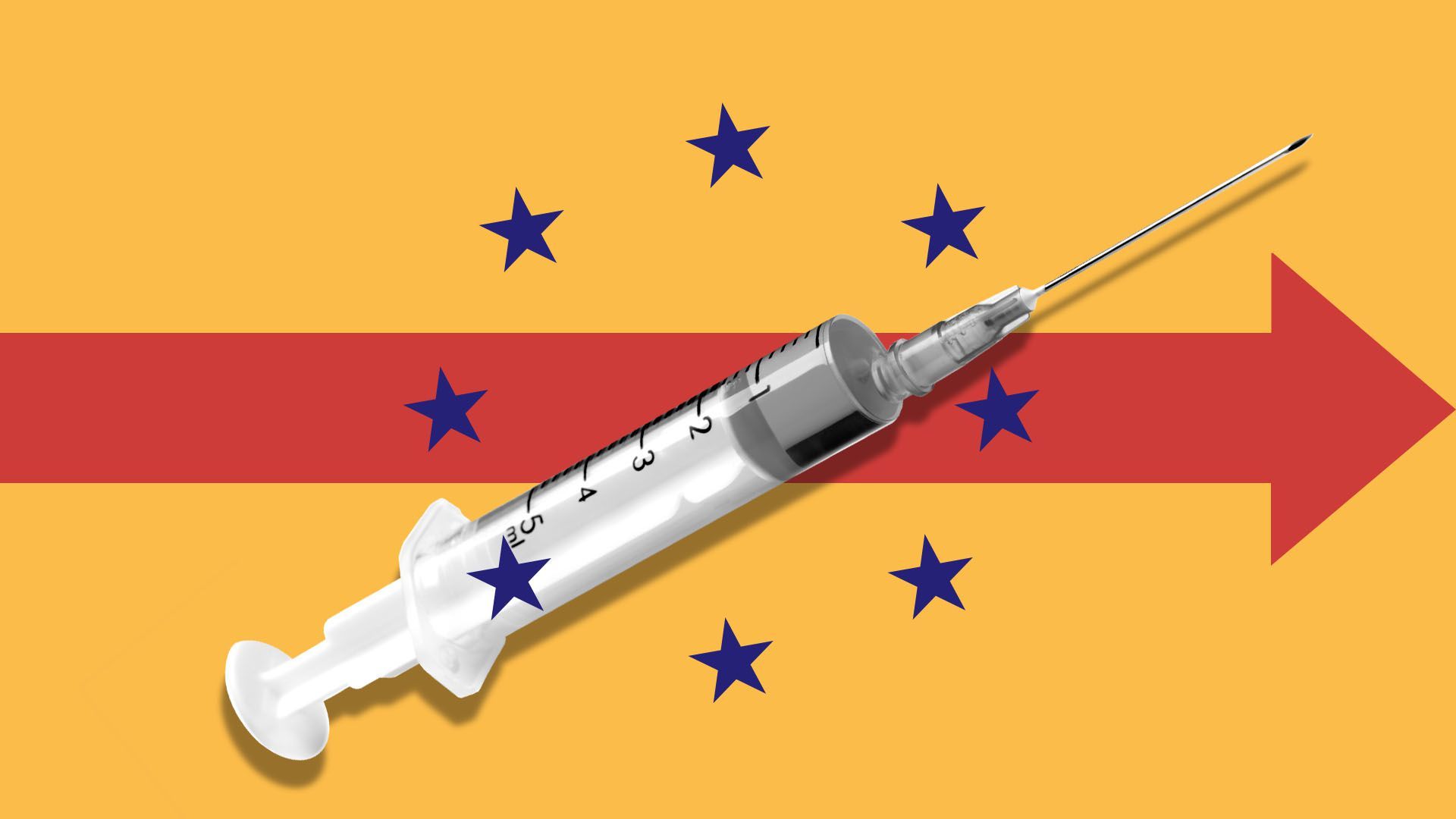
Illustration: Sarah Grillo/Axios
Leaders of EU countries will meet in Brussels next Thursday, writes Axios' Courtenay Brown. The pandemic is at the top of the agenda.
Why it matters: Europe is facing another coronavirus wave. The vaccine rollout is lagging across the bloc, especially after shots of the AstraZeneca vaccine were halted across much of Europe.
- Leaders are set to debate "digital certificates" that could allow free travel across EU nations this summer for vaccinated Europeans and those who have recovered from the virus or who have negative COVID-19 status.
9. Building of the week: Mars House
Image: Krista Kim
Mars House, designed by artist Krista Kim in collaboration with music from Jeff Schroeder of the Smashing Pumpkins, describes itself as "the first NFT digital house in the world."
- According to the architect, "the home and all of the furniture in it can be built in real life by glass furniture-makers in Italy."
- The house sold this week on SuperRare for 288 ether — about $515,000.
Sign up for Axios Capital

Learn about all the ways that money drives the world