Axios C-Suite

March 28, 2026

Happy Saturday ... Axios CEO Jim VandeHei here, lab-testing my new Saturday intel report for CEOs and their inner circles. It's written by me (a two-time CEO) for you (a CEO and your top team).
This is a BETA run for about 500 CEOs close to Axios and me. The list will remain confidential. Invites will expand to others in the weeks ahead. It'll go live in a few weeks and will be free.
- My aim: A blunt, illuminating, insanely useful intel briefing with a heavy bent toward AI, politics, big data and trends.
- My ask: Hit reply. I want equally blunt feedback on how to make this more indispensable. Or ping me with topics you think I should tackle.
What you can expect today (Smart Brevityβ’ count: 2,357 words ... 9 mins.):
- π° Lawyer up!
- π¨ New biz threat
- πΎ Tons of AI intel
π« If you'd like to suggest other CEOs or your C-suite members, hit our Axios C-Suite concierge, Madeleine Woolgar. (OK, she's my EA, but that sounds fancier.)
π¦ I'm interviewing Jamie Dimon this week for "The Axios Show" (past episodes here), so shoot me any brilliant CEO questions.
1 big thing: What I learned this week
I'm going to share intel picked up from top officials in government, AI and business. It was shared confidentially, but with the knowledge I'd use it without sourcing it.
- Democratic hit list. If Dems win the House (highly likely), they'll use oversight and subpoenas to target monopolies, AI, social media and pharmacy benefit managers (PBMs).
The subpoena list is expected to include:
- Law firms that signed deals with President Trump.
- Media giants that settled.
- Donors to Trump's White House ballroom.
- Top execs who negotiated to give the government a stake in their companies.
- Profit-enablers of Trump family or families of Cabinet members.
- Media moguls Larry and David Ellison.
Get ready: Trump can blow off subpoenas. You can't. If you did deals with Trump or kicked in cash for building his projects, lawyer and lobbyist up.
2. π¨ New ... Threat alert: I don't mean to freak you out, but Anthropic is privately warning top government officials that its not-yet-released model β Mythos β makes large-scale cyberattacks MUCH MORE LIKELY in '26.
I previewed this more cryptically in a column on Thursday. The blunter version: The model allows agents to work on their own, with wild sophistication and precision, to penetrate corporate, government and municipal systems. It's a hacker's dream weapon.
- One person briefed said it seems almost certain a large-scale attack will hit THIS YEAR. Businesses are ripe targets.
- Anthropic hasn't released it, but Fortune got its hands on an unpublished blog post from the company describing Mythos: "It presages an upcoming wave of models that can exploit vulnerabilities in ways that far outpace the efforts of defenders."
3. Trump's three war emotions: His war strategy is 75% improvisation, 25% strategy beneath him. I'm big on watching what Trump does, not says. He's moved war machines and people four times now (June strike on Iran, before the current war, plus Venezuela and Middle East reinforcements the past week). So far, he's never moved weapons without using them.
I'm told Trump shifts between three war emotions in this order:
- Fear (rising energy prices, falling stock prices).
- Anger (no credit for military success).
- Happiness (loves the unilateral power and stunning visual results).
Fun/scary fact: Trump gets frequent sizzle reels of the U.S. military blowing stuff up. He eats this up.
π¨π¨π¨ Reminder to email me if you want other CEOs/your inner circle to get this in the future.
2. Your new cyber threat
We'll all face a new security threat at work β one that the new Anthropic model mentioned above, or similar ones by others, dramatically heightens.
The coming AI models are even better at powering agents to think, act, reason and improvise on their own without rest or pause or limitation.
- Think of a warehouse full of the most sophisticated criminals who never sleep, learn on the fly and persist until successful β except the warehouse is infinite.
βΌοΈ What YOU need to know: Your systems are more vulnerable because so many people at your company are firing up Claude, Copilot or other agentic models β often at home β and creating agents of their own.
- These can connect unbidden to internal work systems, opening a new door for cybercriminals to enter.
- The industry has a name for this: "shadow AI." A Dark Reading poll found that 48% of cybersecurity professionals now rank agentic AI as the #1 attack vector for 2026.
The bottom line: You need your entire staff to know right now the dangers of using agents, especially unsupervised, anywhere near sensitive information.
- My tech team says this is the biggest threat to our company right now.
- Yours can build a safe "playpen" for work-related AI experiments using agents. We're scrambling to finish ours.
Ask your CISO one question this week: Do we know how many unauthorized AI agents are running inside our systems right now? If the answer is no β and it probably is β that's your starting point.
- π± Why wait? Text this item to them.
Related worthy read: Palo Alto Networks' Global Incident Response Report 2026.
- The line that should give you heartburn: "In the fastest cases we investigated, attackers needed just 72 minutes to move from initial access to data exfiltration, 4x faster than last year."
3. The AI job transformation and you
Keep an eye on federal and state ideas for rewarding and punishing companies that replace workers with AI.
- I'm convinced AI societal consequences will dominate '28 and produce stridently anti-AI candidates on BOTH sides. Listen to Bernie Sanders or Steve Bannon for a preview.
Why it matters for CEOs: Anyone managing headcount decisions right now is one bad quarter away from being at the center of this political debate.
The big new idea: AI investor Alap Shah, co-author of last month's viral Citrini Research paper, is out with a plan that includes a corporate tax mechanism where firms reliant on human workers would pay less, while companies generating huge output with fewer employees would pay more.
- Translation: If your margins are expanding while your headcount collapses, your tax rate goes up.
- Shah's plan includes a "circuit breaker" that would trigger automatic stabilizers β wage insurance and expanded income support β if AI-related job displacement spikes, measured by labor's share of GDP. Think of it as a fiscal fire alarm wired to the macro data.
- As Shah told our super-plugged-in Axios Macro authors Courtenay Brown and Neil Irwin, if nothing gets passed and the worst scenario materializes, it won't be Armageddon β but it will be "panic legislation, which is ultimately not how you want to do this."
The counterpoint: Yale Budget Lab's Martha Gimbel argues that the unemployment insurance system, while sometimes clunky, already exists in all 50 states and has a strong track record of responding to technological disruption.
The bottom line: The CEOs driving the fastest AI adoption are simultaneously creating the political conditions for their own regulation.
π£ Bonus: CEO quote of the week
"I think it's now. I think we've achieved AGI [artificial general intelligence]."β Nvidia CEO Jensen Huang on the Lex Fridman Podcast.
4. Why your HR head is freaking out
Check in on your head of HR: They are β and should be β rattled by three unfolding realities.
- Everyone fears new layoffs, even if you aren't planning them.
- Be honest, most of you are. I've talked to very few CEOs who don't plan to trim staff in the coming year β even if they plan future growth.
2. Most HR heads aren't AI savvy, yet they assume AI will be the biggest pain in their ass in '26.
- 91% of CHROs now rank AI and workplace digitization as their most immediate concern, per the CHRO Association's 2026 survey.
3. Their job will fundamentally change βΒ and fast.
- The HR functions that are purely administrative (scheduling, screening, form-filling, policy Q&A) should already be handled by AI.
- The next tier (performance, comp, L&D, retention prediction) is being built now, both internally and by outside firms.
- What's not automatable and won't be: culture design, executive coaching, change management, ethical judgment calls and the messy human work of managing through transformation.
What I told my head of HR: Plot to automate everything as fast as possible by the end of this year. Assume our future HR role is much more about culture building, therapy and training of top talent, and letting agents do the rest.
π― Weird shit to watch: Digital twins of employees. Gartner reported earlier this year that digital twins or AI avatars are being developed to replicate high-performing employees.
- Think of AI versions of you: your knowledge, habits and behaviors. This opens uncharted territory in compensation. Ask yourself: who owns the value of a replicated worker's expertise?
- I'm not shying away from this reality. My JimGPT and ClaudeCEO brains are spooky good. I'll share how to build your own AI YOU in a future edition.
β€οΈ Do good: Thank your head of HR. They deal with more crazy, stressful, weird human crap than any of us.
5. Your future foretold

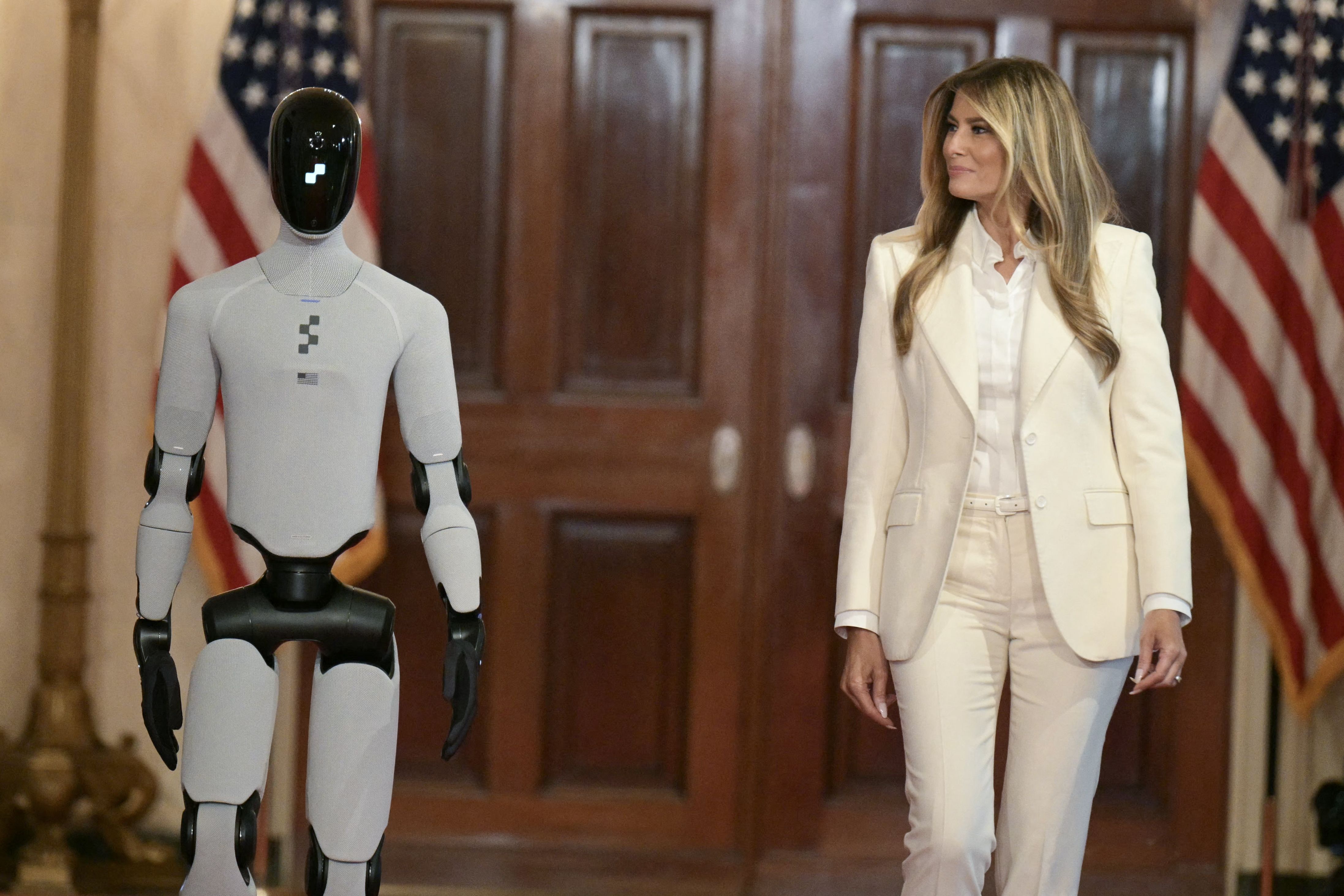
A humanoid robot made by Figure AI strolled alongside First Lady Melania Trump into the East Room β the first time, almost certainly not the last, that one has strolled the White House.
- It delivered opening remarks at Trump's Fostering the Future Together Global Coalition Summit with first spouses from 45 countries, then welcomed guests in 11 languages with flawless pronunciation before walking itself back down the Cross Hall.
- Creepy? Yup. But that will be YOU in front of staff soon.
Fun facts: Figure AI was founded in 2022. It's now valued at $39 billion after raising over $1 billion in its Series C β a 15x valuation jump in just 18 months.
- Investors include Nvidia, Microsoft, Jeff Bezos, Intel, Salesforce and the OpenAI Startup Fund.
The business model to watch: Figure charges roughly $1,000/month per robot β a "Robot-as-a-Service" subscription that covers hardware, software updates and maintenance. No massive capex. Think SaaS, but the software has legs.
- The crowded humanoid robotics race includes Tesla, Boston Dynamics, and a wave of Chinese competitors.
β οΈ On the China front, they're crushing us.
- The country has over 140 humanoid robot manufacturers that collectively launched more than 330 different models by the end of 2025.
- Premier Li Qiang elevated "embodied intelligence" to a strategic national priority in the 2026 Government Work Report for the first time β putting humanoid robots alongside quantum and 6G in China's 15th Five-Year Plan.
The next frontier: Humanoid soldiers are already in Ukraine.
- Foundation, a San Francisco startup, sent two Phantom MK-1 humanoid robots to Ukraine in February for frontline reconnaissance β believed to be the first humanoid deployment to any combat theater.
- The company holds $24 million in research contracts with the U.S. Army, Navy and Air Force and plans to build 50,000 units by the end of 2027.
6. Smart bomb: Insane D.C. volatility
Two quick stats to help explain why volatility is the norm β and seemingly permanent β in Washington politics.
- Every president back to Bill Clinton enjoyed at least two years of full party control of Washington.
- No period of full party control has lasted more than two years for our last three presidents.
The chart below, adapted from Republican lobbyist and Substacker Bruce Mehlman, captures this vividly.
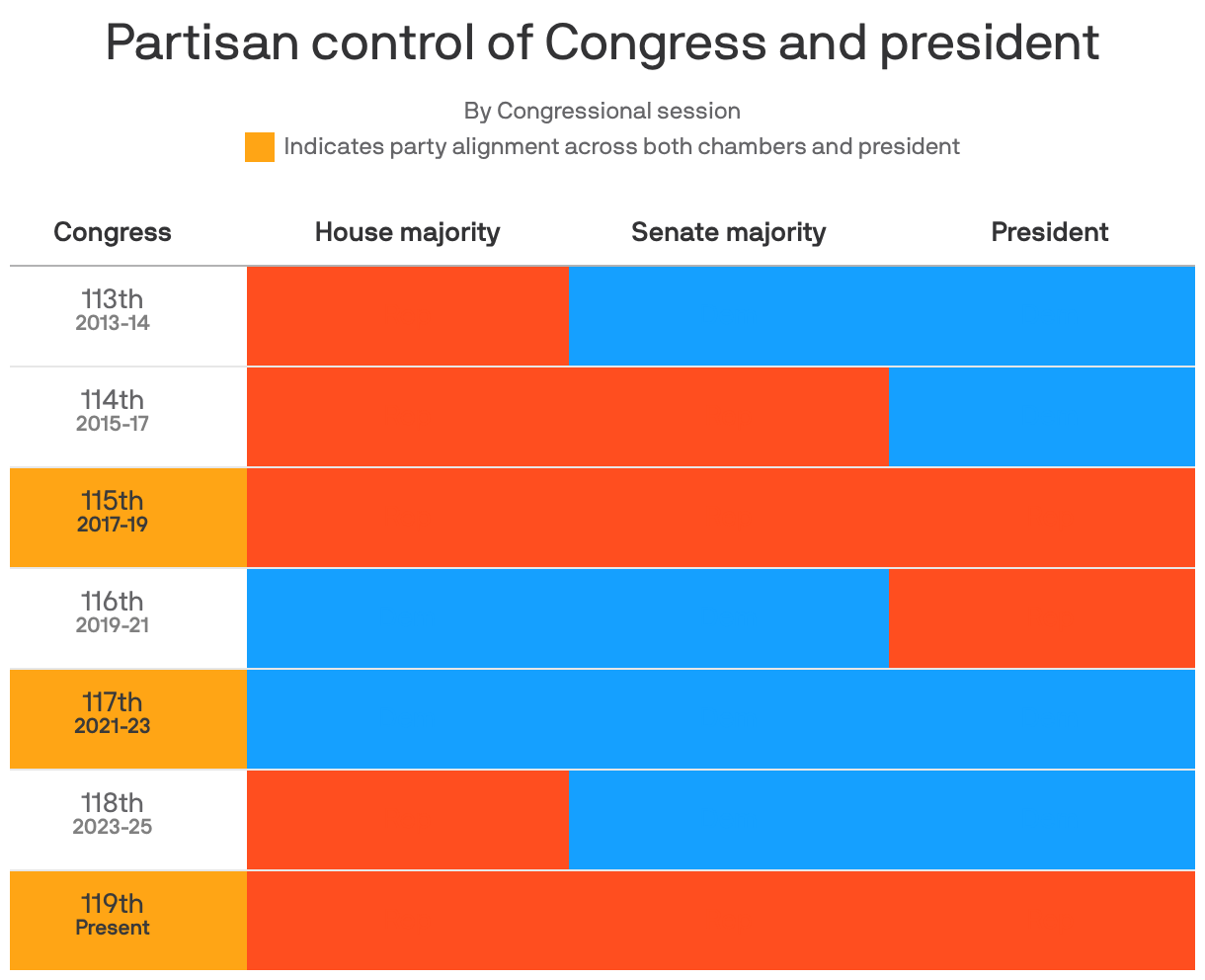
What it means, via Bruce:
- Government struggles to do anything that demands long-term consistency, such as reshoring semiconductor manufacturing.
- Businesses need friends on both sides of the aisle to win policy battles and then protect gains, even when pressured to cut ties by the winning party.
- Successful navigation of Washington demands anticipating insane volatility and assuming and operationalizing agility.
Bruce is an Axios favorite. His charts and trends are always smart, never partisan. Sign up here.
7. CEO-in-waiting to know: John Ternus
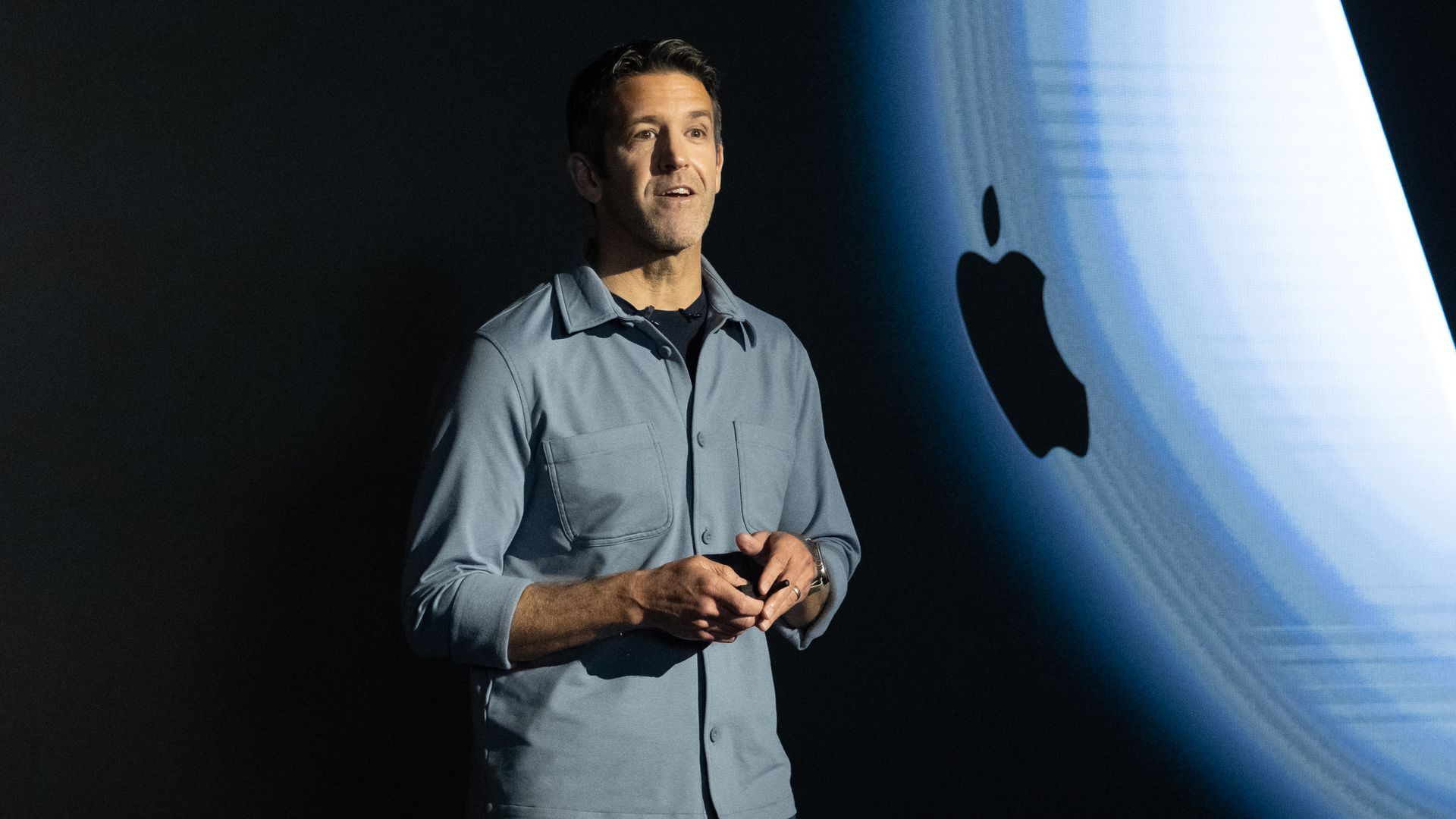
Apple let John Ternus, its hardware chief β not Tim Cook β unveil the MacBook Neo. And a sweeping Bloomberg Businessweek profile this week made a pretty strong case that John Ternus is up next in Cupertino.
- His philosophy: On noticing 35-groove screws in Apple's Cinema Display instead of the specified 25: "I distinctly remember stepping back for a minute and thinking to myself, 'What the hell am I doing? Is this normal?' ... I realized it might not be normal, but it's right." (UPenn commencement address)
- His idea of fun: "A cycling and car-racing enthusiast, Ternus is known to take his colleagues to upstate Washington for off-road rally car racing." (Bloomberg)
- His "favorite child" at Apple: AirPods. "That was enabled by technology that we built in-house, and I think β I don't think, I know β it fundamentally changed how people use earphones." (CNBC)
- His big fumble: He "was a driving force behind the Touch Bar, which replaced the top row of physical keys on MacBook Pro keyboards with a touchscreen. 'He shoehorned it in ... ,' says someone familiar with the work." (Bloomberg)
8. 1 influencer to know
I'm obsessed with America's shards of glass phenomenon. This is the idea that there are hundreds of information bubbles forming based on age, politics and interests.
- Every week, I'm going to introduce you to a different influencer. Maybe you know them, maybe you don't. But you damn well know somebody who trusts them.
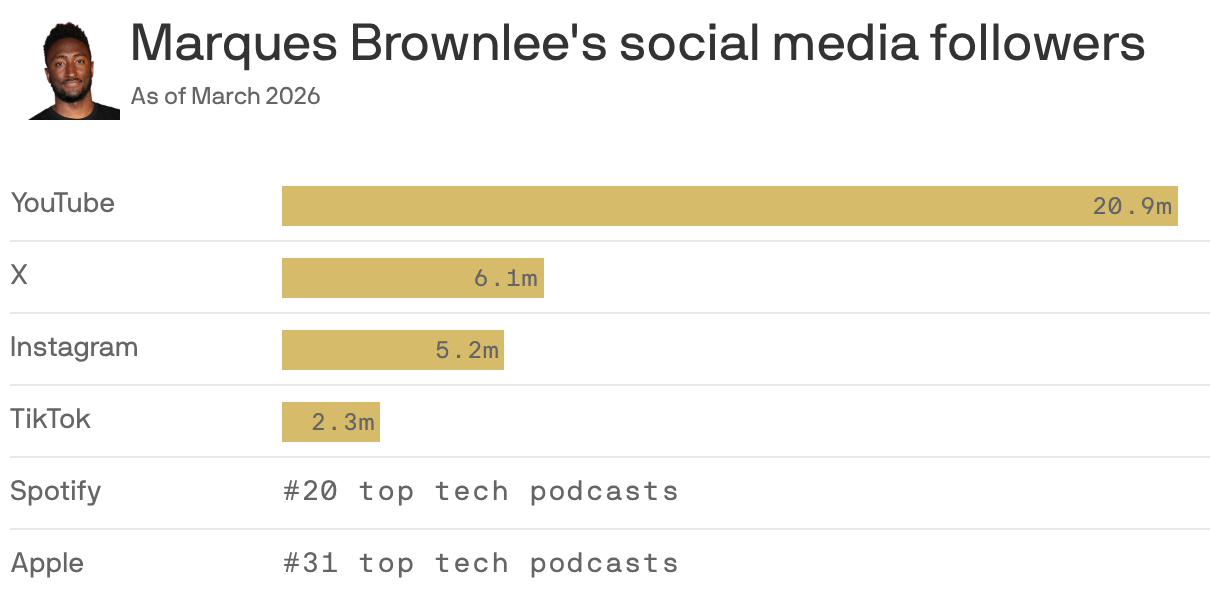
32-year-old Marques Brownlee β often referred to by his handle, MKBHD β is arguably the most influential consumer tech reviewer on the planet. He has become the trust layer for an entire generation's technology purchasing decisions.
9. π§ Worthy of a listen
Check out Tim Ferriss' interview with Jim Collins on his book "What to Make of a Life," out April 7.
Why it's worth your time: It's a reminder that some of the most successful people across history and industry βΒ from Roger Sherman to Toni Morrison βΒ did their best work in their 50s, their 60s, their 70s.
- I'm biased. I'm 55, and I agree.
A new-ish term: encoding β We're hardwired with talents or gifts that often get revealed in new, bad or simply unanticipated situations.
Was this useful? Share it with a fellow CEO, CFO or CHRO who needs it. And send me what's keeping you up at night: [email protected].
- Written by Jim VandeHei | Edited by Shane Savitsky | C-Suite is powered by the reporting and insights of the full Axios newsroom.
Sign up for Axios C-Suite