Axios Boston

September 18, 2025

Hello, Thursday. Enjoy the summer weather while you still can.
☀️ 78º/61º.
Today's newsletter is 1,090 words — a 4-minute read.
1 big thing: The business case for research funds
Boston-area business leaders revived a multi-state coalition in hopes of saving federal research funding.
The big picture: The stakes are much higher this time around for the Business for Federal Research Funding coalition, as the Trump administration seeks to downsize the federal government and punish institutions that don't follow the federal agenda.
- The coalition first formed in 2014 and went on hiatus during the COVID-19 pandemic.
Between the lines: Business leaders are urging lawmakers to consider the economic consequences of research cuts, says Chris Eicher, vice president of government relations for the Greater Boston Chamber of Commerce.
- Massachusetts and other states are already losing talent to institutions overseas, hurting states' competitiveness against major rivals like China.
- Further research cuts could cost states their edge in medical, defense and technological research, Eicher added.
State of play: Ecker and business leaders across 35 states met with congressional representatives on Capitol Hill on Wednesday.
- The bipartisan coalition asked lawmakers to maintain current levels of federal research funding in the next spending bill and to release frozen funds that had already been approved.
By the numbers: Business leaders representing Massachusetts have pointed to a recent UMass Amherst Donahue Institute study that shows research funding supports 81,300 jobs and more than $16 billion in economic activity.
What they're saying: "We've led the world in research funding of all types in innovation and patents for a very long time, and this is not the time to retreat from that," says Jim Rooney, president and CEO of the Greater Boston Chamber of Commerce.
Zoom in: Several Boston-area institutions have laid off workers or paused projects in light of federal funding cuts.
- Massachusetts' life sciences industry alone has lost nearly $500 million in 2025 in federal funding, and its lead on China has shrunk compared to previous years.
- The Broad Institute laid off 75 workers and cut expenses in July in anticipation of federal funding cuts for scientific research, the Harvard Crimson reported.
Keep reading: What's next
2. 🧸 Meet Sasha, the life-saving bear
A teddy bear that saved a Jewish family from certain death in a Nazi concentration camp will soon call Holocaust Museum Boston home.
Why it matters: Sasha, an 81-year-old teddy bear, is one of several artifacts that will tell the story of those who were persecuted under Adolf Hitler's regime, and those who managed to escape.
Driving the news: Jody Kipnis, president and CEO of the museum, plans to create a permanent display for Sasha as part of an exhibition on ghettos.
- Sasha is known for saving the life of young Michael Gruenbaum, who later became a civil engineer for the Boston Redevelopment Authority and the state Department of Public Works, before starting his own consulting firm.
What they're saying: "I kind of echo what my dad used to say: 'Sasha is the reason I'm here,'" David Gruenbaum tells Axios.
- He and his siblings became Sasha's custodians after their father died in 2023.
Kipnis picked up Sasha from the Gruenbaum family on the West Coast over Labor Day weekend.
- She says she wants the bear's display to "tell the story of resilience, resistance and strength."
Flashback: Michael, his sister Marietta and their mother Margaret were in the Terezín ghetto in Nazi-occupied Czechoslovakia in 1944 when they learned they had been selected to board a train to Auschwitz.
- Margaret had worked in the arts department, making teddy bears as Christmas presents for Nazi officers and their friends, per the Gruenbaums.
- She asked her boss to tell the Nazi officer overseeing the arts department that the children wouldn't get their Christmas gifts if her family left.
- The officer wrote a note that got them out of the line to board the trains, saving them from the gas chambers.
- The family survived and eventually immigrated to the U.S.
What's next: The museum, which is under construction on Tremont Street, is set to open in late 2026.
3. 🔙 Back That Mass Up: Hasbro tax credits
💰 A state board approved a tax break of up to $14 million for Hasbro to move to Boston if the toymaker meets certain hiring requirements. (BBJ)
Marwa Khudaynazar, a former City Hall employee, is suing Mayor Michelle Wu over her firing after she accused cabinet official Segun Idowu of misconduct (Boston Globe)
- Wu's office and the Boston Police Department declined comment to the Globe.
❌ Ben & Jerry's cofounder Jerry Greenfield quit the ice cream maker after nearly 50 years, saying parent company Unilever has silenced the company's ability to speak up on political issues, including the war in Gaza. (CNBC)
- A Unilever spokesperson said it disagreed with Greenfield's perspective and that it sought to discuss with the co-founders "how to strengthen Ben & Jerry's powerful values-based position."
🛵 Boston City Councilor Ed Flynn wants to ban mopeds and e-bikes for food delivery, though other councilors suggested outreach and education to get the drivers to obey traffic laws instead. (UHub)
A Massachusetts Appeals Court judge denied a motion to stop a lower court ruling that ordered Shannon O'Brien's reinstatement as chair of the state's Cannabis Control Commission. (Globe)
4. Boston's slime space
The Sloomoo Institute, Manhattan's interactive slime "museum," is opening a retail shop at Faneuil Hall this fall.
The intrigue: The space, called the "Sloomoo MiniMoo," will let children and adults alike play with slime, learn how to make it and enjoy art.
Driving the news: The retail shop plans to open Nov. 18 out of Faneuil Hall with a "slime bar," installations and slime-making classes.
- The institute is also opening a new retail space in King of Prussia.
5. 🤖 Where people want (and don't want) AI


Americans say they're comfortable with AI helping develop new medicines or forecast the weather, but most don't think it should play a role in relationships, religion or creative tasks.
- That's according to a new report released Wednesday from Pew Research Center.
By the numbers: Americans see AI as a way to boost efficiency, but they remain wary of handing over decisions tied to values, relationships or democracy, Pew found.
6. 👟 1 pedestrian-only street to go
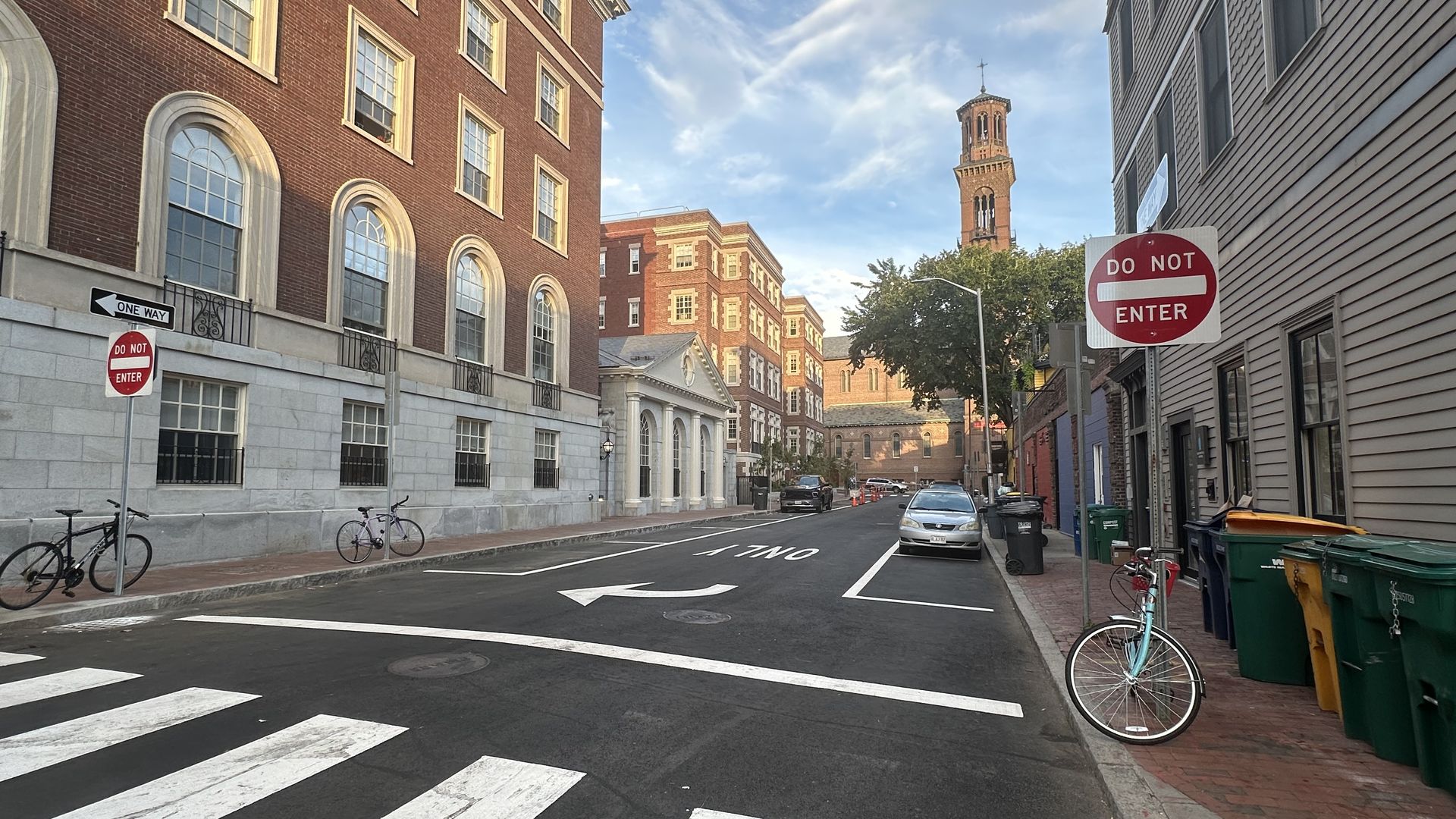
A section of Bow Street will be permanently closed to traffic to make room for pedestrians and outdoor dining spaces next spring.
- Imagine the dumpsters stowed away and the cars out of sight, replaced by tables and umbrellas.
Deehan had a throwback kind of night at the Hong Kong and probably isn't feeling that great this morning.
Steph wants to see more pedestrian-only streetscapes, but is probably in the minority here.
This newsletter was edited by Jeff Weiner.
Sign up for Axios Boston