Axios AI+

July 02, 2024

At the end of its term, the Supreme Court dropped a doozy of a game-changing decision — and no, we're not talking about that presidential immunity thing. Today's AI+ looks at this decision's seismic impact across the tech landscape.
Today's newsletter is 1,234 words, a 4.5-minute read.
1 big thing: SCOTUS drops bomb on Big Tech regulation
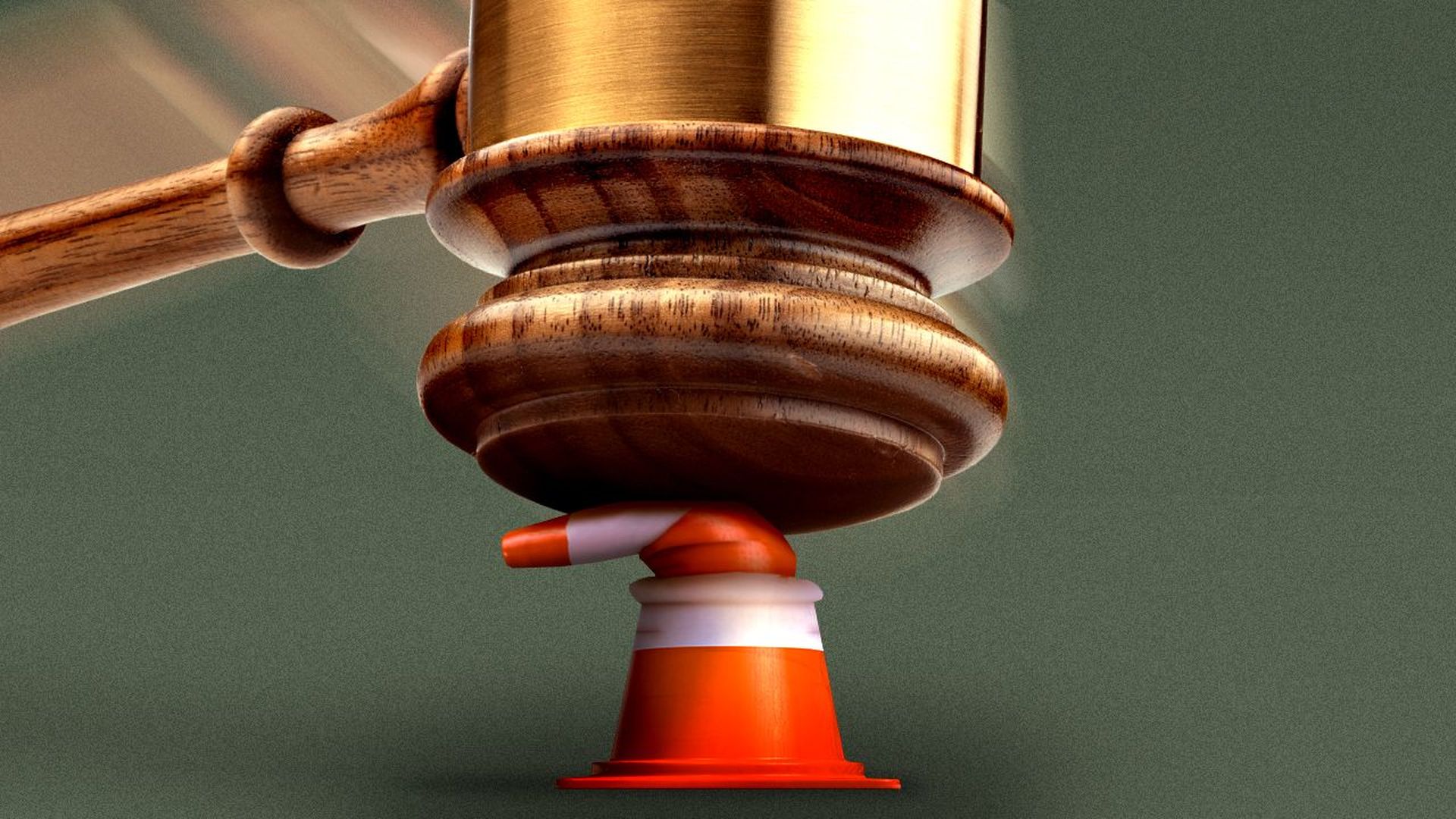
The Supreme Court's decision Friday limiting executive branch power also further hobbled U.S. government efforts to roll back Big Tech's power.
Why it matters: Tech giants' reckless behavior and their products' social harms have long fueled efforts to pass new federal laws limiting the companies' influence — but now, and for a long time to come, advocates will need to find other ways to achieve that goal.
Driving the news: The Supreme Court's decision essentially scuttles the regulatory strategy Congress has long used to establish rules for complex technical realms like health care, the environment and telecommunications.
- For 40 years, under a Supreme Court principle known as "Chevron deference," Congress has assumed it can draft broad principles establishing its goals and plans — and leave the complex implementation details and case-by-case calls to experts at executive branch agencies.
Between the lines: By overturning the Chevron principle, the Court is requiring Congress to write laws that predict the future.
- Legislators can no longer set basic rules and let agencies apply those rules to new circumstances.
- It will be up to an increasingly conservative legal branch to decide whether agencies have overstepped their bounds.
Case in point: This regulatory revolution comes as the U.S. government is just beginning to get its head around artificial intelligence's emergence as tech's new platform.
- Chevron's demise means that any government effort to set guardrails around AI's risks will be harder to pass and enforce.
A separate SCOTUS decision released Monday further darkens regulators' prospects.
- The Corner Post ruling effectively removes an existing six-year limit on the right of affected parties to challenge regulations.
- This means businesses can now go back in time and try to overturn long-established rules they don't like.
Zoom out: The court has struck at the heart of the Progressive Era ideal that experts in government with specialized knowledge can represent the public interest in conflicts with corporate power.
- That's the longtime job of agencies like the Federal Trade Commission, the Federal Communications Commission and other executive-branch bodies tasked with setting rules for the tech sector.
Zoom in: Existing agencies will continue to enforce existing laws — but the change cuts especially hard in the tech world, because the industry already moves too fast for government.
- No law written and approved at the speed of the U.S. political system is ever going to be able to detail rules and remedies for problems with tomorrow's hot technology.
- Until now, every plan to regulate tech relied on existing or new agencies to interpret and enforce broad principles in areas like safety, privacy, free speech and security.
But that's unconstitutional, the Supreme Court now says.
- Congress must lay out all the details in advance in precise laws, and then only the courts can resolve disputes over their meaning — assuming the parties have deep enough pockets to pursue court cases.
Winners: No one has deeper pockets than Microsoft, Apple, Google, Meta and Amazon. They can keep expanding their legal budgets, defending themselves in court and doing whatever they want in the meantime.
- Whole generations of hardware and software can be born and die in the years it takes for a complex case to be tried, appealed and resolved.
Losers: The activists and organizations that support stricter tech regulation just saw the goalposts move into the far distance.
- It's always been tough to pass new laws governing tech companies' behavior.
- The demise of "Chevron deference" means that writing such laws will now be a game of future-prediction that no one can play well.
The other big loser is the public.
- The institutions of representative democracy were never great at handling the metamorphic risks and elusive problems generated by the rise of digital technology.
- Now, instead of being able to defer politically sensitive calls and arcane technical details to administrators, already deadlocked legislative committees will have to get into the weeds before every vote.
- That will make passing new laws — already a long shot — even harder.
The bottom line: Big Tech companies are freer than ever to pursue their interests.
What's next: Individuals dissatisfied with the tech status quo will have to shift their energies.
- Pressure-group lobbying is even less likely to win results.
- Creative opponents of Big Tech will look for innovations in collective action and distributed alternatives to centralized systems.
Go deeper: The Chevron decision will reshape both climate policy and health care policy as well.
2. The end of Chevron thwarts cybersecurity, too


The Supreme Court ruling also scrambled the Biden administration's plans to clean up cyber hygiene practices in critical infrastructure sectors.
Why it matters: Critical infrastructure organizations have failed to implement basic security practices like multi-factor authentication on their own — leaving them easy targets for attacks without new regulations.
Between the lines: It's a nail in the coffin for an executive branch-led strategy that attempted to require many organizations to practice basic cybersecurity via new interpretations of existing law.
- The Biden administration had spent the last three years creatively interpreting existing agencies' rules and applying them to security — rather than waiting for Congress to give agencies direct power to mandate basic cybersecurity practices.
- And it's not just about the current administration: Past security regulations have also hinged on open interpretations of existing laws, cyber policy experts at law firm Venable said in a blog post yesterday.
Yes, but: This regulatory approach had already faced court pushback in the last year.
- An attempt by the Environmental Protection Agency to add questions about cybersecurity to required sanitation surveys by re-interpreting the Safe Drinking Water Act was challenged in a GOP-led lawsuit — and the EPA ultimately rescinded the rule.
What they're saying: "The system was broken before this repeal of the Chevron ruling," Mark Montgomery, director of the Cyberspace Solarium Commission 2.0 at the Foundation for Defense of Democracies, tells Axios.
- "But this will make it harder: It will make it harder because Congress is ill-equipped to write regulatory language," says Montgomery, who also is a former White House and Senate staffer.
Zoom in: The end of "Chevron deference" also means more agency legislative affairs staffers, lobbyists and advocates will be on Capitol Hill to build a robust Congressional Record that courts and agencies can rely on, Nicole Tisdale, a former House Homeland Security Committee staffer and White House official, tells Axios.
A handful of ongoing cyber regulatory efforts could be immediately affected by the ruling, according to Venable.
- CISA's proposed rule mandating critical infrastructure report cyber incidents within 72 hours includes some broad interpretations of the new law it's enforcing that may now need to be rolled back.
- The White House has been hinting at implementing new baseline cybersecurity requirements for hospitals that could need to be re-visited.
The intrigue: A lot of the practices Washington will have to follow aren't new, says Tisdale.
- "Congress has always shaped the legislation, and the courts have always used the record to look at congressional intent," Tisdale says. "It's always been this connected circle; overturning Chevron just requires a lot more effort on Congress' part."
3. Training data
- Meta will now tag images on Instagram and Facebook with the label "AI info," instead of "Made with AI," after creators claimed their human-made images were tagged when they only used basic editing tools. (TechCrunch)
- Sources say French antitrust regulators will investigate Nvidia, citing the AI industry's reliance on the company's chip programming software. (Reuters)
4. + This
This man spent a year throwing AI dinner parties, and lived to tell the tale.
Thanks to Megan Morrone for editing this newsletter and to Caitlin Wolper for copy editing it.
Sign up for Axios AI+
