Axios AI+ Government

January 16, 2026

Morning! AI's power demands are making Democrats and Republicans sound unusually alike, and we break down what that means in today's must-read story. Just start scrolling.
Today's newsletter is 1,245 words, a 4.5-minute read.
1 big thing: AI data center fight blurs political lines

AI's energy demands are creating strange bedfellows as Democrats and Republicans sound increasingly alike ahead of the midterms and 2028.
Why it matters: Political fault lines around AI are still fluid, and candidates from both parties are scrambling to tap into a winning position centered on affordability.
Driving the news: New York Gov. Kathy Hochul this week outlined a plan to make sure that tech companies that want to build data centers "pay their fair share" of the energy demand.
- Hours later, President Trump in a Truth Social post said that tech companies, starting with Microsoft, would "pick up the tab" for their power demands.
- "We're glad to see Donald Trump taking a page from Governor Hochul's playbook on lowering costs for hardworking families, but he shouldn't stop there," said Hochul spokesperson Jen Goodman. "The President should also follow her lead on common-sense AI regulations that will make Americans safer."
Behind the scenes: Trump's post caught the industry off-guard, three sources familiar told Maria.
- Microsoft had planned to announce commitments around data centers the following day.
Between the lines: Both parties are betting that affordability is king — and data center–driven electricity costs fit squarely into that concern.
- Trump and Hochul, along with others in their respective parties, are framing tech power demands as a cost burden that voters shouldn't need to absorb.
- The president even called Sen. Elizabeth Warren (D-Mass.) on Monday to talk about high prices after she gave a speech on Democrats' 2028 economic agenda.
- In that speech, Warren blasted Reid Hoffman's push to back "pro-abundance" candidates who wouldn't impose regulations that slow data center construction.
Follow the money: Expect super PAC money to go to the candidates who can create a friendly environment for industry while appealing to voters' concerns.
- "If you have blue state governors and the president of the United States on the other side giving the boundaries on each side of where to be, that means there's gonna be a lot of people in there that we can come in and support and be helpful to," one political operative who works with industry told Axios.
The other side: Some advocacy groups believe Democrats should have a clearer message when it comes to data centers if they want to win and distinguish themselves from the policies of Trump and Republicans.
- Jeff Hauser with the Revolving Door Project — a government watchdog group that tracks officials' corporate and personal ties — said Sen. Bernie Sanders' (I-Vt.) approach backing a moratorium on data centers is "optimal."
- New York state Sen. Kristen Gonzalez, who has introduced bills to ensure large data centers pay for their demand and use renewables, said Democrats are missing the mark on affordability and there's "a lot of merit" to Sanders' proposal.
- "The tension is that we are in this [climate and affordability] crisis and we have a governor and a private sector that is so bullish on AI, they are willing to push forward and potentially worsen this crisis," said Gonzalez.
The bottom line: As candidates across the political spectrum talk up affordability, voters will have to parse out the policies that actually lower their bills.
2. Inside California's upcoming year in AI
2026 will be action-packed in California as officials and companies prepare for kids' safety fights, new regulations and the midterms.
Why it matters: California has long been the nation's testbed for innovation and regulation, and all eyes will be on the state this year thanks to AI.
What we're watching: Chatbots are set to take center stage this year.
- Assemblymember Rebecca Bauer-Kahan's Leading Ethical AI Development for Kids Act didn't make it across the finish line last year, but she's planning to introduce a bill within the next month "along the same lines" to protect kids from AI chatbots.
- State Sen. Steve Padilla, meanwhile, is pushing to halt the production of toys with AI chatbot capabilities with SB 867, a first-of-its-kind bill that would place a four-year moratorium on toys with AI and chatbot features for kids under 12.
- We'll also be tracking an effort to get a Common Sense-OpenAI ballot initiative meant to protect kids from AI and chatbots on the ballot.
"The enforcement that's in the ballot initiative is not the enforcement that I would like to see. I didn't get to weigh in or draft it," Bauer-Kahan said.
- "Meaningful enforcement will be an important piece of what the legislature is looking at for sure," she said, without specifying what that would look like.
3. Exclusive: Lower-wage workers worry about AI


Workers making under $50,000 annually are worried that AI will undermine their job security and make economic mobility more difficult, according to a poll from HarrisX and Merit America shared exclusively with Ashley.
Why it matters: The calls for upskilling and job retraining in the age of AI are louder than ever, with the technology making workers of all income brackets across the country anxious.
By the numbers: 48% of those surveyed see potential in AI, while 52% are fearful or unclear on how it could impact their jobs in the future. Men and workers under 45 were more likely to view AI positively in the poll.
- 56% of those surveyed think they may have to change jobs because of AI, and 49% think they could lose their jobs to AI.
- 70% of those surveyed said they would stop the development of AI that could eliminate a lot of jobs.
What they're saying: "We need a DARPA-like approach to thinking about and preparing for the future — not a Katrina-like response once economic change has come," Rebecca Taber Staehelin, co-CEO of Merit America, a workforce skills nonprofit, said in a release.
- "America urgently needs to build a reskilling infrastructure that moves as fast as technology disruption."
4. Kelly: People fret about costs, not AI race
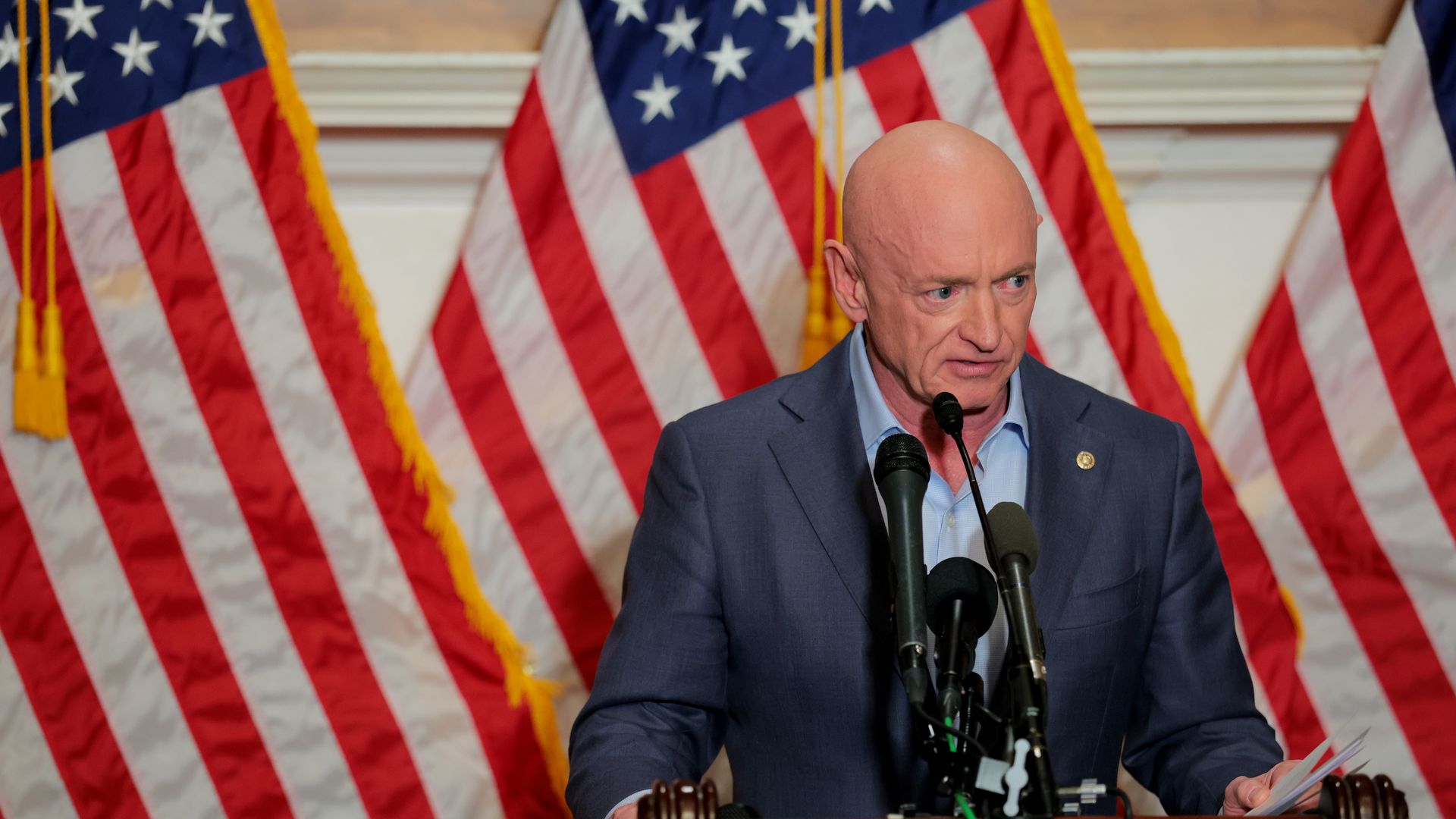
Sen. Mark Kelly (D-Ariz.) says average Americans are too concerned about affordability and other issues to care much about the promise of AI.
Why it matters: Kelly represents a faction of Democrats who don't want to be the anti-AI party, but think that Republicans have gone too far in pushing for a no-rules regulatory environment and have allowed for companies to grow with little oversight.
- Progressive outside groups are urging Democrats to be clearer about AI's connection to affordability, as Axios previously reported.
What they're saying: "We want AI to be successful, and we want our AI infrastructure to be adopted by other countries," Kelly said in an interview with Ashley at an event held by Responsible Innovation Labs.
- Kelly's "AI for America" roadmap released last year focused partly on having AI companies help fund job placement and retraining programs.
Yes, but: The senator said he doesn't think the AI race with China is something most voters have top of mind, and solving affordability needs to come first.
5. Google taps Sen. Young's chief for top role
Google has tapped Sen. Todd Young's (R-Ind.) chief of staff John Connell to lead government affairs and public policy for the U.S. and Canada, the company told Ashley exclusively.
Why it matters: Google snagged another high-level Capitol Hill Republican to be its top lobbyist at a time when tech and AI companies have a more positive — yet tenuous — relationship with the government than in the recent past, thanks to the AI boom and Trump's embrace of the technology.
Thanks to Mackenzie Weinger and David Nather for editing and Matt Piper for copy editing.
Sign up for Axios AI+ Government