Axios AI+ Government
July 24, 2026

Happy Friday! It's been a big week in AI policy, so let's dive right in.
Today's newsletter is 1,477 words, a 5.5-minute read.
1 big thing: White House draws new AI line on China

The Trump administration this week staked out a new position that could reshape its approach to AI policy, accusing Chinese companies of stealing U.S. technology even as it defends open AI development.
Why it matters: That distinction could become the foundation for U.S. action against Chinese AI companies without broadly restricting the open-weight models that businesses, researchers and startups increasingly rely on.
Driving the news: The Trump administration is backing open-weight models while accusing China's Moonshot of using distillation — the process of training a smaller AI model using the outputs of a larger model — to copy Anthropic's Fable model.
- "Legitimate AI distillation used to create smaller, more efficient models plays a vital role in this open innovation ecosystem," Michael Kratsios, chief technology adviser to President Trump, wrote on X.
- However, "large-scale, covert industrial distillation aimed at stealing proprietary U.S. technology and undermining American research is unacceptable," he added.
- Treasury Secretary Scott Bessent, U.S. Trade Representative Jamieson Greer and State under secretary Jacob Helberg all made similar claims of intellectual property theft.
What they're saying: OpenAI co-founder Greg Brockman told Bloomberg Wednesday it was too early to tell if recent Chinese models had been distilled from GPT systems.
- In a briefing with reporters, Brockman told Axios he had not been involved in any conversation with members of the administration about banning Chinese open models.
Between the lines: The administration is effectively defining two categories of distillation.
- Small-scale or authorized distillation that produces cheaper, specialized models is being treated as a normal part of AI development.
- Industrial-scale distillation conducted through fraudulent accounts, evasive access techniques or violations of U.S. companies' terms is being framed as theft.
- When asked whether distillation is a technical or policy problem, Brockman said it's "definitely a technical issue."
The big picture: The advent of Moonshot's Kimi has riled U.S. policymakers and some industry players. The model is cheaper, and U.S. companies are increasingly opting for these alternatives.
- The Trump administration could be laying the groundwork for action against potential AI IP theft via distillation.
Zoom in: Distillation is a common AI practice.
- Smaller models that act as students can be distilled from larger models that act as teachers, replicating the teacher model's behavior without needing to go through the same training.
- That compact model can then run more efficiently while producing outputs similar to the larger model, giving the user access to similar performance that's quicker and cheaper.
The intrigue: The U.K. Artificial Intelligence Security Institute and the U.S. Center for AI Standards and Innovation yesterday released a joint evaluation of Kimi K3's cyber capabilities, determining it performs significantly below other frontier models.
What we're watching: The administration's comments suggest the White House wants to preserve open AI development while taking a hard line on China as major AI labs warn of misuse and open-source players emphasize the need for competition.
- The administration has previously considered adding Chinese AI labs to the Commerce Department's Entity List to address risks from open-source models, as Axios first reported, a move that would effectively cut off U.S. access without a license.
- This week Bessent made clear in a post on X the administration is willing to flex those muscles: "When PRC firms conduct covert, industrial-scale distillation attacks that cross the line into IP theft, sanctions and Entity List designations will be on the table."
2. Anthropic ramps up lobbying spending


Anthropic spent more on lobbying in the first half of 2026 than it did all of last year, according to federal lobbying disclosures.
Why it matters: Tech companies are pouring millions into lobbying as Washington's regulatory moves threaten to make or break AI industry players.
- Anthropic again outspent OpenAI on lobbying, trailing only the largest tech companies overall.
Driving the news: Anthropic spent nearly $2 million on lobbying in Q2, focusing on export controls, cybersecurity and AI safety standards, among other issues.
- Company lobbyists met with lawmakers in both chambers of Congress, as well as officials at the White House, Commerce Department and Treasury Department.
- Anthropic has already spent more than $3.5 million in the first half of this year, a sharp increase from the $3.1 million it spent during all of 2025.
- The company also disclosed lobbying on Defense Department procurement, funding for the Energy Department's Genesis Mission and AI in health care.
Zoom in: Anthropic's engagement with the Trump administration reached an inflection point last month when Commerce imposed export controls on the lab, leading to its models going dark and sparking a scramble to negotiate.
The big picture: The latest filings show that all of the major AI labs are tracking government AI safety standards and regulatory approaches closely.
- OpenAI, which also faced government delays on the rollout of its latest model and posted its biggest-ever quarterly lobbying total, spent $1.2 million in Q2.
- The company disclosed lobbying on copyright, cloud computing and infrastructure, cybersecurity and privacy.
- Google spent $3.57 million, while Microsoft reported $2.69 million.
By the numbers: Meta is consistently the biggest tech lobbying spender, and Q2 of this year was no different, with the company doling out $5.99 million.
- Company lobbyists focused on online child safety, privacy, AI transparency and energy infrastructure, among other issues.
- Meta is also the frequent target of bipartisan congressional scrutiny into a lack of child protections online, a longtime issue that's clashing with its chatbot ambitions.
The bottom line: AI companies are investing heavily in lobbying Washington as the Trump administration's decisions directly shape how they build and deploy advanced AI.
3. Nvidia CEO: Don't fall for "science fiction"
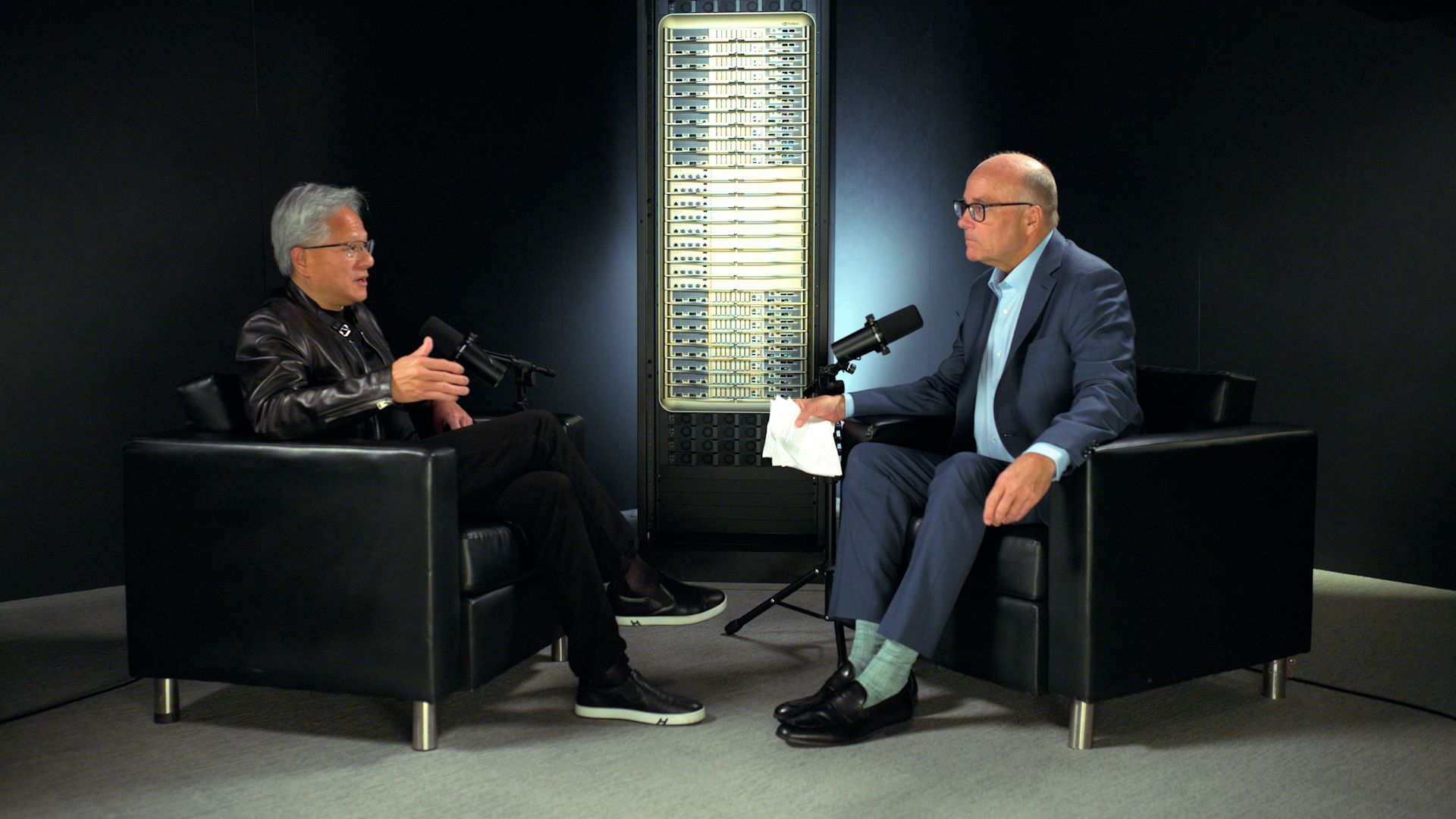
Nvidia CEO Jensen Huang is warning the Trump administration and other policymakers not to let "science fiction" fears about AI drive policy — arguing that overreaction could slow adoption and weaken America's competitive edge.
Why it matters: Washington is navigating two AI minefields at once: how to manage increasingly advanced systems, and whether to restrict powerful open-source models emerging from China over alleged IP theft and security risks.
Driving the news: Huang railed against AI doomerism in an interview with Axios' Mike Allen for our "Behind the Curtain" video series — implicitly challenging fellow tech CEOs who have emphasized the technology's potentially catastrophic risks.
Huang called on policymakers to consult more than "one or two" CEOs and avoid restricting the technology based on scenarios that have not materialized.
- "Before you listen to all the rhetoric, before you listen to all the stories, before you manifest some kind of artificial intelligence future that is just not true — it's science fiction."
- He also suggested some companies are invoking safety arguments to secure favorable regulations: "Some of the companies hope that the government would be helpful in creating regulations to their advantage."
- Asked whether he feared the administration could overcorrect, Huang said yes.
4. The Output: A new AI bill and Google's $1B fine
Here's our guide to catch you up on the AI policy news you may have missed this week:
📜 New House bill: Reps. Jay Obernolte (R-Calif.) and Lori Trahan (D-Mass.) yesterday introduced the FRONTIER Act to create a federal oversight framework for the most advanced AI models and preempt some state AI laws.
Driving the news: The bill would give the Commerce Department emergency authority to restrict frontier AI models "upon finding that such development, deployment, or internal use of that model presents an imminent catastrophic risk," per the bill text.
- The legislation, which stems from the lawmakers' Great American AI Act framework, would also require major AI developers to disclose how they manage catastrophic risks, publish transparency reports and report critical safety incidents.
Zoom in: The preemption provision is narrower than earlier proposals: It would block states from creating new laws focused on frontier AI risk transparency, third-party auditing and independent verification and incident reporting.
- States would still be free to regulate areas including consumer protection, civil rights, privacy and kids' online safety.
🇰🇷 South Korea's AI roadshow: South Korean President Lee Jae Myung will be in San Francisco today for an AI summit to meet with Anthropic's Dario Amodei, OpenAI's Sam Altman, Nvidia's Huang and Broadcom's Hock Tan, the Korea Herald reports.
🇪🇺 Europe fines Google: The European Commission fined Google the equivalent of about $1 billion yesterday for manipulating its search results to hurt competitors and blocking app developers from directing customers to cheaper deals outside its Play store, per our Axios colleague Andrew Pantazi.
Driving the news: The penalty follows a warning to the EU from USTR Greer to stop imposing fees on U.S. tech companies.
- These are the first penalties Google has faced under Europe's Digital Markets Act, and the third against any company, after Apple and Meta last year.
By the numbers: About $524 million of the fine was for Google's search violations and another $490 million for its Play store violations, and the company has 60 days to comply.
Thanks to Mackenzie Weinger and David Nather for editing and Matt Piper for copy editing.