Axios AI+ Government
June 12, 2026


It's Friday, and we're tracking the deadlines you need to know in President Trump's AI order.
Today's newsletter is 1,408 words, a 5.5-minute read.
1 big thing: How Trump's AI strategy is taking shape

The first major deadlines in President Trump's new AI executive order are approaching, and it's already clear that AI safety isn't the centerpiece.
Why it matters: The fast-moving timeline, the agencies involved and the lack of formal requirements for developers make clear that Trump's current AI policy is one squarely focused on cybersecurity and national security rather than broader AI safety concerns.
The big picture: The administration is relying on voluntary cooperation from AI developers rather than mandatory safety requirements.
- That's happening even as the top labs warn of potentially worrying advancements in their latest models.
What they're saying: "There's a risk of a gap developing between what the Trump administration AI policy says and believes about policy implementation," Michael Horowitz, a former Pentagon official and professor at the University of Pennsylvania, told Ashley.
- "That's both due to a talent exodus and the willingness of the Trump administration to change its approach rapidly if the views of the president shift again, which reduces predictability."
Zoom in: Here's a look at the AI order's first major deadlines:
July 2: By this date, the Department of Homeland Security is supposed to have a plan to prioritize cyber defense of federal government information systems and make sure the latest AI models are available to critical infrastructure, including hospitals, banks and utilities.
- The Treasury Department is also expected to establish an "AI cybersecurity clearinghouse" with industry partners focused on finding and patching cyber vulnerabilities.
- The Office of Management and Budget is due to identify grant funding for "advanced AI vulnerability detection."
August 1: By this date, the Office of Personnel Management is tasked with expanding hiring for cybersecurity specialists through the U.S. Tech Force.
- Treasury, the National Security Agency and the Cybersecurity and Infrastructure Security Agency will be required to develop a "classified benchmarking process to assess the advanced cyber capabilities of AI models," including determining who would be covered under that process.
- That same group of agencies is also tasked with designing a voluntary framework with AI developers, with those developers giving the government access to models up to 30 days before public release.
The order doesn't mention or give a role to the Center for AI Standards and Innovation within the Commerce Department, which has been testing AI models for safety since the Biden administration.
- CAISI recently announced new agreements to test models, but was told to take down that announcement shortly after it went up as the White House worked out its AI order, a person familiar with the matter told Axios.
- "CAISI's absence is hard to ignore," Ilona Cohen, chief legal officer at HackerOne and a former Obama administration lawyer, told Axios.
- "When an administration leaves its flagship AI safety institution out of a major AI order, people are going to ask whether the center's role is being reduced or simply redefined," said Cohen.
"The implementation of President Trump's AI agenda is a whole-of-government effort, with numerous agencies contributing to its success," White House spokesperson Liz Huston said in a statement.
- "The entire Administration is working closely together to deliver meaningful results for the American people including strengthening America's cyber and national security, protecting critical infrastructure, and ensuring the United States remains the global leader in AI innovation."
- A Commerce Department spokesperson declined to answer questions about CAISI's lack of a role in the AI order.
What we're watching: Both OpenAI and Anthropic have been talking about how the latest AI models can be dangerous and the industry may benefit from slowing or pausing development.
- "The frontier labs are raising alarms for good reasons, but they also have economic incentives to trumpet their capabilities — that's all the more reason for the government to have the capacity to evaluate these models," Horowitz said.
2. What's inside Trump's national security memo

The White House also recently issued a sweeping national security directive that sets deadlines for securing, procuring and deploying AI across the military and intelligence community.
Why it matters: Issues such as military use of AI, intelligence community procurement of AI tools, and protecting AI models from espionage and distillation attacks are all on the table.
Agencies now face quick deadlines on the following security work:
- Creating a new partnership program by October between frontier AI companies and national security agencies to share threat intelligence, conduct joint AI red-teaming, and help secure advanced AI systems.
- Reviewing and updating procurement processes across these agencies to allow for "rapid onboarding of the most advanced AI models from multiple vendors" in the next 120 days.
- Updating the Defense Department's directive on autonomy in weapon systems in the next three months to ensure "deliberate adoption of AI systems that respect the chain of command and operational authorities."
- Developing standardized methodologies for testing and validating national security AI systems by October.
3. 5 takeaways from Europe's tech chief on AI

As Europe pursues tech sovereignty, European Commission tech chief Henna Virkkunen is trying to boost competitiveness while upholding some of the world's toughest tech regulations.
Why it matters: The EU wants to move faster on AI and emerging tech without weakening the regulations at the heart of its digital strategy.
Here are the five key takeaways from Virkkunen's talk with Maria during Web Summit Rio this week.
1. The EU is unlikely to take equity stakes in AI labs as the Trump administration toys with the idea.
- The role of government is "always to create the conditions for innovations and investments, and the main tool from our side is legislation, and then different funding elements and financial elements that we can support the innovations," she said.
2. The EU AI Act doesn't need updating for AI agents despite some warnings around privacy, cybersecurity and misuse.
- The bloc has delayed enforcement of key provisions of the act following industry complaints it could impede innovation, but the law could risk falling behind the latest agent capabilities.
- The EU believes AI agents are already covered under the existing, technology‑neutral AI Act through its provisions on generative AI and risk mitigation, Virkkunen said.
3. European regulators aren't budging on their regulations and blame Apple for its decision not to roll out Siri AI in the bloc.
- "It's their own decision that they didn't turn it on yet," Virkkunen said, adding there is "nothing" in Europe's Digital Markets Act that is blocking the company from bringing its new products to the market.
4. The EU and Brazil are coming closer as trusted digital partners.
- The bloc is gaining influence in the region with countries aligned with its policies around open markets, secure technologies, and a rules‑based international order, Virkkunen said.
- Virkkunen said she will head to São Paulo today to sign an agreement strengthening cooperation on connectivity, data and other digital priorities.
5. Five years from now, success would mean Europe has built stronger AI, semiconductor, quantum and cybersecurity industries, and that businesses are using them.
- "What we want to make sure all the time is that ... people can trust our technologies," she said, adding that Europe must ensure its tech growth is sustainable. "Especially now when we see that we need three times more data centers in the coming years than we have now."
4. AI at AM Live: Darío Gil and Scott Kupor
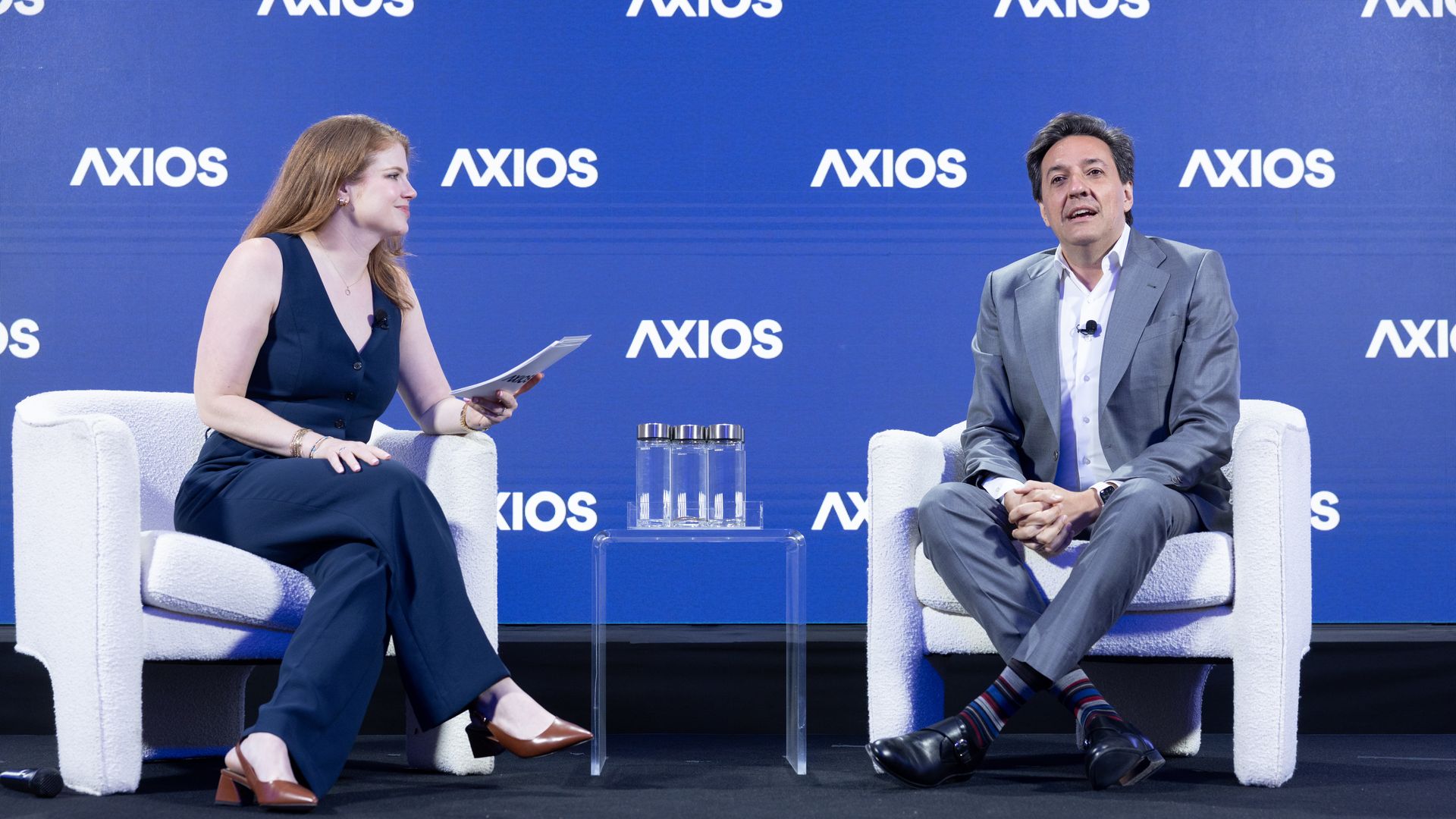
Tech, AI and the federal workforce were central to the conversation at this week's first Axios AM Live in Washington.
Driving the news: Ashley spoke with Darío Gil, under secretary for science at the Department of Energy and head of the Genesis Mission (check out Maria's profile of him), and Office of Personnel Management director Scott Kupor.
Gil said he understands why people are wary about the rapid advancement of AI, and it's partly the industry's fault for communicating poorly.
"I understand the wariness. I myself don't like how my community has been talking about AI, and I've been openly critical about that. Some of my colleagues ... are very good at technology. They're terrible communicators."
"It has to be a future of optimism, not because we're trying to sell a kind of good, but because we're going to solve problems that people care about."
Kupor said that it's OK for historically risk-averse government employees to take some chances by lightly emulating the Silicon Valley playbook.
"In Silicon Valley we talked about permissionless innovation and permissionless risk. Here [in the government] I would call it permissioned risk and permissioned innovation."
Thanks to Mackenzie Weinger and David Nather for editing and Matt Piper for copy editing.
Sign up for Axios AI+ Government
