Axios AI+ Government
December 12, 2025


Good morning! We've got a packed edition for you today, starting with President Trump's executive order from last night, so let's dive right in.
Today's newsletter is 1,327 words, a 5-minute read.
1 big thing: Trump signs executive order targeting state AI laws


President Trump last night signed an executive order to override state AI laws, setting up high-stakes clashes nationwide and inside his own party.
Why it matters: Trump and AI czar David Sacks are moving aggressively in favor of industry to rein in state regulation of the technology.
- The EO aims to gut state AI laws by launching legal challenges and conditioning federal grants on compliance.
- MAGA populists made a failed last-minute bid to try to shape the executive order, pitching two draft proposals to the White House this week.
What they're saying: "There's only going to be one winner here, and that's probably going to be the U.S. or China. And right now, we're winning by a lot," Trump said.
- Trump said "people want to be in the United States and they want to do it here ... but if they had to get 50 different approvals from 50 different states, you can forget it because that's not possible to do."
- Trump added he thinks this effort has "great Republican support" and "probably" Democratic support, too.
What's inside: The executive order calls on government agencies to "check the most onerous and excessive" state laws in favor of a "minimally burdensome, uniform national policy framework."
- The executive order tasks the attorney general with establishing an "AI Litigation Task Force" within 30 days to challenge state AI laws "including on grounds that such laws unconstitutionally regulate interstate commerce."
- The commerce secretary will have to identify and evaluate existing state laws that conflict with the order.
- Those would include laws that "require AI models to alter their truthful outputs" or lead to the disclosure or reporting of information "in a manner that would violate the First Amendment or any other provision of the Constitution."
- The commerce secretary will also have to issue a policy notice within 90 days outlining the eligibility conditions for states to receive remaining Broadband Equity, Access and Deployment funding to expand internet access.
The executive order calls for the White House to prepare a legislative recommendation for Congress to establish a federal framework for AI that preempts state laws.
- The order tees up congressional action, saying the administration and Congress must work on a framework that forbids state laws that conflict with the executive order, ensures "children are protected, censorship is prevented, copyright is respected, and communities are safeguarded."
- "Until such a national standard exists, however, it is imperative that my Administration takes action to check the most onerous and excessive laws emerging from the States that threaten to stymie innovation," the text states.
Ex-Trump adviser Steve Bannon, a major MAGA voice, told Ashley in a text message that "David Sacks having face-planted twice on jamming AI Amnesty into must-pass legislation now completely misleads the President on preemption."
Catch up quick: The White House suffered a significant loss when Congress rejected including preemption language in the annual defense policy bill despite intense pressure from Trump, the White House and the tech industry.
- It was the second major defeat this year in the administration's bid to reshape the AI policy landscape through Congress: Senators stripped a similar provision from the budget bill in a 99-1 vote.
- The White House first floated a version of this executive order targeting state AI laws in November after Trump publicly backed a ban.
- Some MAGA conservatives and Republican governors view the White House's approach as too broad and a giveaway to AI companies at the expense of states' rights.
What's next: Expect legal challenges from states — and Republican infighting.
2. Exclusive: Linda McMahon bets on AI
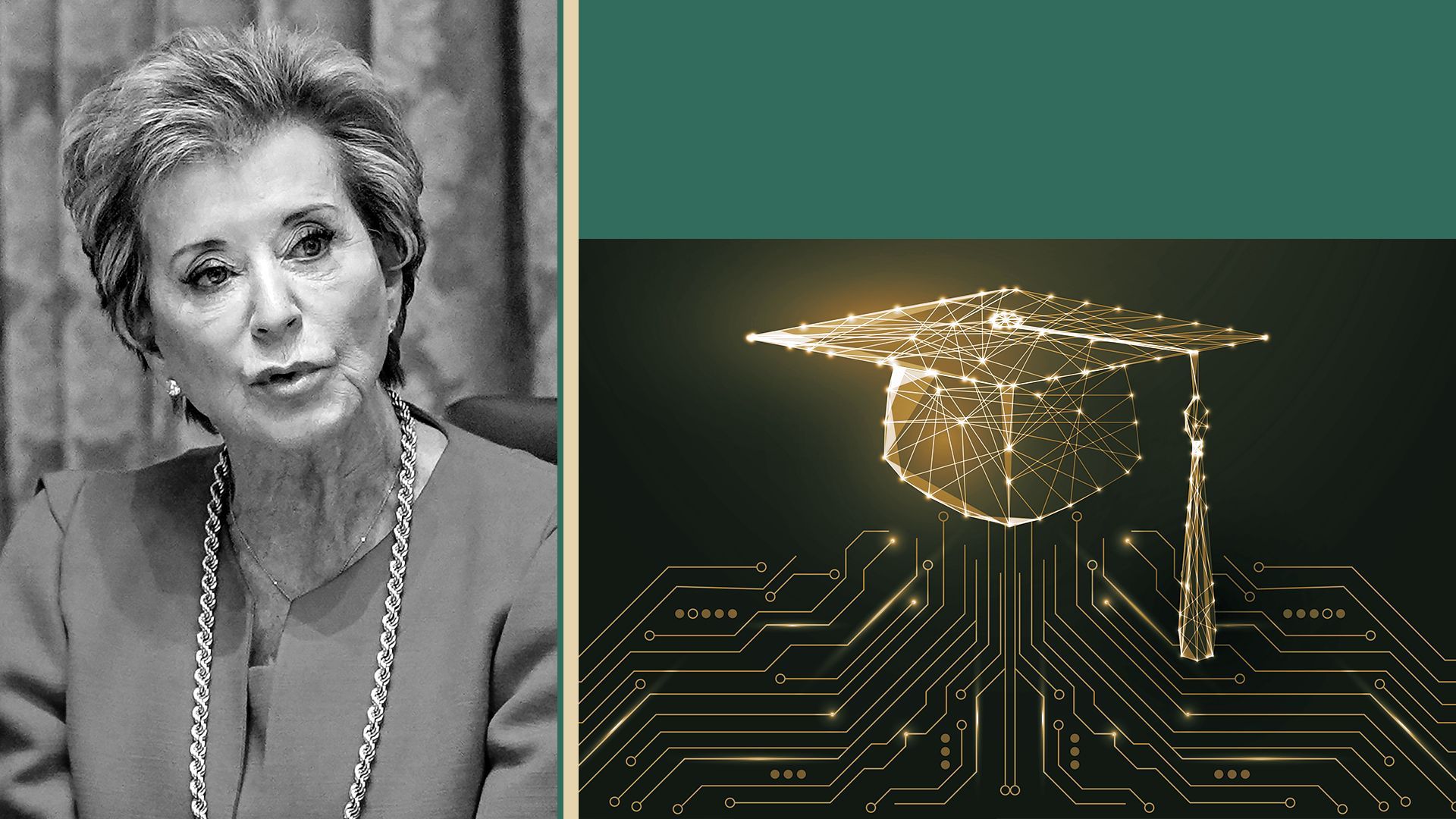
Education Secretary Linda McMahon told Ashley that she's betting big on AI as a fix for American classrooms as she carries out President Trump's directive to dismantle her department.
Why it matters: McMahon said she sees AI as a useful tool to both return control of education to the states and engage students, arguing she's already seen evidence that it works.
The big picture: The Education Department has seen mass rolling layoffs since the beginning of the year.
- Last month, it announced several of its offices would be farmed out to other agencies including the Labor and Interior departments.
- Earlier this year, the Office of Education Technology, which had been tasked with training educators on new technologies including AI, was shuttered. McMahon said that work now comes directly from experts in her office.
- First lady Melania Trump hosted a September event touting AI in education, flanked by tech company executives offering major tech and software commitments to schools.
What they're saying: "I have visited schools, and I have seen AI working," said McMahon, recalling a visit she had to the AI-led Alpha School in Austin, Texas.
- "To see that in action absolutely lets you know how engaged students are. It's not just sitting in front of the screen, it's interaction."
- "But we have to have guardrails, I do believe in parental controls around this, but it is an incredibly great tool used appropriately for students."
3. White House issues guidance against "woke" AI
The Trump administration yesterday released guidance for federal agencies to try to ensure that the AI models they procure are not spitting out "woke" responses.
Why it matters: Company contracts with the federal government could be at risk if large language models are seen as violating the White House's guidelines.
What's inside: The guidance from the Office of Management and Budget states that agencies looking to buy AI systems must determine whether the models comply with what it calls two "unbiased AI principles" — "truth-seeking" and "ideological neutrality."
- The information they have to obtain will vary depending on the company's role in the software supply chain and the relationship between the company and the model developer, according to the guidance.
- Generally, the closer the company is to the model developer, the more information should be available.
- "Where practicable, agencies should avoid requirements that compel a vendor to disclose sensitive technical data, such as specific model weights," the guidance states.
Beyond LLMs, agencies should also use this guidance for other types of generative AI, such as image or voice tools.
4. Hochul proposes major changes to AI bill
New York Gov. Kathy Hochul (D) has proposed significant changes to an AI bill that would mandate transparency measures from frontier AI companies, per sources who have reviewed them.
Why it matters: States are increasingly the venue of intense tech lobbying as they get more active on regulating AI, even as Trump pushes ahead with plans to stop them with the executive order.
- According to the sources who have reviewed the document, the original RAISE Act has been crossed out, with replacement text that nearly verbatim resembles a California AI safety bill that Gov. Gavin Newsom (D) signed this year, SB 53.
Driving the news: Hochul this week "redlined" the RAISE Act, an AI safety bill from New York state Sen. Andrew Gounardes and Assemblymember Alex Bores that was written to require incident reporting and safety plans for powerful AI models.
5. Exclusive: Key Dem demands AI job impact data

The chair of the New Democrat Coalition's AI Task Force is pushing tech companies that have laid off workers to detail how AI factored into those decisions, according to a letter shared first with Maria.
Why it matters: Layoffs are fueling anxiety about AI, but policymakers lack quality data to understand the impact of the technology on the workforce.
Driving the news: Rep. Valerie Foushee (D-N.C.) sent the letter yesterday to Amazon, Salesforce, Meta, Verizon, Microsoft, IBM, Google, Accenture, HP, Intel, Target, UPS, Synopsys and Lenovo.
Foushee asked the companies to respond to questions that address:
- The demographic impact of this year's layoffs;
- How many layoffs were directly tied to AI;
- And how employees have been notified that they were being let go.
What's next: Companies have until Dec. 31 to respond to Foushee's letter.
Thanks to Mackenzie Weinger and David Nather for editing and Matt Piper for copy editing.