Axios AI+ Government
August 07, 2026

It's Friday! We're breaking down the state-by-state laws for election AI deepfakes and unpacking the biggest unanswered questions in the White House's new AI framework.
🚗 Join Axios Live on Saturday, Aug. 22 from 3:30–5:30pm ET for Moving America Forward, a conversation on how leaders across government and industry are advancing the future of mobility, infrastructure and innovation.
- Register here.
Today's newsletter is 974 words, a 3.5-minute read.
1 big thing: Voters' uneven deepfake protections
Americans across the country could have very different experiences with AI deepfakes leading up to Election Day, thanks to a patchwork of state rules.
Why it matters: AI-generated attack ads and campaign content are rampant leading up to the midterms as candidates across the political spectrum use the technology.
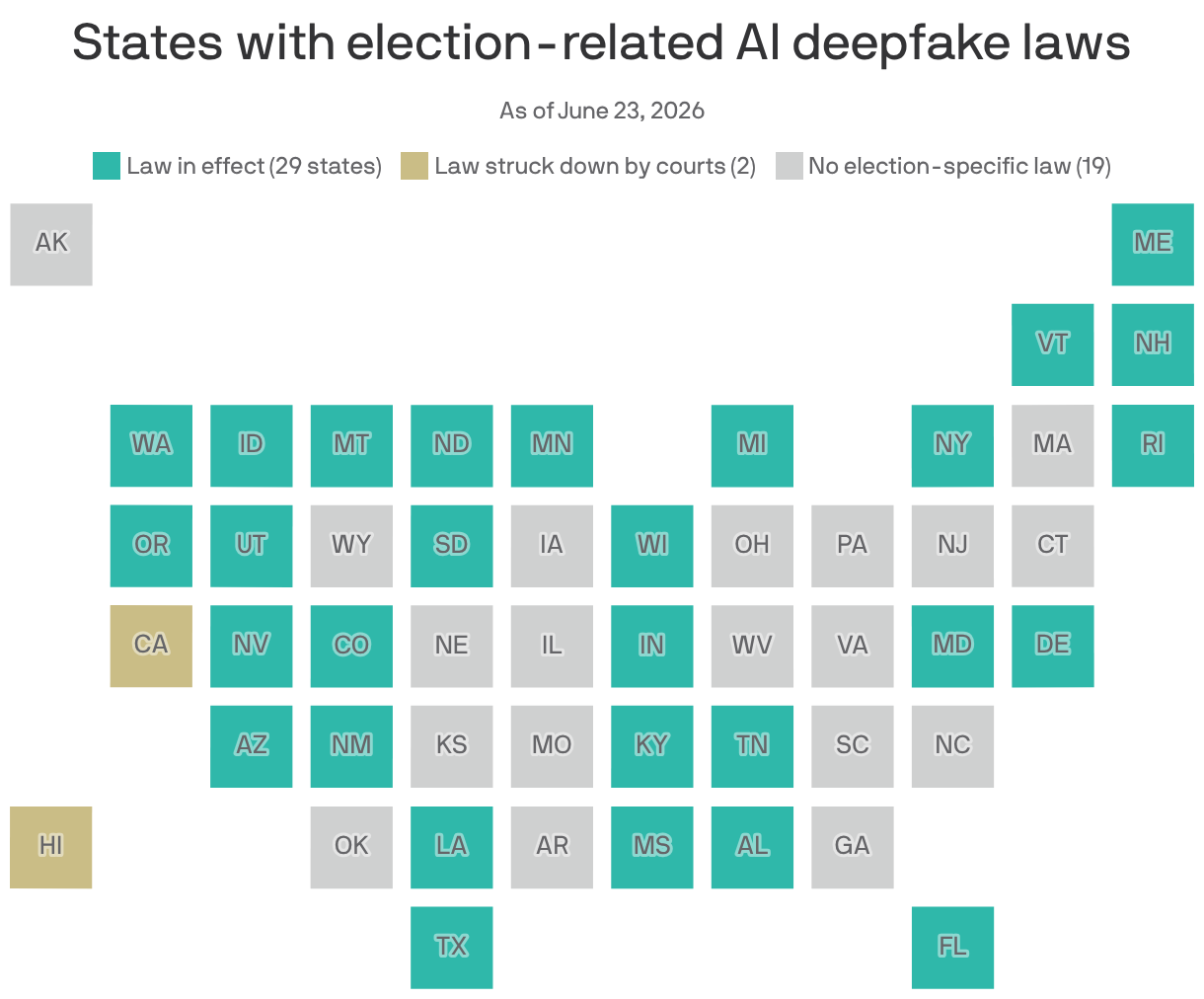
State of play: Twenty-nine states have AI election deepfake laws in effect, while two others — California and Hawaii — have had their laws permanently enjoined, according to the National Conference of State Legislatures.
- Minnesota and Texas prohibit political deepfakes for a certain number of days before an election. Maryland's ban is year-round.
- The other states require disclosures when AI is used in political ads. Some states like Colorado and Utah require more detailed disclosures, such as the deepfake's creator, when it was created and how it was edited.
Friction point: California's and Hawaii's AI deepfakes laws were struck down in court on First Amendment grounds.
- Both states are pressing ahead with alternative approaches that don't specifically regulate election AI deepfakes.
- California's AI Transparency Act, part of which went into effect Aug. 3, requires disclosures of AI-generated images, and Hawaii last month passed a law prohibiting deepfakes in ads without the subject's consent.
The big picture: At the federal level, lawmakers have yet to establish a baseline standard for election AI deepfakes.
Zoom out: Congress' first AI deepfakes law addressed a different issue.
- The Take It Down Act, which took effect in May, marked Congress' first attempt at tackling nonconsensual intimate imagery — an issue that has collided with election ads targeting women lawmakers.
- Passing the law was one thing. Implementing it effectively is another, advocates say, citing inconsistent removal processes of posts and predicting litigation will be needed to secure strong enforcement.
- Lawmakers are also seeking to build on that first step, with House Democrats planning to push legislation next year specifically targeting election deepfakes if they regain power.
The bottom line: Proposals to tackle AI in elections have been floated in Congress for years, but states have moved faster — creating different realities for voters depending on where they live.
2. What Trump's AI framework means for China

The White House's AI framework takes a hands-off approach to open models, raising new questions about how the administration plans to tackle security concerns posed by Chinese labs.
Why it matters: The Trump administration's decision to leave open models outside its AI framework puts the focus now on its approach to Chinese models.
The big picture: The AI framework is built around voluntary cooperation with AI developers, not labs from adversarial nations.
- "This was never going to be the right tool for Kimi K3 or Qwen," said Joseph Hoefer, AI principal at Monument Advocacy, referring to advanced open models from China's Moonshot and Alibaba.
- Under the framework, companies can submit closed models voluntarily to the government, which then reviews them under agreed-upon security terms.
The framework relies on voluntary cooperation from companies seeking to be in the U.S. government's "good graces," said a source familiar with the discussions.
- "China doesn't care about that."
Catch up quick: The White House does not plan to publicly release the framework, which explicitly says nothing in it should be interpreted as restricting open models once they've been released, Axios first reported.
- "The covered-model framework is a pre-release cooperation mechanism," Hoefer told Axios. "Restricting Chinese model use is an access and procurement fight that's still being negotiated separately."
What we're watching: There are other tools at the U.S. government's disposal that could be used to address Chinese open models.
3. The Output: Kids' online safety, taxes and more
Here's our guide to catch you up on the AI policy news you may have missed this week:
💰 AI tax idea: Sen. Ron Wyden (D-Ore.) yesterday released a draft proposal to change the tax treatment of AI data centers.
- His plan would end existing tax incentives for data centers and establish a new excise tax on data center investments to help fund communities impacted by the AI buildout.
- "American communities are rightfully questioning whether the rapid buildout of data centers across the nation will benefit them," Wyden said.
🏗️ KY data centers: Kentucky Gov. Andy Beshear (D) signed an executive order yesterday establishing new standards for data center development in the state.
- The order requires developers to show they won't increase electricity costs for existing customers, harm the environment or avoid local taxes.
- Developers must also commit to building "a meaningful relationship with the community" before projects move forward.
📲 KOSA advances: The Senate Commerce Committee this week unanimously advanced the Kids Online Safety Act, sending the bipartisan bill to the Senate floor for consideration.
- "The Senate has repeatedly shown that there is broad, bipartisan support for a version of KOSA that creates a duty of care to protect kids from online predators, addictive algorithms, and harmful product design," Sens. Richard Blumenthal (D-Conn.) and Marsha Blackburn (R-Tenn.) said in a joint statement.
- The House-passed version doesn't include "duty of care" language, which would require platforms to take reasonable steps to mitigate harms stemming from design features like endless scroll or algorithmic recommendations.
🛞 NSF's new hubs: The National Science Foundation announced a new $100 million program to establish up to 10 state and regional AI infrastructure hubs, aiming to expand access to computing power and data.
🇪🇺 EU rules: The European Union has now begun enforcing AI Act transparency rules, including disclosure requirements for certain AI systems and labeling requirements for AI-generated content.
Thanks to Mackenzie Weinger and David Nather for editing and Matt Piper for copy editing.