What months at sea do to San Diego sailors and their ships

Add Axios as your preferred source to
see more of our stories on Google.
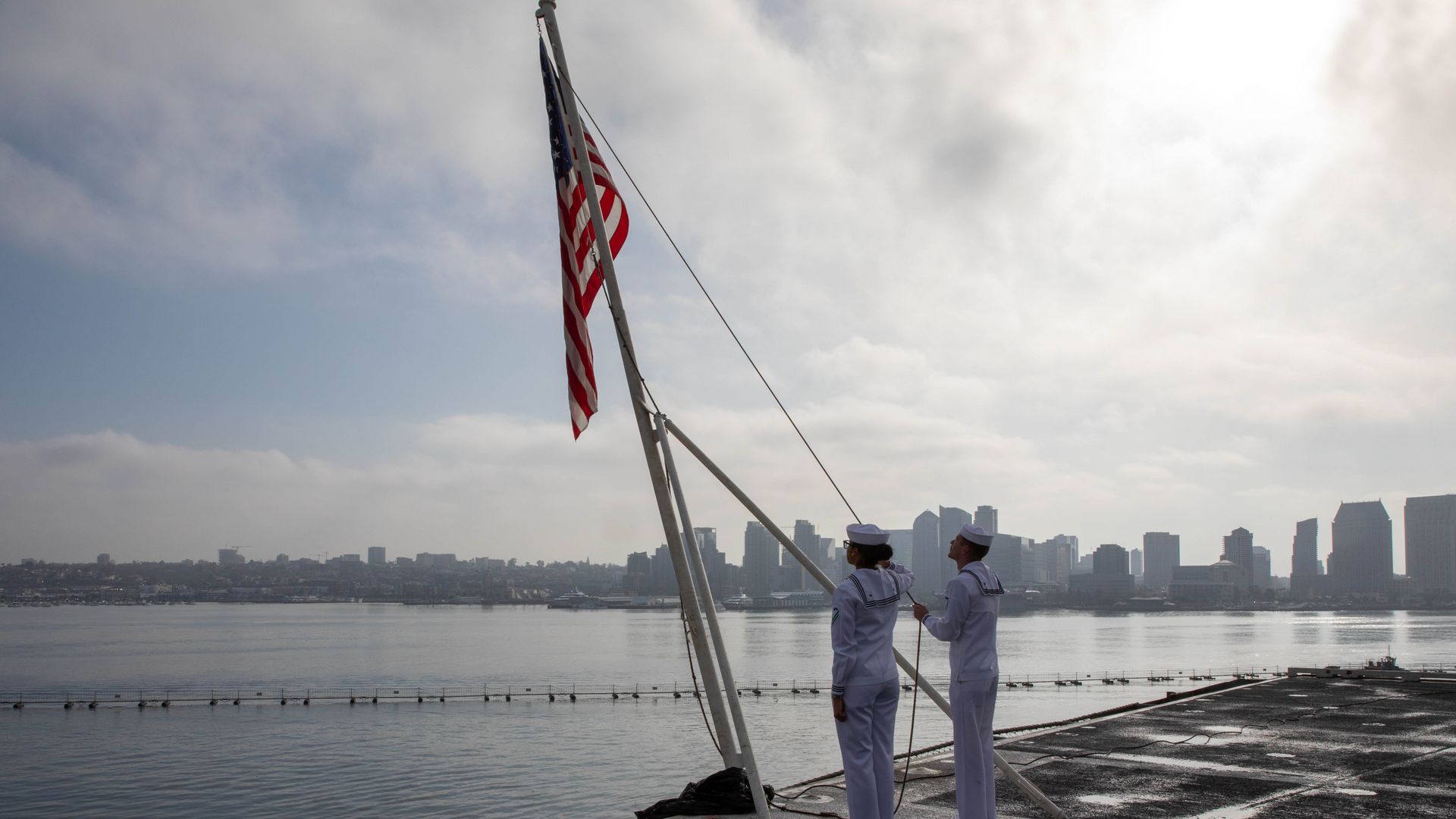
Two sailors salute the American flag aboard the USS Abraham Lincoln in San Diego in 2025. Photo: Courtesy of Hannah Tross/U.S. Navy/DVIDS
Those Navy ships you see coming in and out of San Diego Bay are often full of sailors who have either just endured the endless exhaustion of a deployment or are on their way to one.
Why it matters: Deployments cause stress not only for the men and women onboard, but for their ships, too, raising questions of how much sailors and the gray hulls they serve on can sustain.
State of play: The fight that the aircraft carrier USS Abraham Lincoln and its support warships (known as a carrier strike group) are helping to wage against Iran has little precedent in modern U.S. history when it comes to sailor stress and wear on the ship, retired Navy ship commanders told Axios.
But the hardships of any deployment are not new.
- “Deployments are stressful periods in which families are separated, and even with the improved communications we have today, there’s considerable uncertainty among Sailors and their families about what might be next,” Bradley Martin, a retired Navy ship commander who spent two-thirds of his 30-year Navy career at sea, told Axios in an email.
Context: In peacetime, a ship’s commanding officer (or CO) will work to make sure that food and other services are on hand to keep crew morale up, Martin said, something that has been more difficult to provide during Lincoln’s wartime deployment.
- COs will sometimes allow a swim call — where sailors can jump into the deep blue sea around them (with plenty of spotters in the water) — or host “steel beach picnics,” basically big barbecues on the flight deck, to maintain morale, Martin said.
- “And of course the promise of a port call has historically been a great morale boost,” he said. “The absence of that can make morale a lot more difficult to maintain.”
While Lincoln’s 5,000 or so sailors have had to make due without those comforts of a peacetime deployment, the carrier itself is also paying a price, according to Martin.
- Lincoln has been operating in the merciless heat of a Middle East spring and summer, Martin said. And it’s going to need a lot of TLC maintenance when it finally gets home.
- “Piping will have corroded, rust will be in all kinds of hard-to-reach spaces,” he said, adding that ships ridden hard often need twice as much maintenance as planners expected.
- And when maintenance lasts longer than expected, the number of carriers the Navy has available to respond to other global hot spots is affected.
Keeping a carrier out longer than a standard deployment is kind of like putting off maintenance on your car, according to John Cordle, a retired warship captain.
- Some ship systems wear down with use, others with time, he told Axios via email.
- But either way, “the maintenance lights” start coming on after about six months, a standard deployment stint for a carrier like the Lincoln.
“But we just keep driving the car,” Cordle said.