"The Big Middle" aims to reverse political polarization

Add Axios as your preferred source to
see more of our stories on Google.
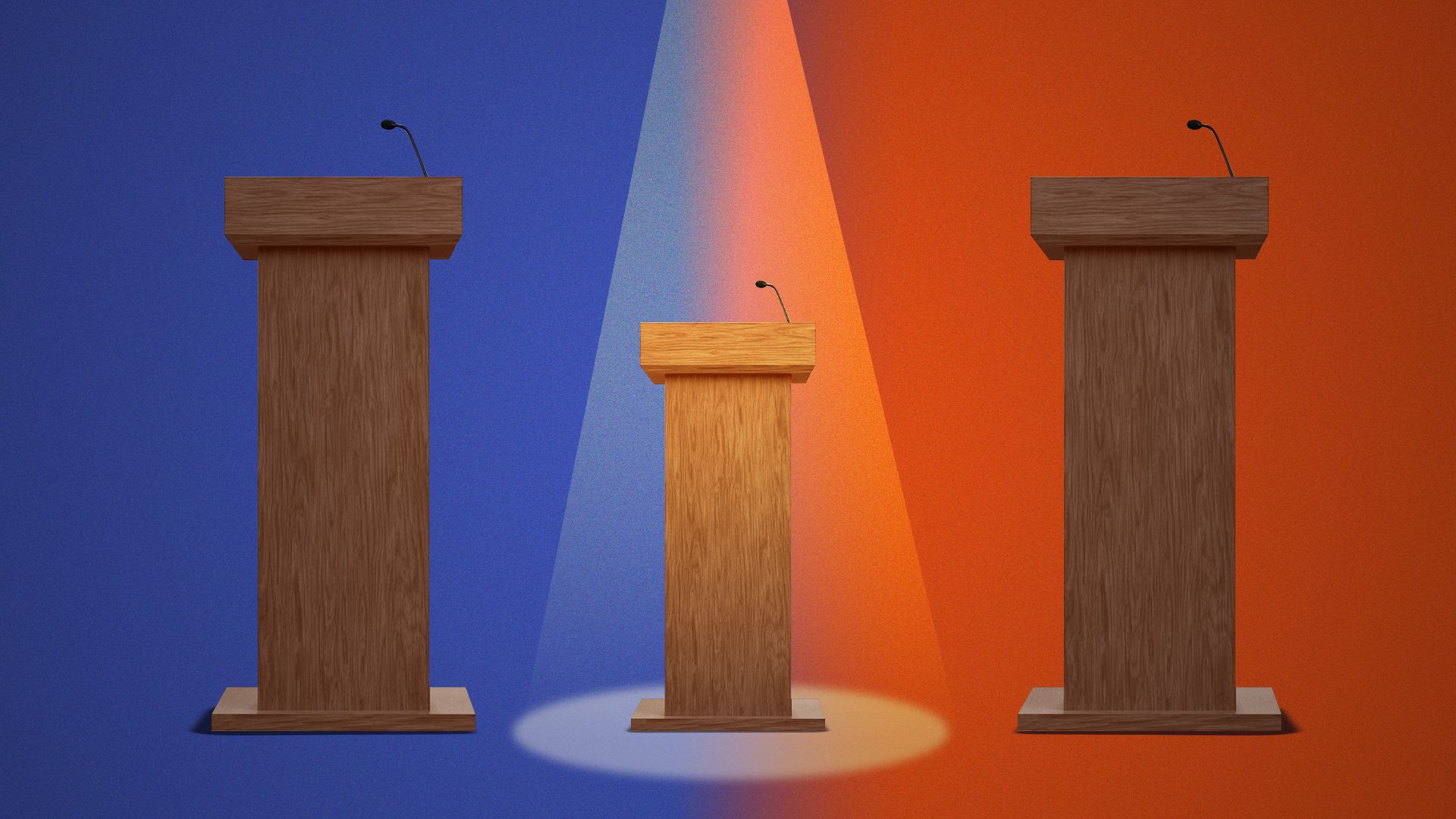
Illustration: Aïda Amer/Axios
Encinitas resident Allan Hoving thinks he can actually get people to agree on politics.
The big picture: Hoving launched a new substack web show this month called "The Big Middle," where he uses a series of questions and surveys to bring the live audience to a consensus in real time.
How it works: People log on to watch discussion around a timely topic, for example, the war in Iran.
- The show uses software called Converge that's typically employed by large corporations to reach agreement on big decisions.
- It leads people through a series of questions where they can answer in their own words.
- By the end, they reach an agreement on what should be done.
- For the Iran conflict, that agreement involved winding down U.S. military involvement while keeping pressure on Iran's nuclear program.
And yes, they reached an agreement, Hoving told Axios.
- "The consensus is usually not 100%, but we're looking for like that big middle of America, 60% or 70% who really do agree on solutions," Hoving said. "We're looking to reflect back what we think the consensus is based on the inputs and the feedback that the audience has just provided."
The pilot show had about 75 viewers. Hoving hopes to scale up to reach thousands who could come to even bigger agreements together.
Yes, but: Not everyone is going to agree, and Hoving knows that.
- "There are folks at the edges who are not interested in consensus, but when you look at who is interested in consensus, it tends to be center right, center left, but maybe skewing a little bit center left," he said.
Context: About a third of Americans called themselves moderate in the last Gallup poll, while 25% were "very liberal" or "liberal" and 37% were "very conservative" or "conservative."
- A quarter of San Diego County voters are "no party preference," while 40% are Democrats and 27% are Republicans, according to the latest voter registration data.
Flashback: Hoving has had the dream for this show for more than a decade, when he began to see how social media companies and cable TV were using a "polarization process to generate audience and profits for themselves."
- "So, I have always been interested in how can you reverse that process to bring people together," he said.
Hoving worked for "Rolling Stone" as the letters editor in the 1980s and said the germ of this idea started way back then.
- "They would dump the mailbag on my desk, and I would have to distill the sentiments of the readership and fit it into two columns of space," he said. "I always found that challenging and rewarding, to try to reflect back to the readership. Now we have infinite space online and I want to be able to synthesize what the consensus is and reflect that back."