AI, chickens and big wins for San Diego students

Add Axios as your preferred source to
see more of our stories on Google.
Not your typical baking soda volcano. Photos: Courtesy of The Rhoades School
Local students were among the top winners at the California Science & Engineering State Fair.
The big picture: When you hear what they did, you'll either feel extremely hopeful or extremely dumb. Or maybe both.
Zoom in: Almost 900 students from 356 schools across the state showcased their science projects and competed for more than $30,000 in prizes.
- Eight San Diego students took big honors, including Emma Liu from The Bishop's School, with the project "Defining 3D Phenotypic Cell States of Polymorphonuclear Neutrophils via Novel Computational Pipeline."
- And Ihan Sung from Eastlake High School for "Renewable Ammonia Electrochemical Synthesis by Glow Discharge with an Iron Based Catalyst."
Six middle schoolers from San Diego also won top prizes in the Junior Innovators Challenge.
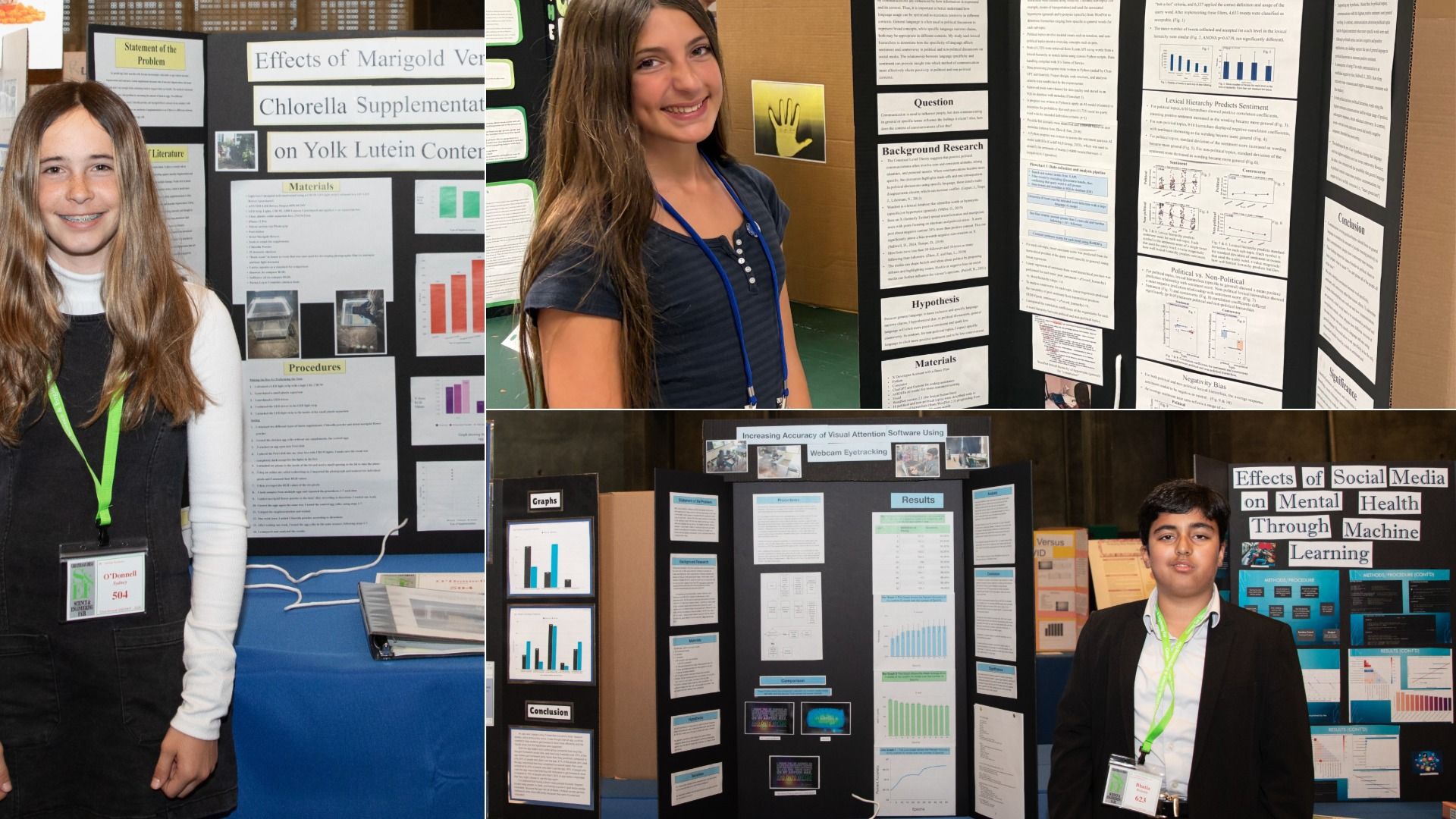
- Sydney O'Donnell from The Rhoades School took inspiration from home for her project "Effects of Marigold versus Chlorella Supplementation on Egg Yolk Lutein Content."
- "I have 35 chickens at home," she told Axios. She found you can supplement chicken eggs with lutein (a natural pigment similar to beta-carotene), which is good because "lutein is helpful to maintain eye health."
Another winner, Olympia Sternson, found that politicians speak more generally and less specifically than ordinary people.
- "A main challenge I faced was that I didn't know how to objectively define words as specific or general," she told Axios. "I addressed this problem by using lexical hierarchies to systematically define words on a range from specific to general."
Rishabh Bhatia used vision prediction software to study where our eyes go when we watch videos for his project, "Improving Human Visual Attention Prediction Using Deep Learning and Webcam Eye Tracking."
- "Whenever the test subject moves their face just at the slightest, it will completely throw off my calibration results, and I would have to restart calibration and testing for that test subject," he said. "To solve this, I implemented an artificial intelligence model that would track the location of the test subject's face, and whenever the test subject's face moves, it would adjust the calibration values accordingly."
The bottom line: Talking to these students makes you feel like maybe we're not totally doomed after all.