USD students tackle potential wrongful convictions

Add Axios as your preferred source to
see more of our stories on Google.
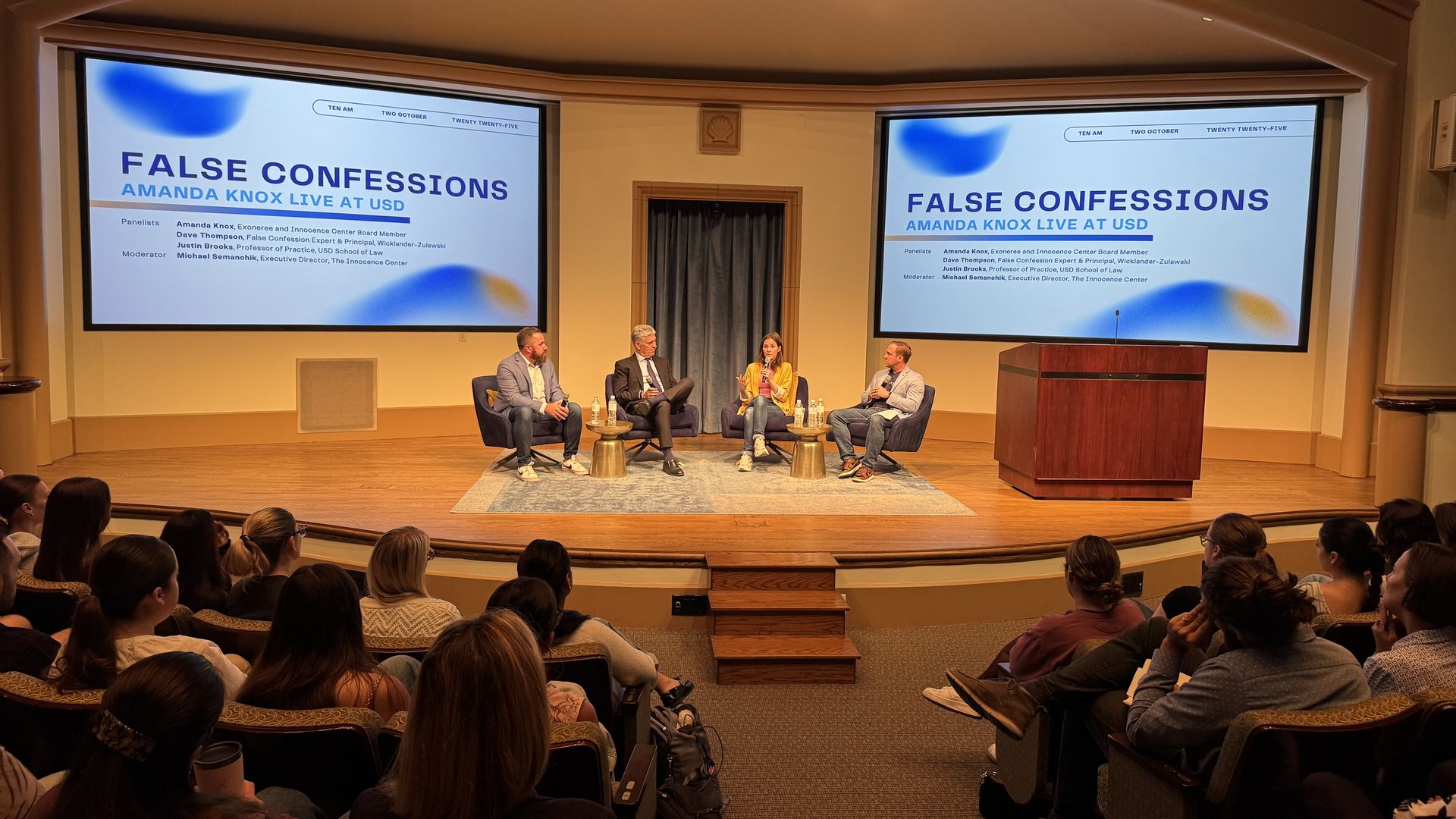
Amanda Knox speaks at the USD innocence clinic kickoff event. Photo: Courtesy of The Innocence Center
University of San Diego law students have a new way to take on legal cases and work to free people who've been wrongfully convicted.
Why it matters: The school just launched a new partnership with The Innocence Center, a nonprofit law firm founded by the former California Innocence Project team with more than 40 exonerations nationwide.
Flashback: Law student Delanie Pence helped the school establish the partnership and told Axios she was inspired by her professor Justin Brooks, who famously defended NFL linebacker Brian Banks (Greg Kinnear played Brooks in a movie about the case).
- "I asked after class why we don't have an innocence clinic on our campus," Pence told Axios. "The answer was basically that no one had initiated it yet."
- The school's first innocence clinic class started with six students last month.
How it works: Each student is assigned a case and reviews thousands of pages of court records and police files looking for red flags.
- Red flags include possible eyewitness identification issues, junk science, ineffective counsel and government misconduct, Michael Semanchik, executive director of The Innocence Center, told Axios.
- "If the case has some legs, then we'll pay for an investigator and for the student to go out into the field and do some investigation," he said. "If there's something there, then we'll work with the student to draft the legal documents we need to free the person in prison."
Case in point: If a student sees a case that relies on a single eyewitness, the student might go back and see if there were other people who weren't interviewed at the time of the crime, or additional cellphone evidence or biological material that could be DNA-tested, he said.
In the room: Students who do real case work become better lawyers down the road, Semanchik said.
- "You can't learn how to deconstruct a case by reading about it in a law book. You have to go to the crime scene. You have to actually view the crime scene photos. You've got to interview people," he said, "It's a whole lot different from some of the more theoretical work that you're doing in law school."
What they're saying: For law student Pence, visiting prison made the work real.
- "It really put into perspective the lives that are being changed through innocence work," she told Axios.
- The work builds on existing USD clinics that have allowed law students to provide free legal services to those in need, Robert Muth, vice dean and professor at the University of San Diego School of Law, told Axios in a statement.
- "The Innocence Clinic…will continue this tradition by educating future attorneys while raising awareness about wrongful convictions in our community."
What's next: Semanchik hopes to expand the class to more students next year.
- "I would guess there's probably 10,000 innocent people sitting in prison in California right now, and we have limited resources," he said. "The more resources we have, the more work we can do to chip away at that big number."