5 years after George Floyd's murder, policing reform lags in San Diego

Add Axios as your preferred source to
see more of our stories on Google.
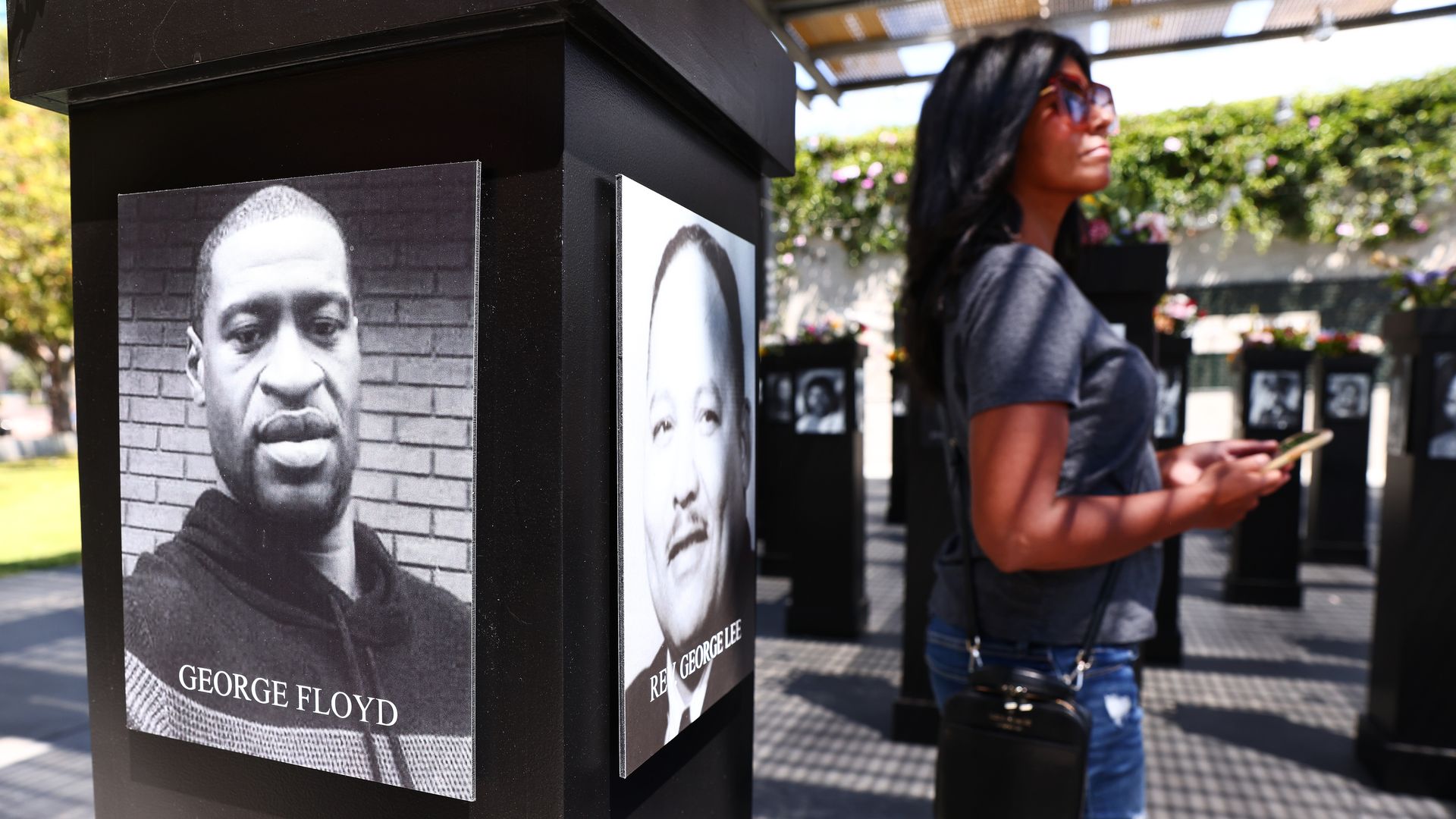
The Say Their Names memorial exhibit at Martin Luther King Jr. Promenade on July 20, 2021. Photo: Mario Tama/Getty Images
It's been five years since Minneapolis police officer Derek Chauvin murdered George Floyd, setting off a wave of protests across the country and in San Diego County.
State of play: In San Diego, that wave converged with the reaction to the arrest two days later of Amaurie Johnson by La Mesa police officer Matthew Dages at a trolley stop.
- Bystander video of Dages grabbing Johnson and forcing him to a bench went viral, with critics seeing an example of police brutality and racial profiling.
- Dages was fired, though he was acquitted of charges of lying on the police report.
The big picture: La Mesa became ground zero in San Diego for the civil unrest and demonstrations that dominated the summer of 2020.
- On May 30, about 1,000 protesters shut down traffic on Interstate 8 before sheriff's deputies began shooting tear gas and flash bangs to disperse protests near the La Mesa Police Department.
- Hours later, demonstrators had set cars on fire, some local businesses were looted and vandalized, and a Chase Bank branch was burned down.
Between the lines: Days of protests downtown spread across the county, accelerating a sluggish debate on criminal justice that had been underway in the county for years.
- But sustained policy changes from that shift have been elusive.
Flashback: Five days after Floyd's murder, former Mayor Kevin Faulconer and the former police chief announced the department was banning the use of the carotid restraint, after defending its use against reform efforts for years.
- Faulconer also reversed his position on a long-sought reform of the city's police oversight board, pledging to support a ballot measure that would give the new body subpoena power to investigate allegations of misconduct.
- The police union had successfully kept that measure off the ballot through procedural obstructions, until Faulconer's shift. Seventy-five percent of November 2020 voters approved it.
Friction point: That board is still not operating as envisioned. It took two years for the city to create the new body, creating a significant backlog of cases to review.
- Late last year, the commission's executive director and attorney left, issuing exit memos outlining changes it should undergo.
- A council committee last month approved procedures to give it the power to conduct independent investigations. Now, the full council can decide whether to send those procedures to the police union for negotiations.
By the numbers: The city of San Diego was adopting its budget in 2020, and criminal justice advocates demanded a $100 million cut to SDPD's budget.
- The City Council instead increased SDPD's budget by $29 million. It has since grown from $568 million to $708 million in the city's current proposed budget.
Case-in point: The region's police reform push reached the Metropolitan Transit System in 2020 too, with the agency abandoning its punitive approach to fare evasion amid a shift in how its security officers operated.
- Last year, the agency reversed that policy change amid increased fare evasion and committed to hiring more officers and increasing security on trolleys and busses.