San Diego grew more in 2024 than any year since the pandemic, but lags national trend


Add Axios as your preferred source to
see more of our stories on Google.
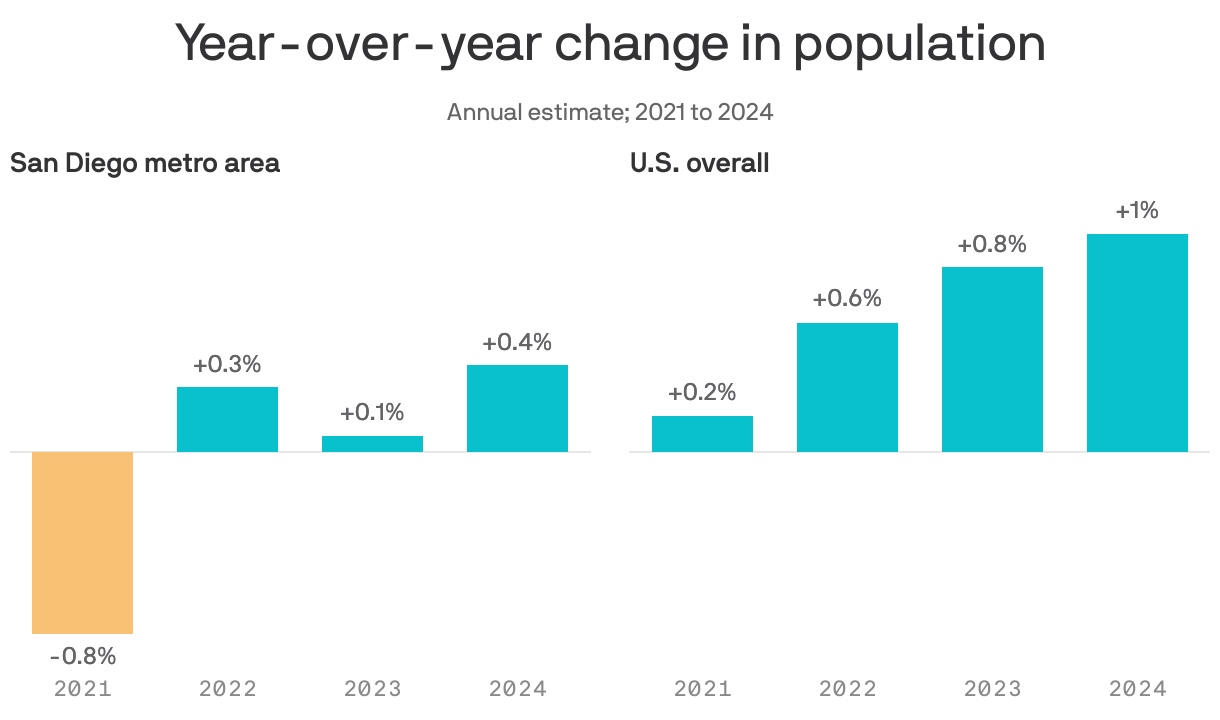
U.S. cities are growing again, and San Diego is too, with its strongest year of population growth since the pandemic.
Why it matters: Growth had been a fact of life in California and San Diego for decades, but the region's population flatlined in recent years as the high cost of living forced people out and challenged leaders to tell a new story of the local economy.
Driving the news: The San Diego metropolitan area grew by 12,909 people between 2023 and 2024, to 3.29 million, according to new figures released by the U.S. Census Bureau.
- That still wasn't enough undo the region's big drop in the first year of the pandemic, leaving San Diego's population still slightly behind the 3.3 million of 2020.
By the numbers: San Diego's decline of 2,383 people between 2020 and 2024, or 0.1%, came at a slower pace California's other largest cities.
- Los Angeles' population shrunk by 1.9% during that time, while San Francisco's fell 2.1%.
- Cheaper, inland metro areas fared better. Riverside grew by 3%, Fresno by 2% and Sacramento by 2.6%. San Jose also grew, though only by 0.3%.

The big picture: The number of people living in U.S. metro areas rose by almost 3.2 million between 2023 and 2024 — a gain of about 1.1%.
- Nearly 90% of U.S. metro areas grew from 2023 to 2024, the bureau says.
Between the lines: International migration accounted for 2.7 million of the total population gain in U.S. metros, the Census Bureau reported.
Zoom in: San Diego's population did increase by 24,226 thanks to international migration in 2024, but it fell by 23,934 due to domestic migration — San Diegans moving to other places in the U.S. — during the same period for a net gain of 292 people.
- Natural change increased San Diego's population by 12,667 from 2023 to 2024, thanks to births outpacing deaths during that time.