San Diego's new transit plans are taking shape

Add Axios as your preferred source to
see more of our stories on Google.
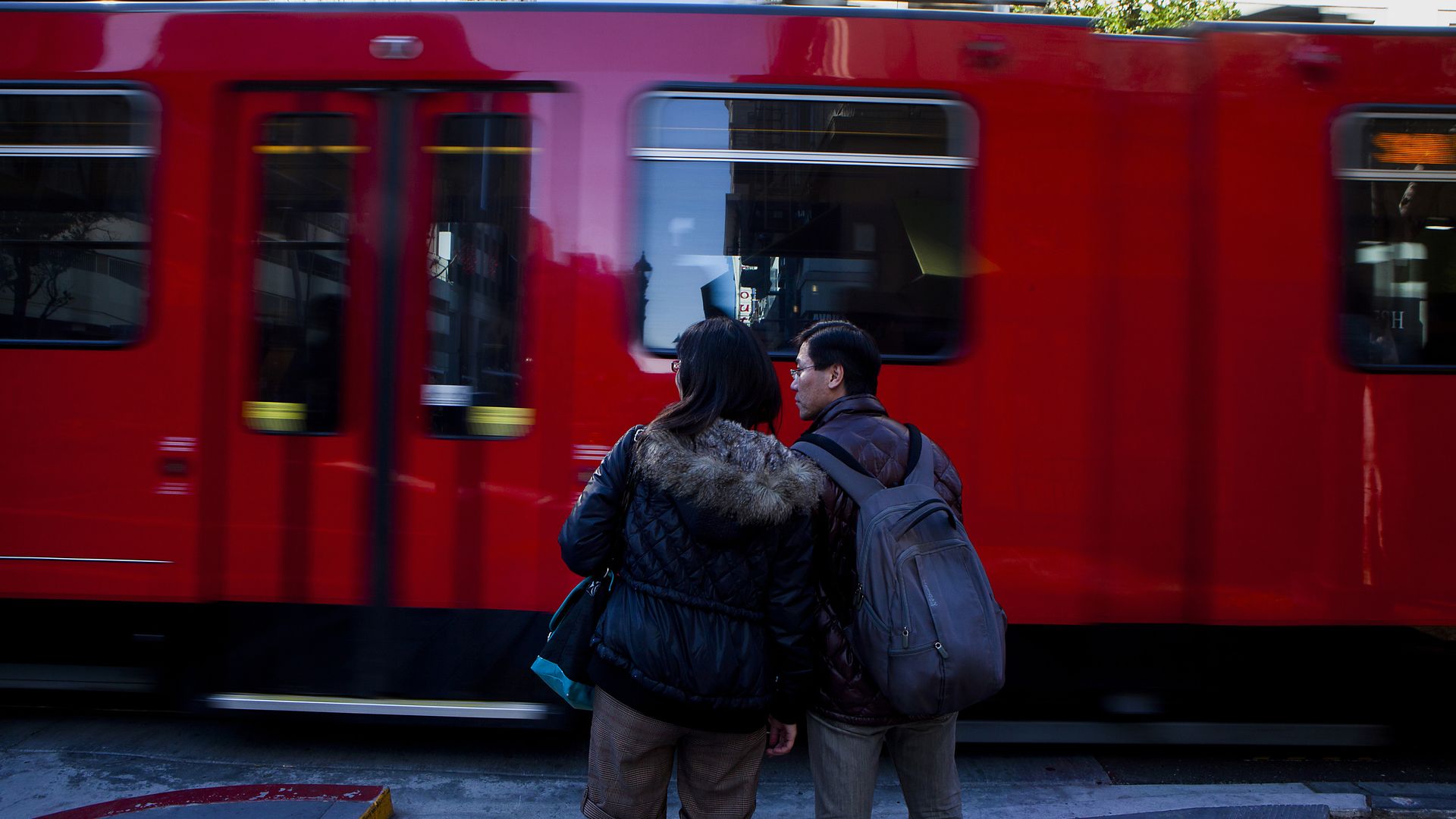
Passengers wait to board the San Diego Trolley downtown. Photo: Sam Hodgson/Bloomberg via Getty Images
Regional planners are fine-tuning the future of San Diego's transit network, but big projects that would change the face of the system are all decades away at best.
Why it matters: City leaders for years have debated how to expand the region's transportation system to accommodate new housing and manage emissions.
- Planners have settled on a strategy of increasing bus service in the short term, while they work on major transit-infrastructure projects that could take decades.
Driving the news: The San Diego Association of Governments in June finalized its multi-decade plan for the I-8 corridor — a list of nearly 500 projects across the central swath of the region.
- That's the sixth of 10 state-required blueprints — only projects listed in the corridor plans are eligible for partial state funding from SB 1, the state's 2017 gas tax.
- Separately, SANDAG's board in September will review the outline of its long-term, countywide transportation plan, which it's required to update every four years to show how the county will meet state greenhouse gas-reduction targets.
Zoom in: Some of the most attention-grabbing projects in the I-8 plan aren't expected to become reality anytime soon, such as:
- A trolley extension — from a still-in-planning airport connection out to Ocean Beach — for an estimated $1.7 billion, delivered between 2035 and 2050.
- A streetcar loop from downtown around neighborhoods ringing Balboa Park — Logan Heights, Golden Hill, South Park, North Park, University Heights and Hillcrest — for about $1.6 billion, on the same timeline.
- A "skyway" — or aerial gondola — from the Fashion Valley Transit Station out of Mission Valley to the UCSD Medical Center in Hillcrest, for roughly $227 million.
Between the lines: Those projects are each treated as very much up in the air, with uncertain funding and a delivery timeline between 2035 and 2050, so planners are currently focused on short-term alternatives.
- The OB Trolley spur, for instance, would be preceded by a rapid bus route for $48 million, built by 2035.
- The new rapid bus network, planners say, will rely on preferential treatment at stoplights and dedicated roadways more than existing rapid bus routes have.
- Many of the short-term plans also call for simply increasing bus frequency and extending service hours for speed and convenience.
The bottom line: The full regional plan the agency is scheduled to adopt in 2025 is primarily focused on building out a robust rapid bus network, said Antoinette Meier, senior director of regional planning.
- "There's a lot of unmet need out there today," she said. "Our biggest priority right now is transit we can implement quickly."