UCSD researchers suggest Mars has water, a key 'ingredient for life'

Add Axios as your preferred source to
see more of our stories on Google.
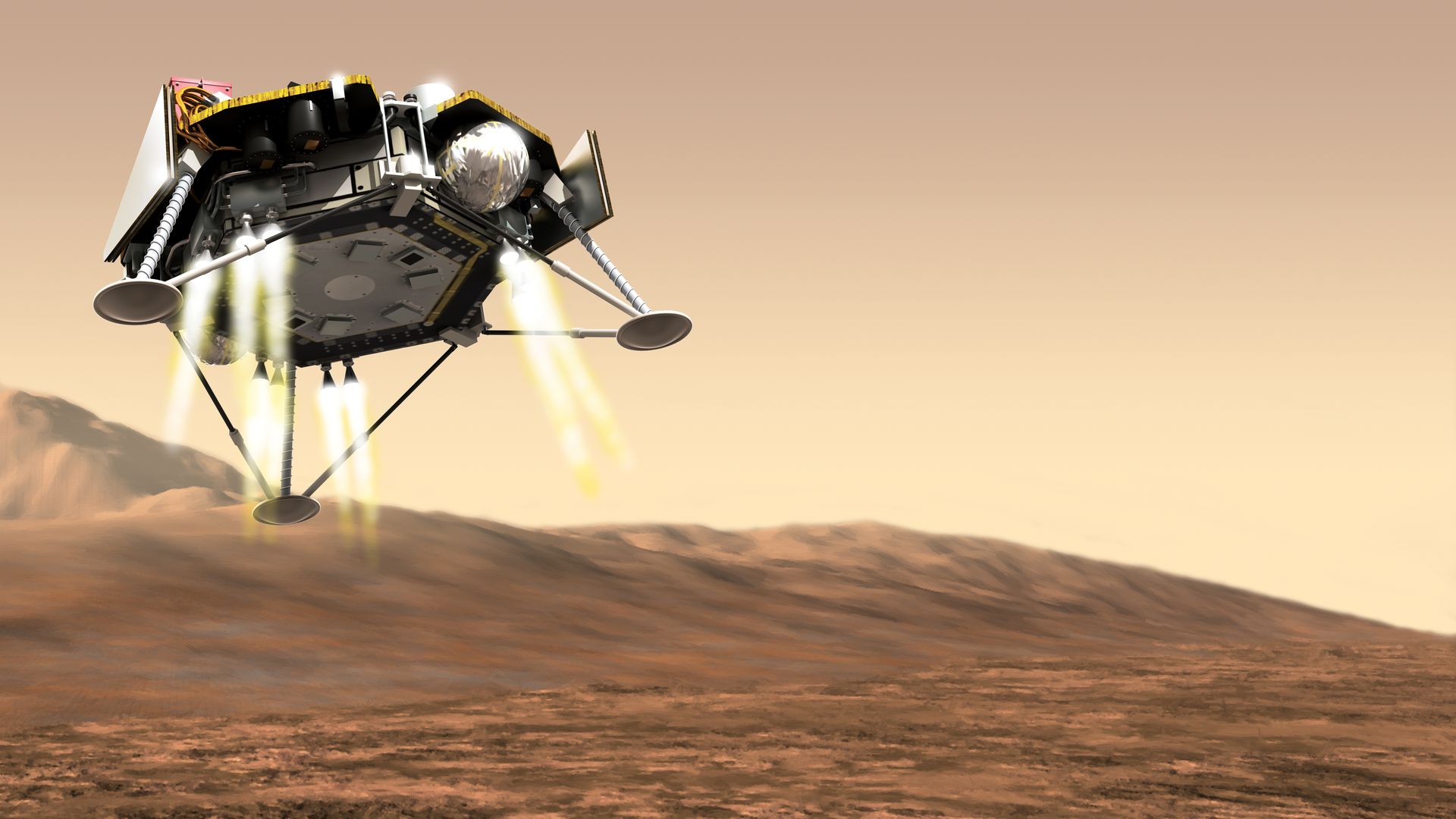
A rendering of the InSight robotic lander exploring Mars. Illustration: Adrian Mann/Future Publishing via Getty Images
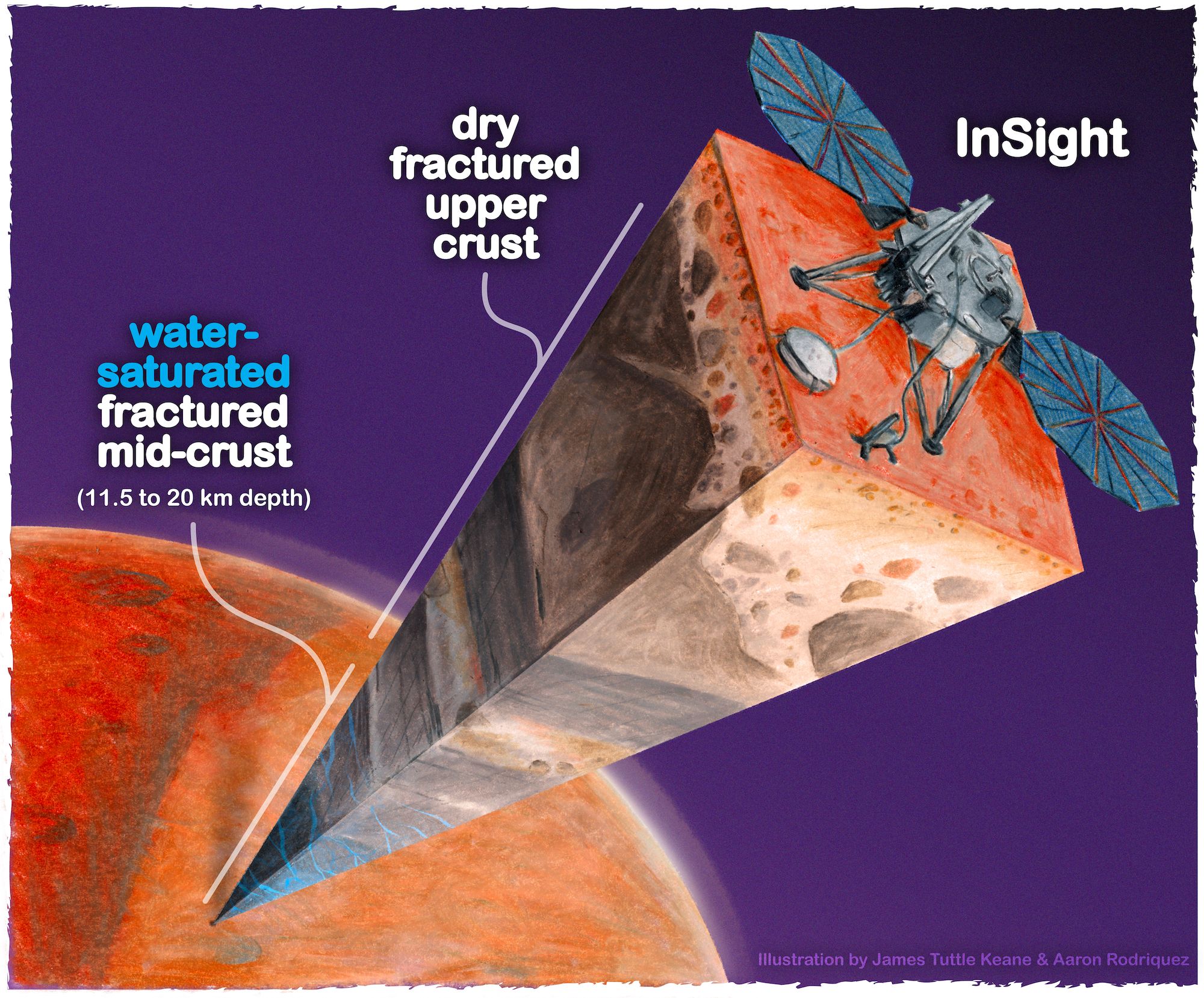
In a new study, UC San Diego researchers suggest Mars has large amounts of liquid water miles beneath its surface after analyzing data from NASA's InSight lander mission.
Why it matters: Knowing if, when, where and how much water exists on Mars helps scientists determine the water cycle and evolution of the planet, and whether it can sustain life or was able to in the past.
Between the lines: "An important ingredient for life is beneath Mars … it's potentially habitable," co-author Vashan Wright, a geophysicist at UC San Diego's Scripps Institution of Oceanography, told Axios. "It does not mean there is life on Mars."
- This study "provides the best evidence to date that the planet still has liquid water in addition to that frozen at its poles," according to UCSD.
Catch up quick: NASA's InSight lander, which launched in 2018, was the first outer-space robotic explorer to perform an in-depth study of Mars' crust, mantle and core.
- It spent more than four years collecting data and science on the red planet before the mission ended in 2022 after losing communication with the agency's Jet Propulsion Laboratory in Pasadena.
- InSight — which stands for Interior Exploration using Seismic Investigations, Geodesy and Heat Transport — helped scientists better understand the planet's interior, weather patterns and atmosphere.
- It detected more than 1,300 Mars-quakes during its run and felt the shockwaves from a major meteor strike.
Zoom in: Wright and his team analyzed gravity data, along with data the lander collected, including the speed of seismic waves from Mars-quakes and meteor impacts.
- The speed depends on what type of rock the crust is made of, where it has cracks and what fills the cracks.
- The researchers used rock physics models to determine that large amounts of liquid water currently fills those underground cracks.
Context: Billions of years ago, the cold, desolate planet had lakes, rivers and oceans much like Earth.
- Scientists are still working to understand why it dried up and where that water went.
- This analysis suggests stores of groundwater sit in the crust, which could fuel future research.
The latest: The study was published Monday in the journal Proceedings of the National Academy of Sciences.
- Scripps Oceanography associate professor Matthias Morzfeld and Michael Manga from the University of California Berkeley are also co-authors.
- The work was supported by the Canadian Institute for Advanced Research, the National Science Foundation and the US Office of Naval Research.
What they're saying: "I hope it inspires people as much as it inspires me ... to be able to explore what lies beneath another planet, especially one that looked similar to Earth three to four billion years ago," Wright said.