Racial segregation is rising in San Diego schools 70 years after Brown v. Board decision


Add Axios as your preferred source to
see more of our stories on Google.
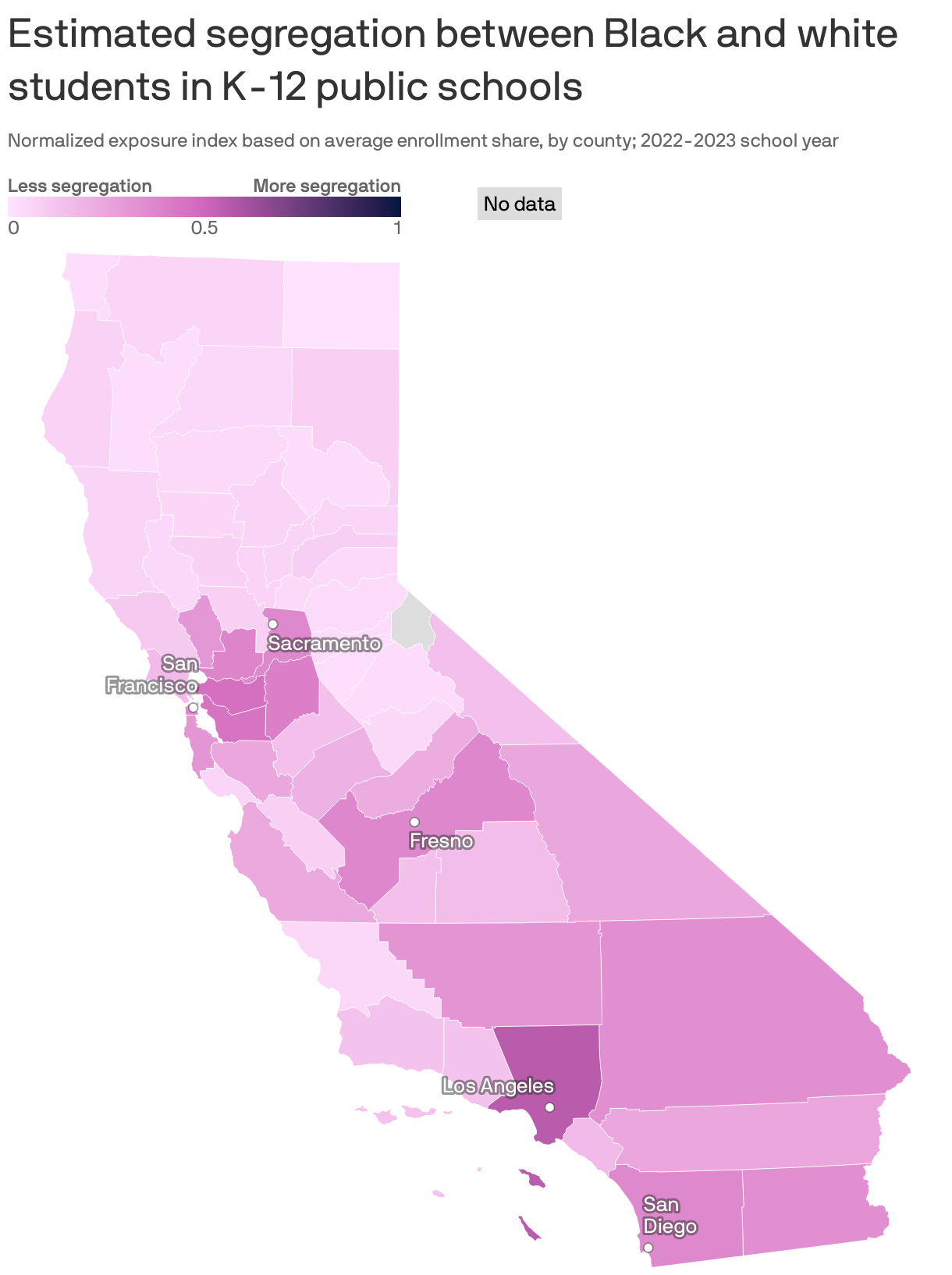
Segregation in schools across the country has increased dramatically over the last three decades, according to two new reports and an Axios review of federal data.
Why it matters: Today marks the 70th anniversary of the landmark Brown v. Board of Education ruling, yet American public schools are growing more separate and unequal even though the country is more racially and ethnically diverse than ever.
The big picture: Analyzing data from U.S. public schools going back to 1967, a Stanford and USC study found that segregation between white and Black students is up 64% since 1988 in the 100 largest districts.
Zoom in: Public schools across San Diego County have become slightly more segregated since 1991, but less so than Los Angeles County and parts of the Bay Area.
- Segregation within San Diego Unified School District has risen in the past 30 years, particularly between white and Black students.
By the numbers: In 1991, San Diego Unified Schools had a segregation rating of 0.28 for Black and white students and 0.29 for Hispanic and white students.
- By 2022, those ratings had jumped to 0.48 and 0.33, respectively.
- The rating measures segregation by exposure of students of different races and ethnicities, with 0 being the least segregated and 1 being the most segregated.
Meanwhile, the district's demographics also shifted — the percentage of white, Black and Asian students decreased, while the percentage of Hispanic students increased.
- Most schools with the lowest proportion of white students are in San Diego's southeastern neighborhoods.
- Schools in coastal neighborhoods and northern parts of the county have higher concentrations of white students.
Flashback: In 1977, a Superior Court judge ordered the integration of local public schools and allowed for voluntary busing (instead of forced), as well as magnet schools.
The big picture: The resegregation of America's public schools coincides with the rise of charter schools and school choice options, and as civil rights groups have turned away from desegregation battles.
- Segregated schools disproportionately hurt Black and Latino students because they tend to have fewer resources, more teacher shortages, higher student-to-counselor ratios and fewer Advanced Placement class options.
The other side: Debbie Veney of the National Alliance for Public Charter Schools tells Axios that neighborhood schools and charters are not causing racial segregation, but simply serving the students who appear at their doorsteps.
- She suggested focusing instead on why white families change schools "when too many Black, brown or low-income kids start showing up."
Between the lines: Schools on average have become less white and more Latino, Asian American and multiracial. But students of color are going to schools with fewer white students and fewer resources, a UCLA Civil Rights Project report found.
- California's intensely segregated schools, defined as those with 90-100% nonwhite students, spiked from 11% to 44% from 1988 to 2021, per the UCLA analysis of federal data.
Keep reading: National desegregation trends