California's food waste is declining, but more is filling up landfills

Add Axios as your preferred source to
see more of our stories on Google.
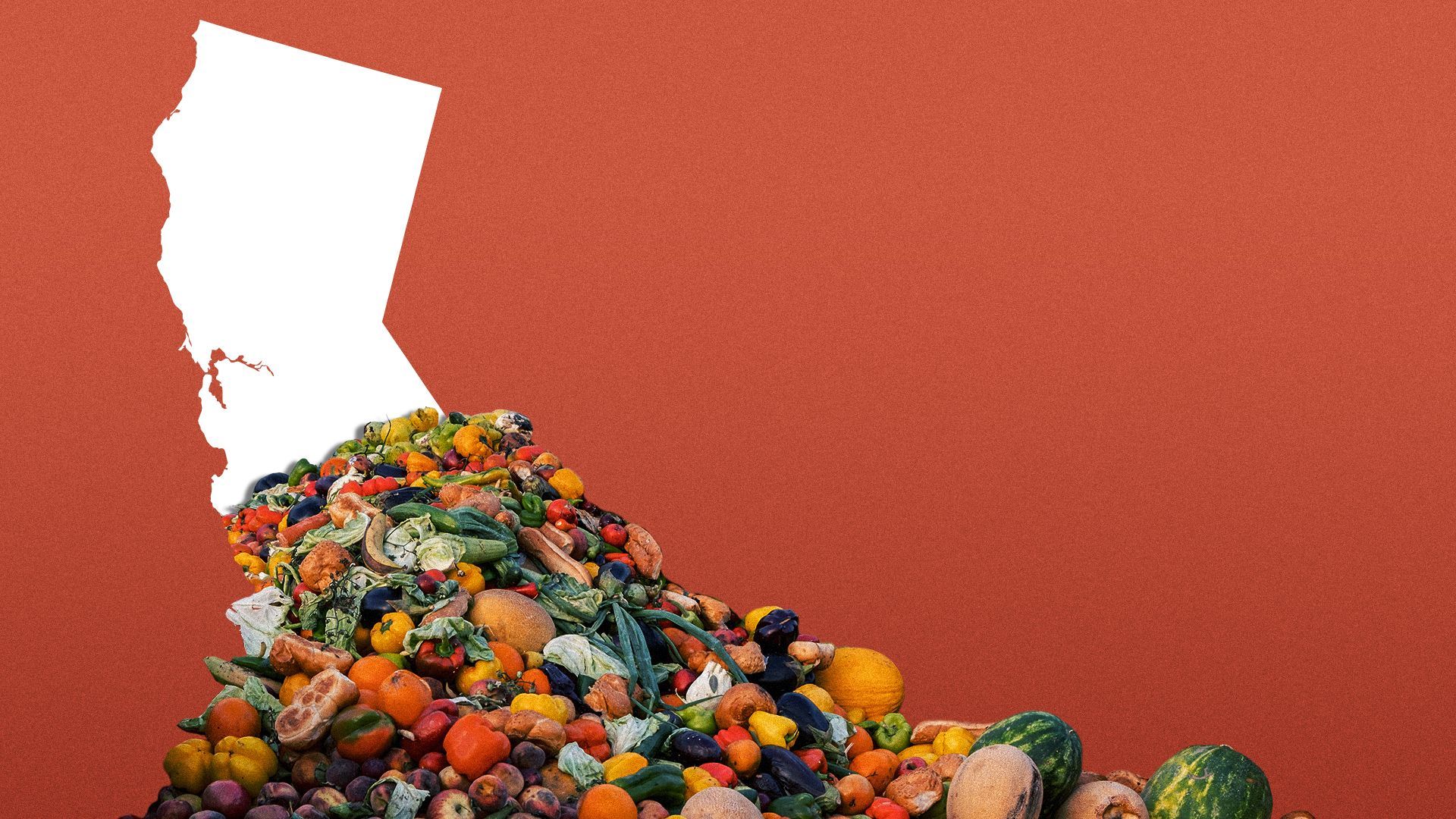
Illustration: Lindsey Bailey/Axios
Consumers and businesses in California produced nearly 12 million tons of food waste in 2022, a 11% decrease from 2016, per the latest data from the nonprofit ReFED.
- Threat level: About a quarter of it ends up in landfills, which leak methane gas.
What's happening: The decrease suggests that the state's tighter restrictions to address food waste are making a dent — sort of.
Why it matters: Wasting food squanders the resources that go into producing it, with ripple effects on climate resources and the economy.
- Food waste makes up 24% of municipal landfill input and contributes to 6.1% of U.S. greenhouse gas emissions.
- On average, a person wastes $759 on uneaten food each year.
- Californians send 11.2 billion pounds of food to landfills each year, according to the state Department of Resources Recycling and Recovery.
Between the lines: While other states have seen increases in food waste, California's drop is partly due to a 2016 law (SB 1383) aimed at reducing organic waste in landfills and emissions of short-lived climate pollutants, including methane and other greenhouse gasses.
- It mandates cutting 75% of organic waste disposal by 2025 and redirecting 20% of edible food currently thrown away to people in need by 2025, per CalRecycle.
- In 2022, the law required certain businesses, including grocery stores, wholesale vendors and other food service providers to donate unused food to recovery organizations like Feeding San Diego.
- As of Jan. 1, the law expanded to include restaurants, hotels, state agencies and health facilities with cafeterias, and other large venues like the zoo.
Reality check: While California's food waste has decreased overall, the amount of organic waste in landfills has jumped since 2019, ReFED data shows.
- San Diego and the state haven't met their goals to divert that waste from landfills, Voice of San Diego reported recently.
- Meanwhile, the state is poised to miss its 2025 target.
Zoom in: The city of San Diego rolled out more than 200,000 green bins for composting to residents last year in compliance with the law.
- Yes, but: That effort came late and added costs for residents, some of whom didn’t use them correctly to start with, per VOSD.
By the numbers: The city has incremental goals to have zero waste (including food scraps, trash, packaging materials and household items) going into the Miramar landfill by 2040.
- Divert 75% of the trash collected in the city by 2020 (missed). That jumps to:
- 82% by 2030
- 90% by 2035
- The city reported in November it diverted 71% of waste in 2022.
What we're watching: The enforcement of these laws and policies could mean cities, businesses or residents are fined for failing to comply.
- San Diego is developing an enforcement plan, but for now it's education-based. Residents might see an "oops" tag on their bins if wrong items are in there.
Be smart: Use the city's recycling guide or WasteFreeSD for instructions to donate, recycle or properly dispose of many household items. ReFED suggests following the "Food Waste Five" strategies for reducing waste at home:
- Store food properly.
- Freeze food to extend its freshness.
- Dedicate one day each week for eating leftovers.
- Understand the meaning behind date "best by" labels.
- Plan your meals before buying groceries.