Fewer San Diego workers suffer from long commutes

Add Axios as your preferred source to
see more of our stories on Google.
Commutes are getting less painful — at least for some of you.
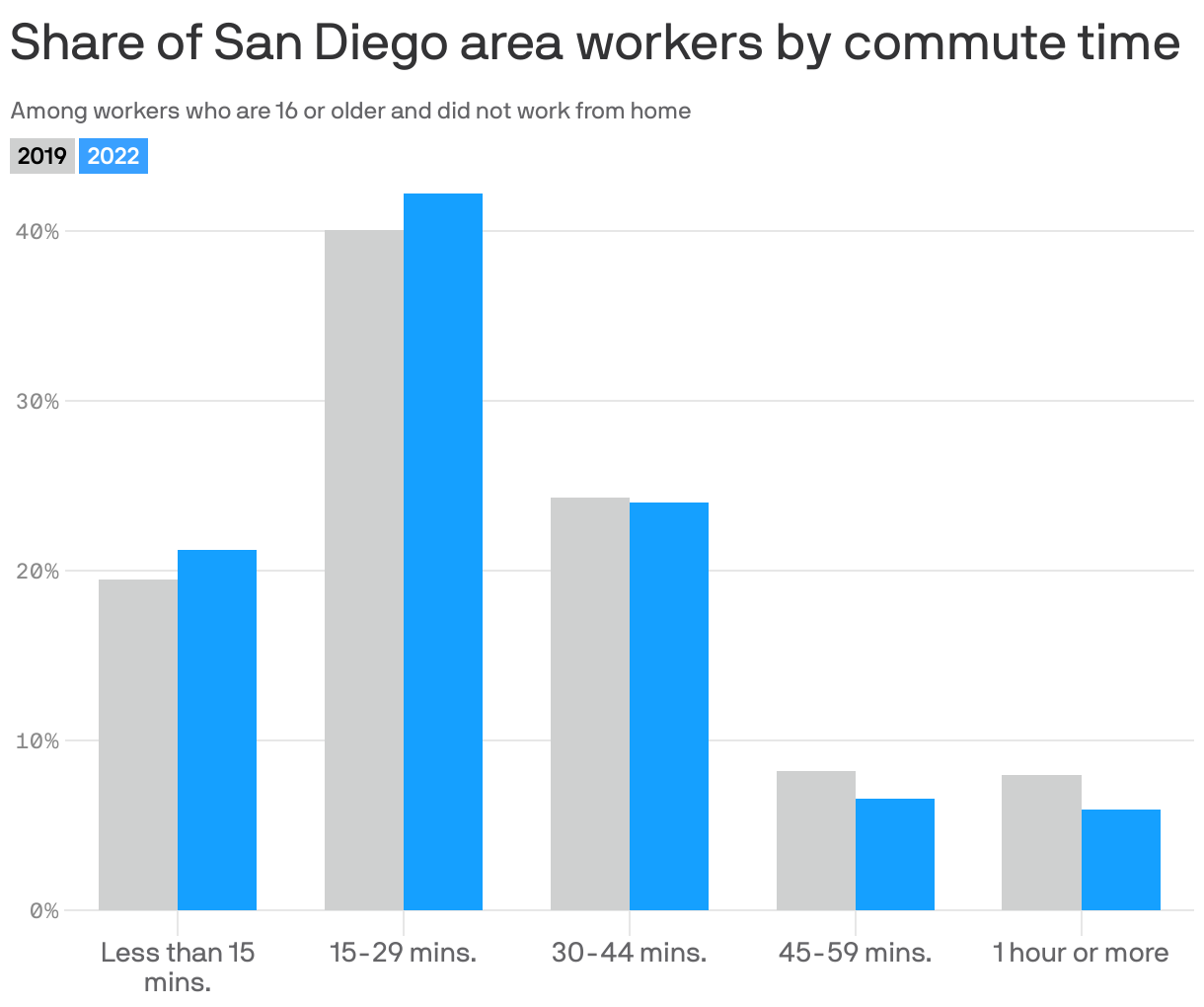
Driving the news: In the years after the pandemic, fewer San Diego workers have commutes of 45 minutes or longer, while more of us get to work in 30 minutes or less, according to census data.
- San Diego's decline in long commutes is consistent with the national trend.
Why it matters: Long commutes cost people money, hurt their mental health and job satisfaction, and are bad for the environment.
By the numbers: From 2019 to 2022, there was little change in the share of San Diego workers who commute 30 to 44 minutes. Now, the group of people with the shortest commutes is growing and those with the longest commutes are shrinking.
- Pre-pandemic, 59.5% of San Diego workers had a 29-minute commute or less. That grew to 63.5% last year.
- In 2019, 16.2% of San Diego workers commuted for 45 minutes or more — a figure that fell to 12.6% last year.
Yes, but: The census data refers to people who live in San Diego.
- It doesn't account for those who moved to Riverside County for cheaper housing, but longer commutes.
- The San Diego Regional Chamber of Commerce in 2020 estimated 53,000 people commuted from Riverside County, accounting for an extra 400,000 tons of carbon emissions compared to if they lived in North County.
The big picture: San Diego's rate of workers with an hour or longer commute — 6% — is lower than other large cities.
- That sort of commute is far more prevalent in Washington, D.C. (14.1%), San Francisco (12.8%), Boston (11.9%), Atlanta (11.9%), Chicago (11.7%), and Houston (10.3%).
- San Diego's share of hour+ commuters is more in line with Denver (6.4%), Charlotte (6.3%), Detroit (6.1%), Portland (6%) and Phoenix (5.8%).
Of note: These numbers refer to all commuters, whether they drive, bike, walk or rely on mass transit.
- That means it isn't affected by the rise of remote work — except insofar as more people working from home means fewer people on the road during rush hour, which could contribute to shorter commutes.
On the other hand, Cindy Burke, senior director of data science at SANDAG, pointed to the agency's 2022 "state of the commute" report, which found travel times during rush hour have increased for consecutive years.
- It's possible, she said, that flexibility from hybrid work-from-home schedules has let some workers shorten their commutes by avoiding rush hour, even while gridlock at peak commute times creeps back from the pandemic.
- "We don't see commutes getting shorter, if you just look at peak travel times," she said.
- But people who work weekends, or who have off-hour shifts, could be the workers reaping benefits of shortened commutes.