The woman who named Swissvale

Add Axios as your preferred source to
see more of our stories on Google.
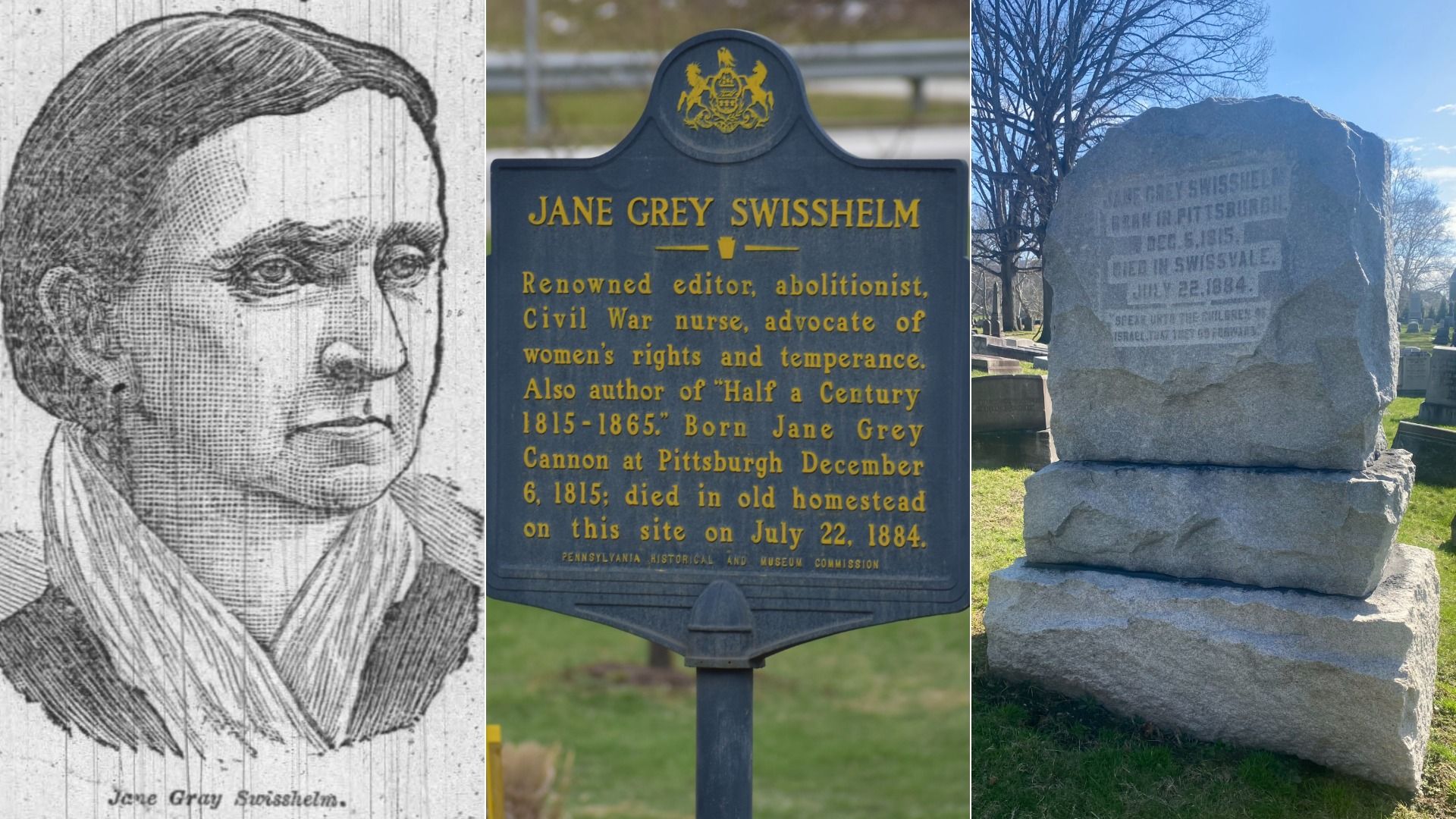
An etched portrait of Jane Grey Swisshelm alongside her historical marker and burial site in Allegheny Cemetery. Photos: St. Louis Globe-Democrat archives, Chrissy Suttles/Axios
Jane Grey Swisshelm spent her life challenging the limits of 19th-century America, and much of that fight took shape in Pittsburgh.
Why it matters: Women's History Month often spotlights Pittsburgh trailblazers like Nellie Bly and Rachel Carson, but Swisshelm's impact on law, journalism and the abolitionist movement is mostly unsung.
The big picture: Born in Pittsburgh in 1815, Swisshelm founded several newspapers and leveraged them to oppose slavery and advocate for married women's property rights.
Zoom in: As a young woman, she married James Swisshelm and settled in Swissvale — a name she gave the area where his family owned a farmstead.
- The couple spent time in Kentucky, where she encountered slavery firsthand, an experience that cemented her as a staunch abolitionist.
- She published the influential anti-slavery and women's rights newspaper The Pittsburgh Saturday Visiter, and later launched a similar publication in St. Cloud, Minnesota, with the same mission. Her writing at times earned her powerful political enemies who once destroyed the paper's printing press and hurled pieces into the river.
- As a correspondent for Horace Greeley's New York Tribune, she became the first woman admitted to the U.S. Senate press gallery. Some historians say this makes her the nation's first female political reporter.
Between the lines: She struggled with the constraints of married life at the time, and she and James eventually divorced — a rare and stigmatized move.
- The law gave her husband control of the inheritance she received from her own family's property, so Swisshelm published letters calling for reform that contributed to Pennsylvania laws allowing married women to own and inherit property, says Leslie Przybylek, senior curator at the Heinz History Center.
What they're saying: "She was balancing this dichotomy between the things she wanted to do and what society is saying she should do," says Przybylek. "I don't think she ever quite finds the happy balance between those."
Yes, but: During the U.S.-Dakota War, Swisshelm used her newspaper to call for harsh punishment and removal of all Indigenous people from Minnesota, traveling to Washington, D.C., to lobby President Lincoln to be more forceful.
She published her autobiography in 1880 and died in Swissvale four years later.
The intrigue: Her national prominence gave the Swisshelm name its distinction, Przybylek says. Both the borough of Swissvale and Swisshelm Park are named after her.
- A historical marker honoring her life is at Braddock and Greendale Avenues in Edgewood. She's buried in Allegheny Cemetery's lot 10.
Go deeper: The Heinz History Center displays a self-portrait and holds copies of the Pittsburgh Saturday Visiter in its archives, available to the public by request.