School recess is back in play


Add Axios as your preferred source to
see more of our stories on Google.
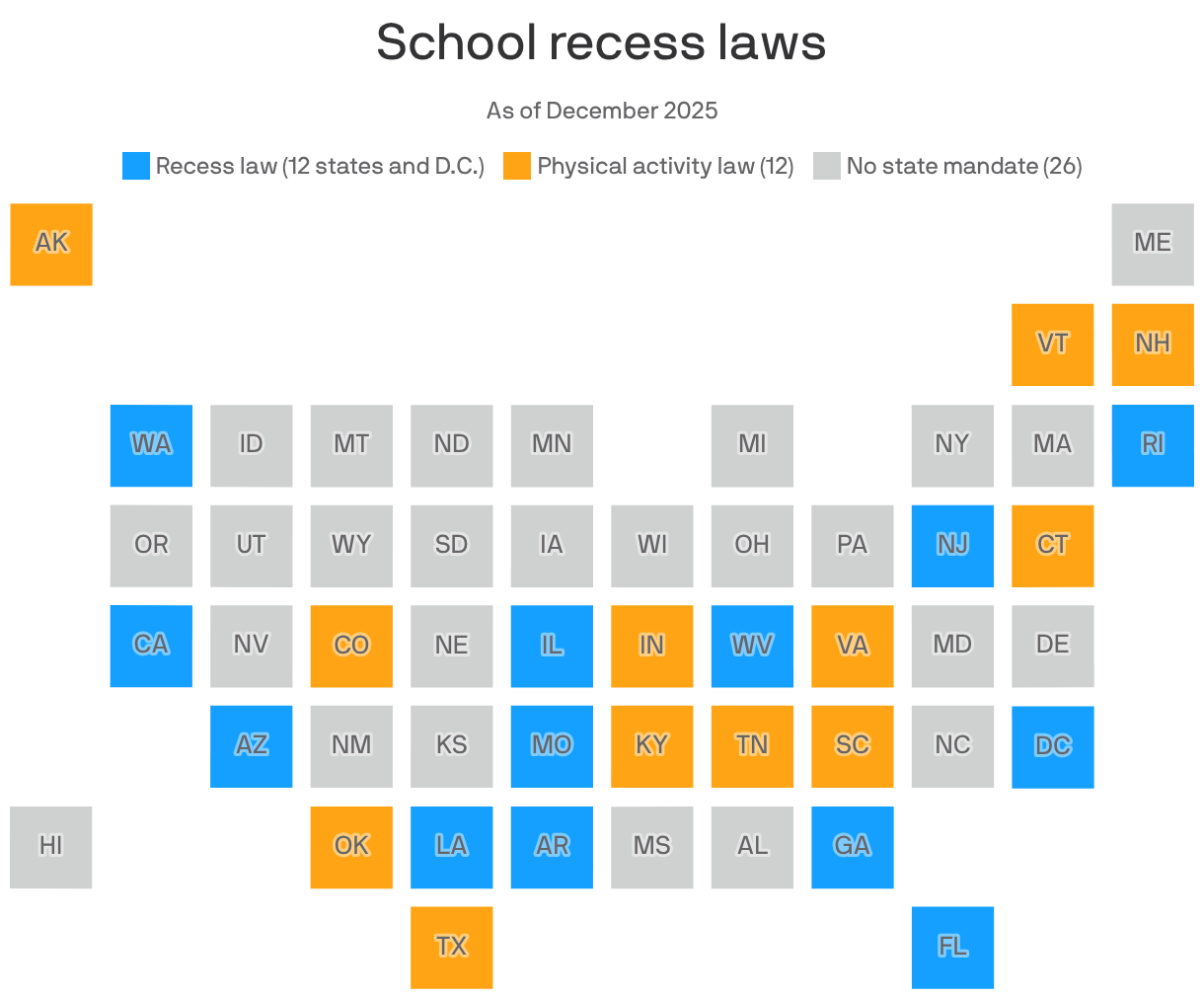
After decades of diminished recess time, nearly half of U.S. states now require it or other physical activity by law.
Why it matters: Yes, recess is literally child's play. But researchers, pediatricians and parents say it's crucial for young students' physical and mental health.
Zoom in: Missouri state law requires elementary schools to provide at least one 20-minute recess a day, which can be folded into lunch, plus an average of 30 minutes of daily physical activity.
- Kansas has no mandate, though the state education department recommends 30 minutes of daily elementary recess.
State of play: Both statehouses tried to expand requirements this year. Both efforts died.
- A Missouri bill requiring 60 minutes of daily physical activity, scaled back from K-12 to K-5 under pressure, squeaked through the House but never got a Senate floor vote.
- Kansas lawmakers passed a bill requiring 30 minutes of daily unstructured recess and fitness tests for elementary students. Gov. Laura Kelly vetoed it, saying she agreed with it but that curriculum standards belong to the State Board of Education.
By the numbers: As of December, school recess is mandated in 12 states and D.C., and laws requiring physical activity exist in 12 states, according to Johns Hopkins research.
- From 2001 to 2019, weekly recess time in U.S. schools dropped by 60 minutes, education consulting company EAB found.
- The drop is often attributed to "No Child Left Behind."
Between the lines: Nearly every state has P.E. legislation, but neither necessarily requires free play.
- Unstructured play doesn't just teach social skills, but research connects it to increased classroom motivation and behavior, better school attendance, and less stress for students.
What they're saying: "Recess gives you a better feeling about school. Recess refreshes you. Recess helps you feel a little bit less cynical about what's going on," psychologist Peter Gray, author of the forthcoming book "Restoring Childhood," tells Axios.
The bottom line: Both states agree kids need recess. Neither has been willing to require more of it.