The kratom crackdown splits KC at the state line

Add Axios as your preferred source to
see more of our stories on Google.
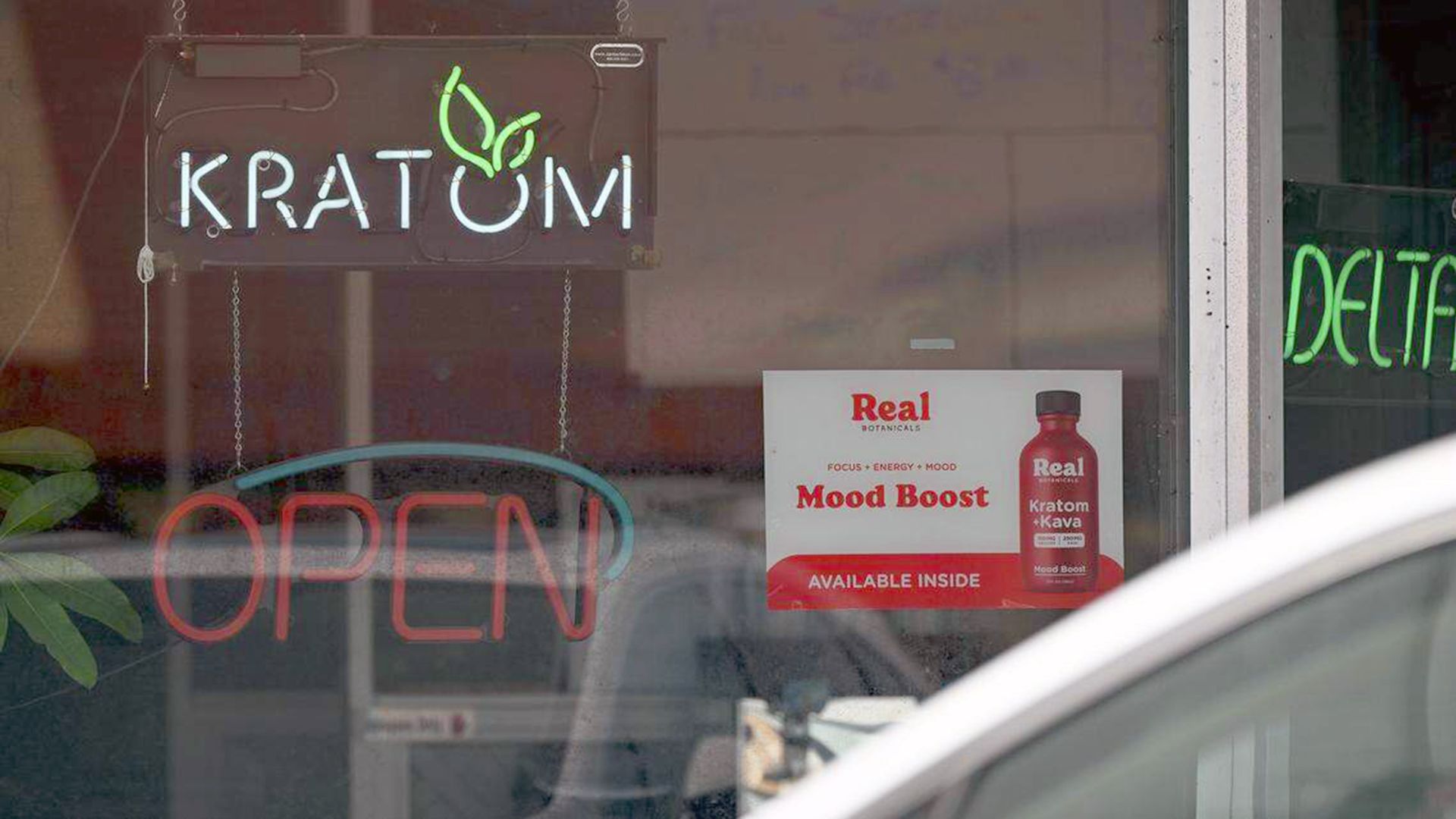
Signage for kratom products outside a store. Photo: Tiffany Tompkins/Getty Images
A product local leaders and law enforcement call "gas station heroin" is now illegal in Kansas — and the federal government may soon make it illegal nationwide.
Why it matters: Possessing kratom or its derivative, 7-hydroxymitragynine (7-OH), became a felony in Kansas on July 1, splitting the rules in a metro that's home to the Midwest's largest 7-OH producer.
Context: Kratom comes from a Southeast Asian tree whose leaves naturally carry trace amounts of 7-OH, the compound behind its opioid-like effects.
- Companies concentrate or synthesize it into tablets, gummies and drinks sold over the counter at gas stations and smoke shops.
State of play: Kansas' new law bans kratom and 7-OH outright. Johnson County District Attorney Steve Howe says possession is now a Level 4 felony and selling is a Level 3.
- Missouri lawmakers debated a statewide ban this spring but adjourned without passing one, leaving both legal under state law.
Zoom in: Kansas City, Independence and Blue Springs ban synthetic 7-OH anyway.
- KC businesses caught selling it face fines of up to $1,000 a day.
- Meanwhile, Attorney General Catherine Hanaway reached settlements in June, halting Missouri sales by two KC-based companies, CBD American Shaman and distributor Relax Relief Rejuvenate Trading.
Zoom out: The same day Kansas' ban took effect, the U.S. Drug Enforcement Administration filed its intent to place concentrated 7-OH in the same federal category as heroin.
- The move is a notice of intent, not a ban. The order can't take effect before early August and would exempt botanical kratom below a set 7-OH threshold.
Threat level: Johnson County chief medical examiner Diane Peterson said that 7-OH had factored into six deaths there over the previous six weeks, roughly mid-May through June, up from one in all of 2025.
- "It's just as dangerous, if not more, than fentanyl," she said.
The other side: The founder of CBD American Shaman has called local bans disheartening, arguing the products help people manage pain and addiction and should be regulated, not banned.
If you have it: Kansas residents can drop products at the Johnson County sheriff's collection box in New Century or other disposal sites.
- On the Missouri side, some Walgreens locations offer medication disposal kiosks.
What's next: If the federal order takes effect next month, covered 7-OH products will become illegal nationwide for at least two years.