Our surrogacy laws are all over the place


Add Axios as your preferred source to
see more of our stories on Google.
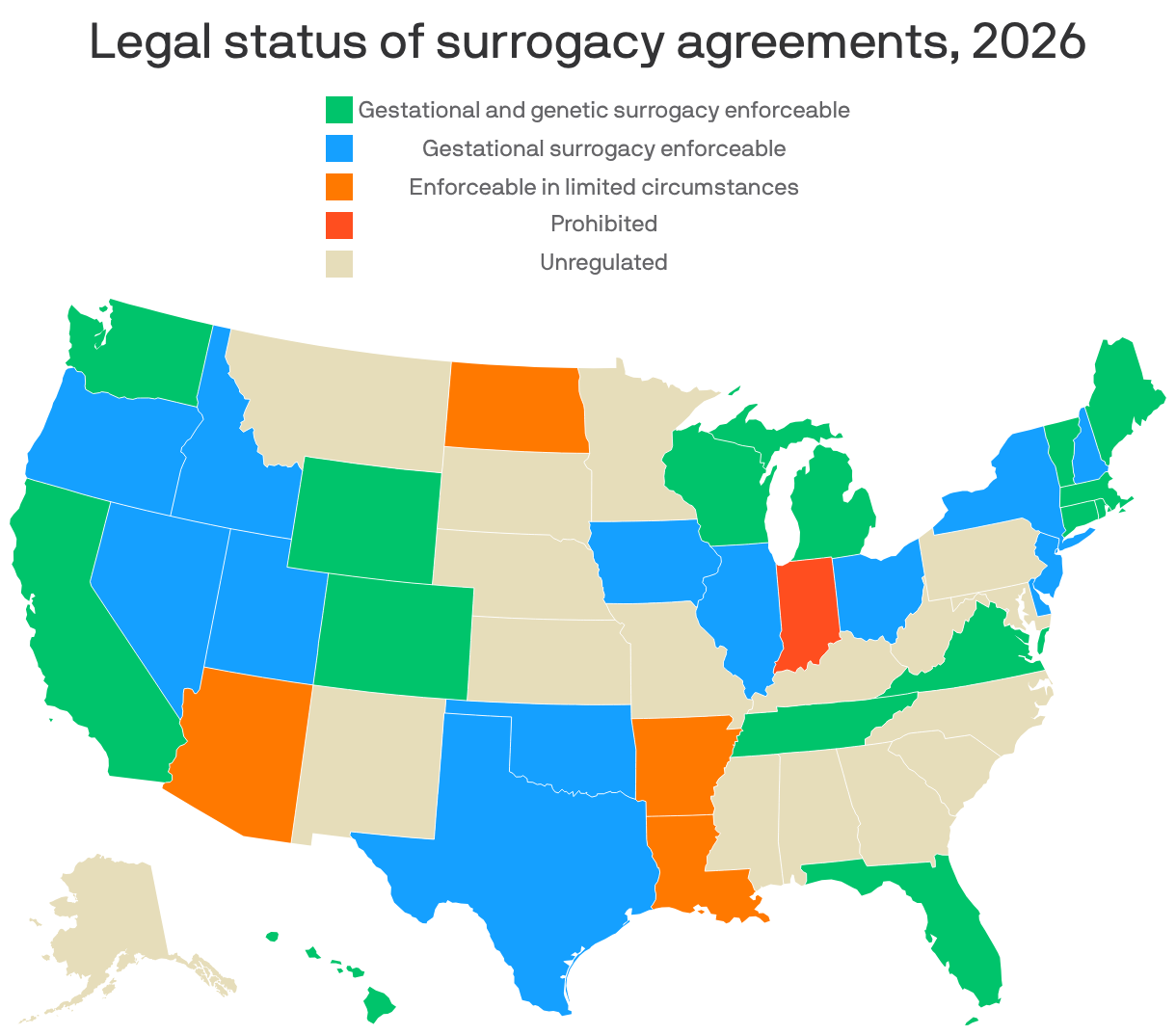
Kansas City families navigating surrogacy face two different legal systems depending on which side of the state line they use.
The big picture: Some state regulations have barriers for intended parents who are single, unmarried, not a heterosexual couple and/or not genetically related to the child.
By the numbers: As of 2026, surrogacy agreements are enforceable in 31 states (with some limitations), void in one, and unregulated in 17, Surrogacy360 tells Axios.
Major differences between state laws include:
- How a surrogate must be compensated (if not considered "altruistic").
- Who becomes the legal parents of a child born via a surrogate.
- And whether genetic surrogacy (when the surrogate uses her own egg) is even allowed.
Zoom in: Missouri law does not clearly allow or prohibit surrogacy, so courts rely on broader parentage rules to sort it out.
- Judges do not issue pre-birth parentage orders. Intended parents are typically not legally recognized until after the child is born.
- Parentage is finalized after delivery, and outcomes can vary depending on the family's situation and the judge handling the case.
Kansas follows a more defined process. Courts regularly approve pre-birth parentage orders, especially when at least one intended parent has a genetic connection.
- That allows parents to establish legal rights before birth and often be recognized right away.
- Most surrogacy contracts are enforceable, though some cases still require additional legal steps.
Zoom out: The trend across the country has largely been toward clearer regulation that protects surrogates, intended parents and children.
- New surrogacy regulations were enacted in Massachusetts, Michigan and Illinois last year, and in Oregon and Hawaii this year.
What they're saying: A growing number of lawyers "have begun to specialize in advising either intended parents or being the separate counsel for a surrogate," says Ming Wong, an attorney and the director of community justice and access at the National Center for LGBTQ Rights.
- Because contracts involve so many potential risks, like one party changing their mind midway through the process, "we always encourage people to at least talk to an attorney … even in a state where it's not criminalized," Wong says.
Yes, but: In states without enforceable surrogacy rules, Wong says, there's a risk that agreements could look like a criminal act, similar to "baby-selling."
- Still, surrogacy is practiced in most U.S. states, even in those where laws are unclear, according to surrogacy agency Creative Family Connections, which has a map showing how laws for compensated surrogacy are practiced across the country.