Electricity bills in Kansas and Missouri rising amid data center boom

Add Axios as your preferred source to
see more of our stories on Google.
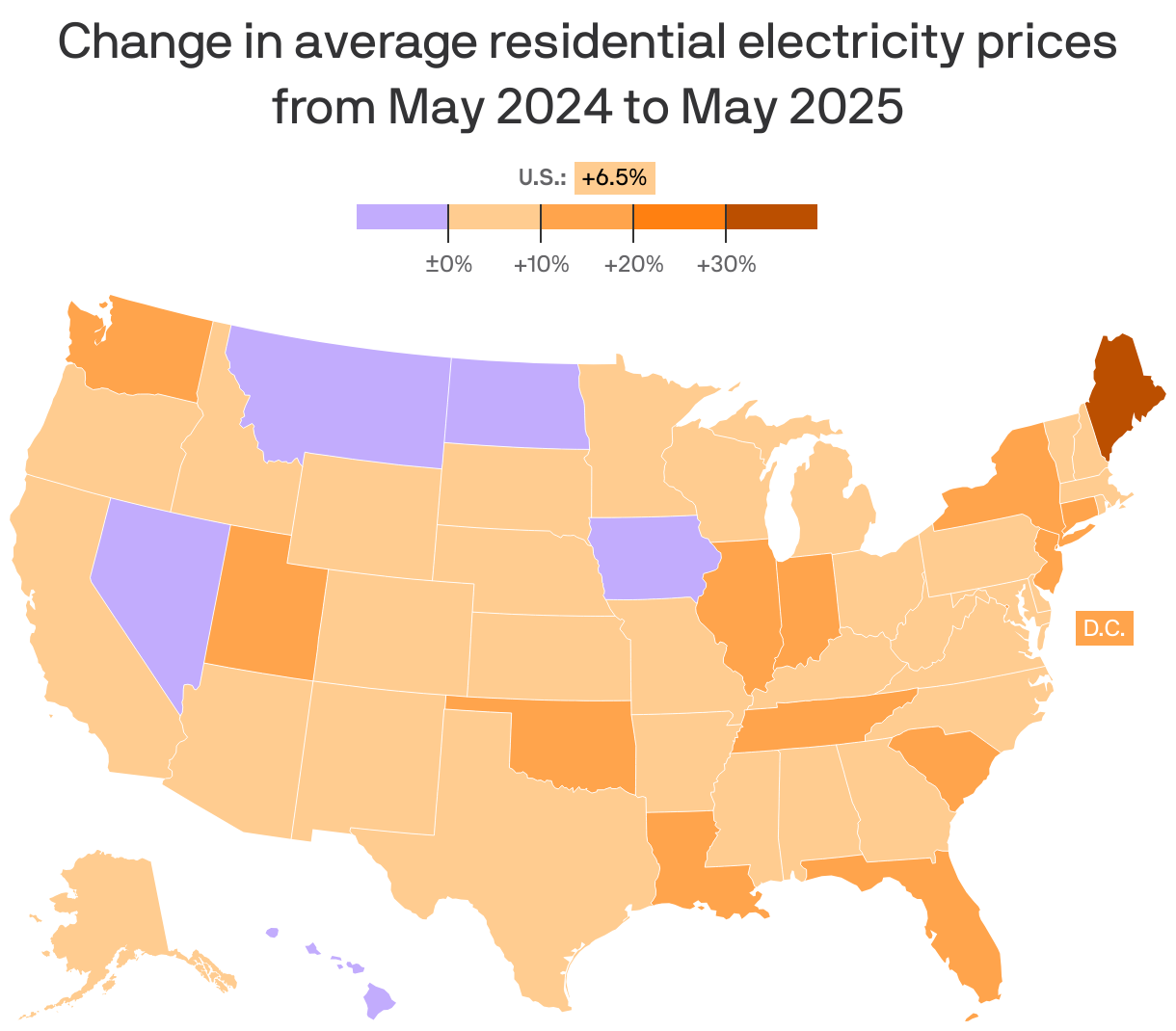
Electricity costs are rising nationwide — and could get even higher for some amid the explosion in data centers powering AI and more.
Why it matters: Surging power bills could further stress many Americans' budgets as pretty much everything else gets more expensive, too.
By the numbers: The nationwide average retail residential price for 1 kilowatt-hour of electricity rose about 6.5%, per the latest available data from the U.S. Energy Information Administration.
- In Missouri and Kansas, it was a little more than 4% — although Evergy rates have dropped 5%, according to communications manager Kaley Bohlen.
Between the lines: Electricity prices vary regionally and have many influences. However, some analysts point to data centers as a driver of rising rates due to both their demand for energy and also because grid operators are investing in new energy infrastructure — and passing those costs along to customers.
- When Evergy was asked about energy usage for the anticipated $10 billion Northland data center, Bohlen pointed to several new solar and gas investments in Kansas and Missouri.
- She told Axios some construction costs will be included on customer bills next year.
What we're hearing: "Anywhere you're seeing a massive takeoff in load growth, the most likely cause is data centers, and that is almost certainly going to have an impact on electric rates," says Cathy Kunkel, energy consultant at the Institute for Energy Economics and Financial Analysis.
- A new IEEFA analysis highlights a dramatic spike in capacity market prices set at auction by PJM — an electric grid operator covering many Mid-Atlantic and Midwest states — largely tied to data centers.
- One estimate in the report found that data centers accounted for over 60% of the increase in prices — representing $9.3 billion that will be passed along to customers.
What's next: The Trump administration is pushing "coal, natural gas, nuclear and hydropower plants to feed AI demand," Axios' Daniel Moore reports — but is hostile towards wind and solar.
- Adding new generation of any kind, meanwhile, takes time and money.
The bottom line: Many of us are paying for the AI boom, whether we use the tech or not.