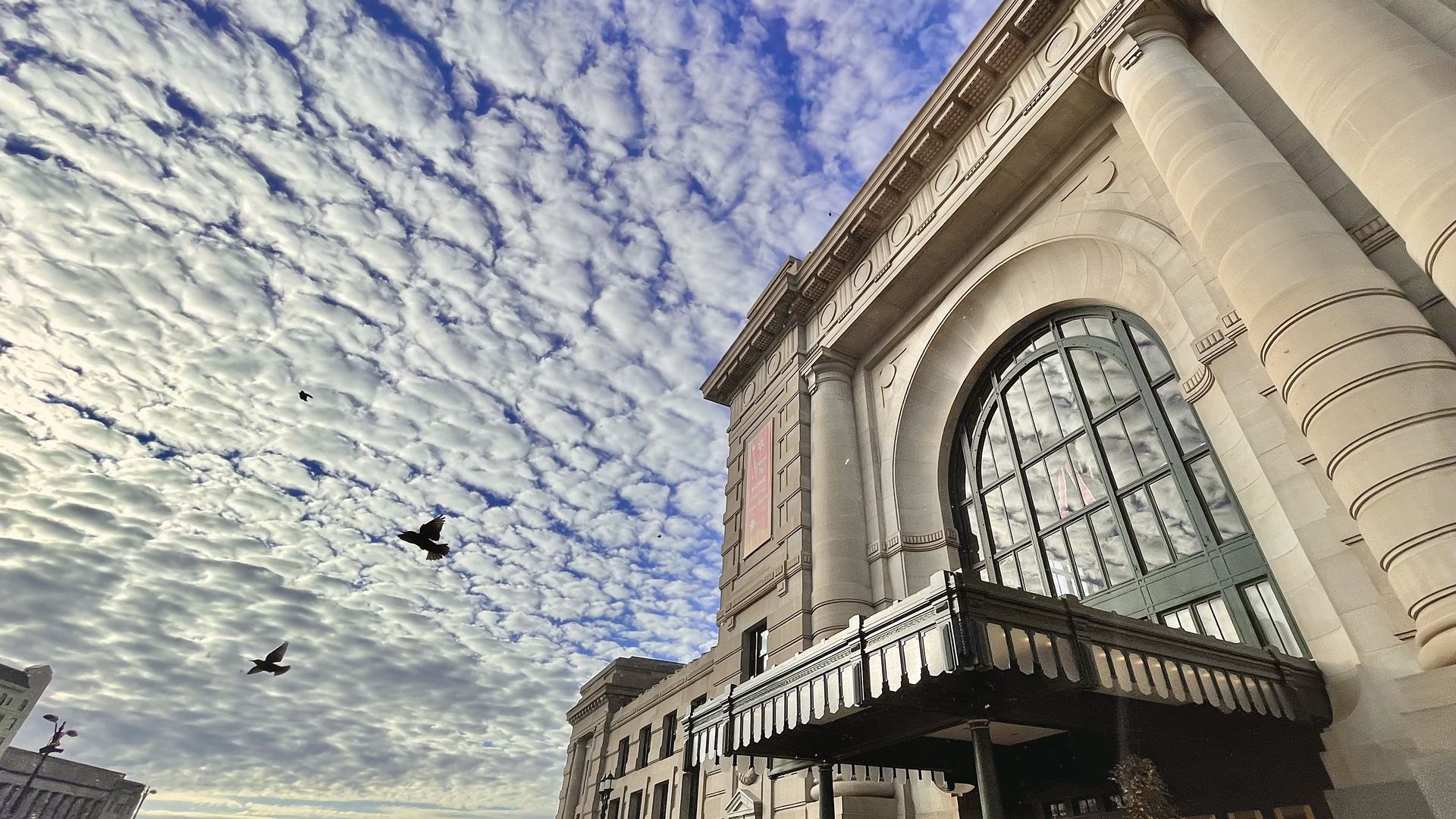
If Union Station's walls could talk. Photo: Travis Meier/Axios
On this day in 1933,a mass shooting outside of Union Station killed four law officers and the prisoner they were transporting in what would become known as the Kansas City Massacre.
The big picture: The killings shocked the nation as one of the deadliest attacks on law enforcement at the time, according to the FBI, and increased federal scrutiny of organized crime across the country.
Zoom in: Federal agents working with Kansas City police officers were transporting notorious criminal Frank Nash from the site of his arrest in Hot Springs, Arkansas back to the prison he escaped from in Leavenworth, Kansas.
As they were changing from train to car, three gangsters who were trying to free Nash — Charles Arthur "Pretty Boy" Floyd, Vernon Miller and Adam Richetti — ambushed the vehicle and opened fire with automatic weapons.
One federal agent, two Kansas City police officers, a police chief from Oklahoma and Nash were killed.
Zoom out: A year later, the 1934 Crime Bill uniformly established and expanded the use of firearms by federal agents and established jurisdiction to make arrests across the country.
The growing Division of Investigations was rebranded as the FBI in 1935.
The intrigue: Legend has it that visitors can still see bullet holes in Union Station's facade, but police testing debunked that theory, according to Union Station's website.