"Fire weather" is happening more often in Kansas and Missouri


Add Axios as your preferred source to
see more of our stories on Google.
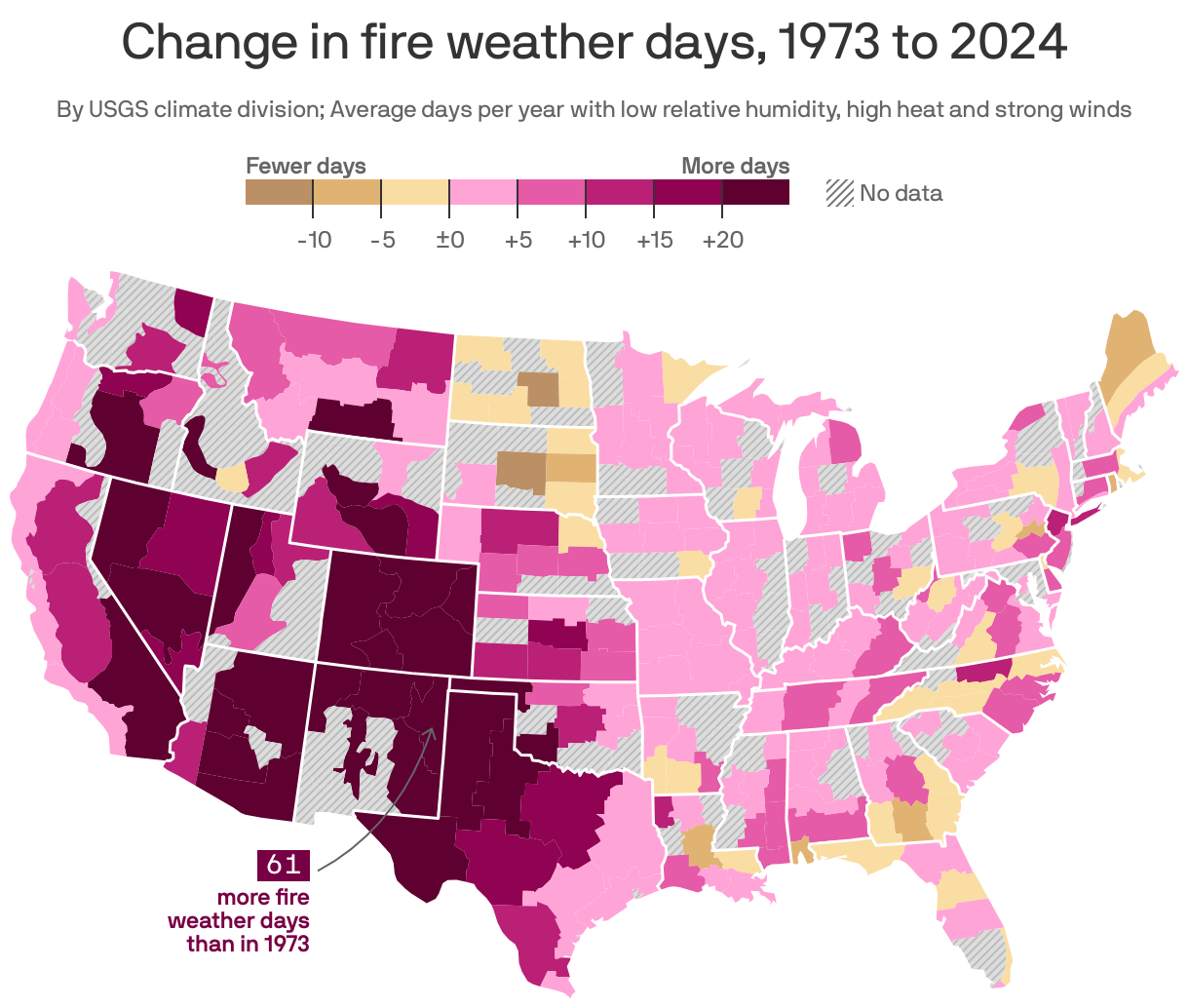
Hot, dry and windy weather that helps wildfires spread is becoming more common across much of the U.S., including Kansas and Missouri, a new analysis finds.
Why it matters: What used to be several months of fire season is stretching in some places into a yearlong phenomenon, straining fire departments and others tasked with controlling or containing wild blazes.
Zoom in: "Fire weather" is getting more frequent in Kansas and Missouri, per an analysis from Climate Central, a climate research group.
- Central Kansas, which includes Hays and Salina, experienced the biggest increase in the area, adding an average of 18 more fire weather days between 1973 and 2024 for a total of 26 per year.
- Counties around Wichita see about 18 fire weather days a year, while western Kansas experiences 45 or more.
- Areas around the Kansas City metro have also increased, from two to five on the Missouri side and from five to 10 on the Kansas side.
Zoom out: Some areas, including parts of Texas, California and New Mexico, now experience "around two more months of fire weather per year compared to a half-century ago," the group says.
Yes, but: Fire weather days decreased in a handful of areas, such as central North Dakota (-12) and northern Maine (-8).
Stunning stat: Human-made problems like unattended campfires and sparks from power lines start 87% of wildfires, Climate Central says, citing the National Interagency Fire Center.
- Regardless of how a fire starts, "fire weather" can help it spread and grow.
State of play: In April, Kansas Gov. Laura Kelly signed a bipartisan bill that would award damages to those affected by fires started by electric companies.
- The bill also directs the Kansas Corporation Commission to workshop wildfire risk and mitigation.
How it works: Climate Central's fire weather analysis is based on data from 476 nationwide weather stations and is broken down by 245 climate divisions across the continental U.S.
- The group defined a "fire weather day" as one with temperatures of at least 45°-55°F (depending on the season), relative humidity within 5% of regional thresholds, and sustained wind speeds of 15mph or more — all happening together during at least two hourly measurements on a given day.